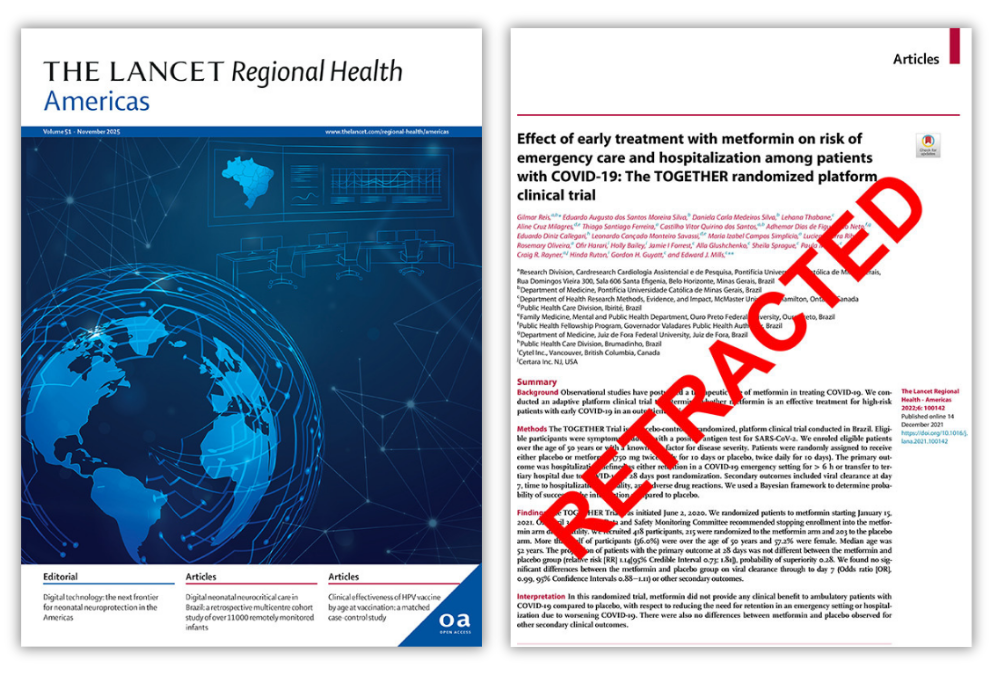
Lancet journal retracts COVID-19 metformin paper nearly 2 years after authors request correction

A paper on a clinical trial of metformin for the treatment of COVID-19 has been retracted nearly two years after the authors flagged data issues that resulted in an expression of concern. 

The results of the Brazil-based TOGETHER trial, published in December 2021 in The Lancet Regional Health–Americas, found metformin was no better than placebo at improving health outcomes in people with COVID-19. The study has been cited 45 times, 25 of which came after the expression of concern was published, according to Clarivate’s Web of Science. 

Early observational studies in people with COVID-19 found positive effects of metformin, an oral medication most often used for type 2 diabetes, including reduced disease severity and mortality rates. But clinical trials, including the now-retracted study and a more recent randomized trial, found no differences in time to recovery or disease severity between patients who got metformin and those who received placebo. 

Continue reading Lancet journal retracts COVID-19 metformin paper nearly 2 years after authors request correction
AI unreliable in identifying retracted research papers, says study

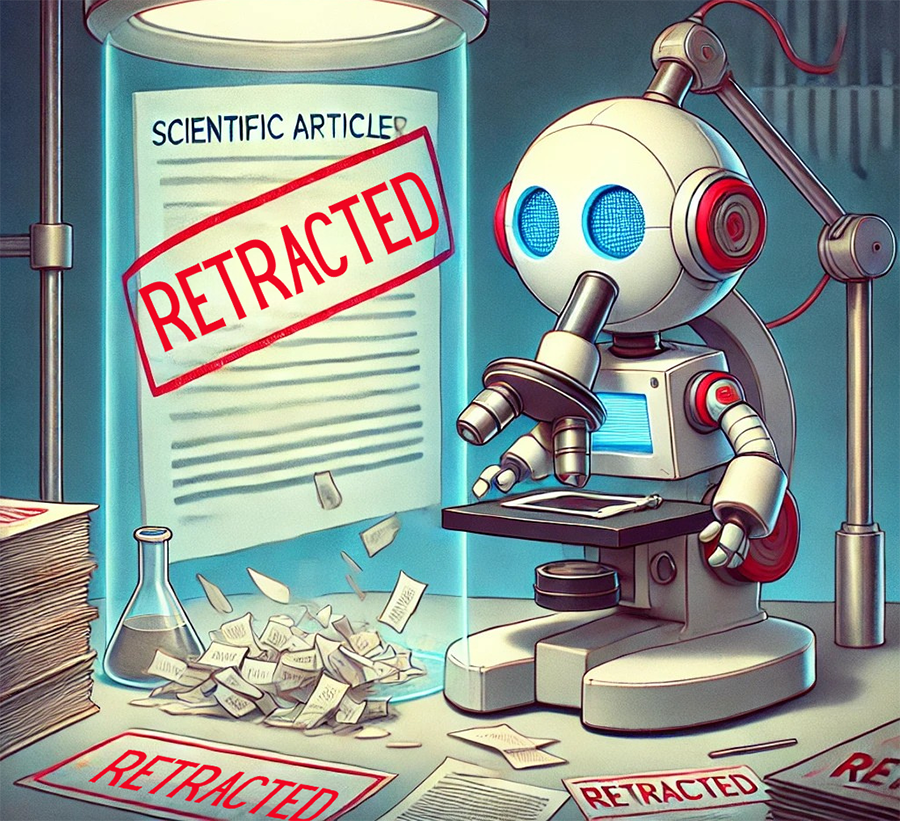
LLMs don’t reliably identify retracted papers, a new study finds. (Image: DALL-E)

Large language models should not be used to weed out retracted literature, a study of 21 chatbots concludes. Not only were the chatbots unreliable at correctly identifying retracted papers, they spit out different results when given the same prompts.

The “very simple study,” as lead author Konradin Metze called it, used LLM chatbots like ChatGPT, Copilot, Gemini, and others to see whether they would successfully identify retracted articles in a list of references.

Metze and colleagues compiled a list of 132 publications. The list comprised the 50 most cited, retracted papers by Joachim Boldt, a prolific German researcher who also sits at the top of the Retraction Watch Leaderboard. Another 50 were Boldt’s most cited non-retracted papers. The rest were works by other researchers with the last name “Boldt” and first initial of “J.” The study authors prompted each chatbot to indicate which of the listed references had been retracted.

Continue reading AI unreliable in identifying retracted research papers, says study

AMA ethics journal shutters after 26 years

The American Medical Association will cease publication of its ethics journal at the end of this year. 

The AMA Journal of Ethics, an open access, peer-reviewed journal was founded in 1999 under the name Virtual Mentor

“The loss of the AMA JoE will be most acutely felt by medical students and trainees, since it had a unique production model that included them in the process,” said Matthew Wynia, a physician and bioethicist at the University of Colorado whose work has been featured in the journal and who previously led the AMA Institute for Ethics.

Continue reading AMA ethics journal shutters after 26 years

Journal retracts ‘bizarre’ placebo effect paper

An Elsevier journal has retracted a study on the placebo effect coauthored by a researcher known for extreme claims that have failed to withstand scrutiny. The move comes after critics said the researchers misunderstood “what a ‘treatment effect’ is.” 

The study, published in the Journal of Clinical Epidemiology in December 2024, analyzed 30 clinical trials examining treatments for a total of five conditions. The authors concluded “the placebo-effect is the major driver of treatment effects in clinical trials that alone explains 69% of the variance.” It has been cited once, according to Clarivate’s Web of Science.

The last author of the study is Harald Walach, who may be familiar to readers of Retraction Watch. In one now-retracted paper, Walach and his coauthors claimed the COVID-19 vaccines killed two people for every three deaths they prevented. In a different, also retracted paper, Walach and colleagues claimed children’s masks trap carbon dioxide. (They later republished the article in a different journal.) 

Continue reading Journal retracts ‘bizarre’ placebo effect paper

Review mill in Italy targeting ob-gyn journals, researchers allege

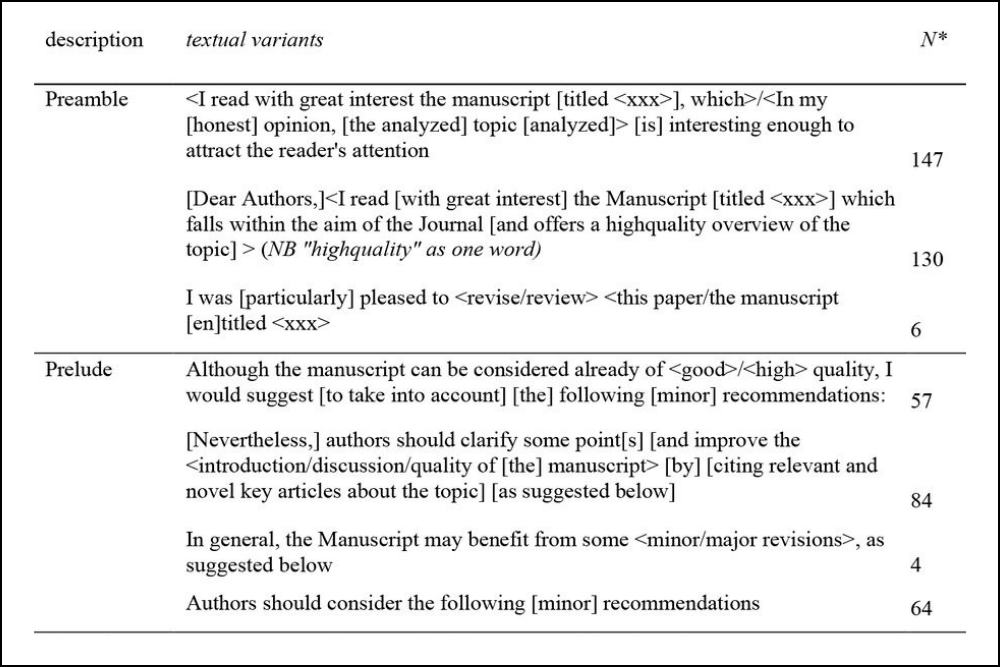
Examples of “boilerplate” text used in the suspect reviews.
M.A. Oviedo-Garcia et al/medRxiv 2025

A network of peer reviewers in Italy is targeting medical journals, threatening “both the scientific record and patient safety,” a team of researchers report. Without more transparency by journals, they say, most review mills will remain impossible to detect.

In a preprint posted on medRxiv on October 23, sleuths Dorothy Bishop, René Aquarius and Maria Ángeles Oviedo-García say they discovered the alleged review mill when they stumbled upon seemingly “boilerplate” comments in a peer review. This discovery led the trio to search for published peer reviews that shared similar terminology — work that ultimately identified 195 suspect reviews of 170 articles published between Feb. 6, 2019, and July 7, 2025. The researchers speculate the number of articles affected is likely higher given most journals do not publish their peer reviews.

The alleged mill is run by “well-established, Italian physicians in the fields of gynecology and oncology,” wrote the authors of the new study, which also noted the reviewers were refereeing papers with clinical implications, a pattern the authors called “alarming.” 

Continue reading Review mill in Italy targeting ob-gyn journals, researchers allege

Despite new retractions, suspect organ transplant papers remain in the literature 

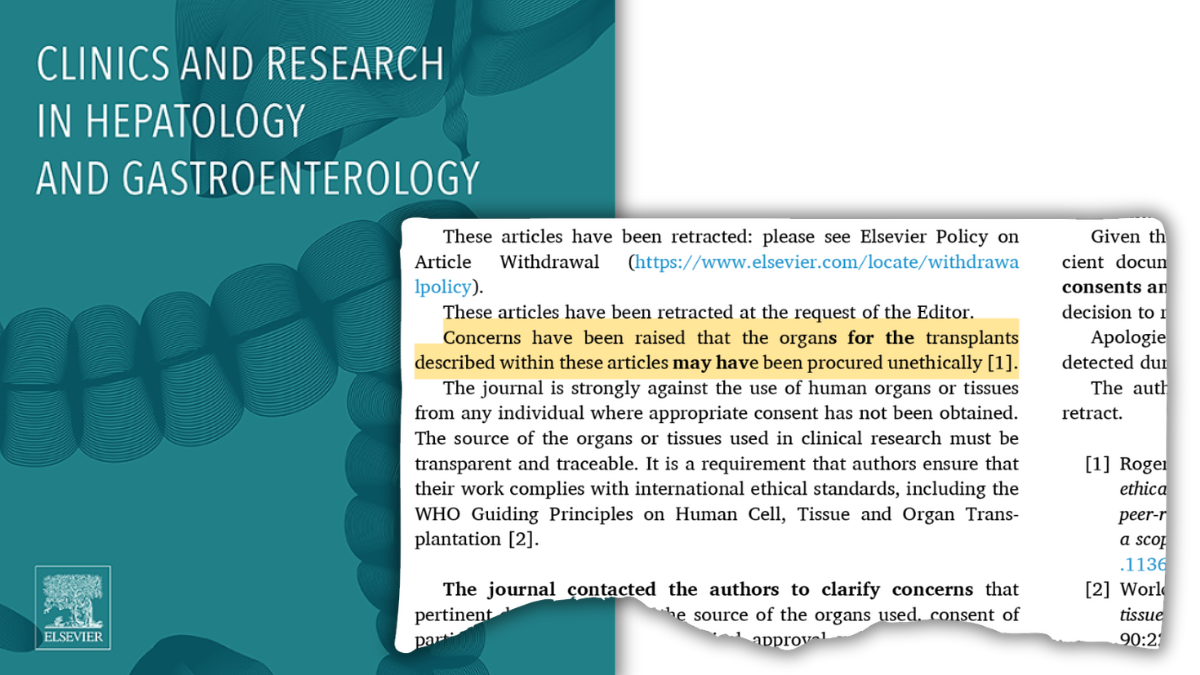
Six years after researchers called for the retraction of more than 400 papers about organ transplantation amid suspicion the organs used in the studies came from executed Chinese prisoners, journals are still working to clear the record. 

Although more than 40 papers were retracted or otherwise flagged shortly after the 2019 study was published, by our count, only 44 of the 445 papers have been retracted to date. At least 17 of the articles marked with expressions of concern in 2019-2020 remain as such. 

The analysis, published in BMJ Open, found more than 400 studies of organ transplants in China that didn’t report whether the sources gave their consent for donation, nor assurances the organs involved did not come from executed prisoners. As reported by The Guardian in 2019, the study exposed “a mass failure of English language medical journals to comply with international ethical standards in place to ensure organ donors provide consent for transplantation.”  Thirteen retractions this year directly cite the Rogers paper.

Continue reading Despite new retractions, suspect organ transplant papers remain in the literature 

Controversial Paxil “Study 329” earns expression of concern after critic sues publisher

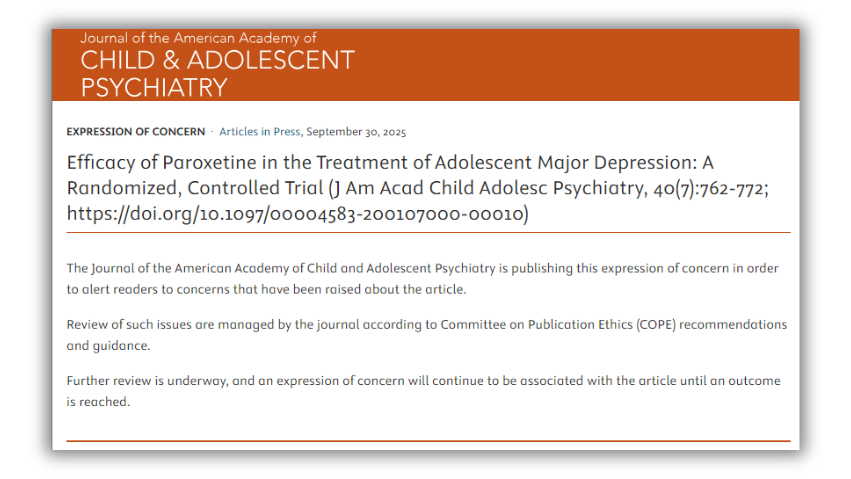
After more than 20 years of criticism and calls for retraction, a journal has placed an expression of concern on a study of the antidepressant Paxil in teens that critics say has led to unwarranted and potentially harmful prescribing of the drug to youth. 

The 2001 paper, published in the Journal of the American Academy of Child & Adolescent Psychiatry (JAACAP), reported findings from a randomized trial known as “Study 329,” which concluded the antidepressant Paxil was safe and effective in kids ages 12 to 18. 

In 2012, Paxil maker GlaxoSmithKline agreed to pay $3 billion to settle civil and criminal charges that included “unlawful promotion” of the drug for adolescents, for whom the product was never approved, and allegations the company “participated in preparing, publishing and distributing a misleading medical journal article” — the JAACAP paper.  A reanalysis in 2015 found the drug was “ineffective and unsafe” for the age group studied.

Continue reading Controversial Paxil “Study 329” earns expression of concern after critic sues publisher

Authors defend retracted paper on vitamin D and COVID-19 called ‘deeply bizarre’ by critic

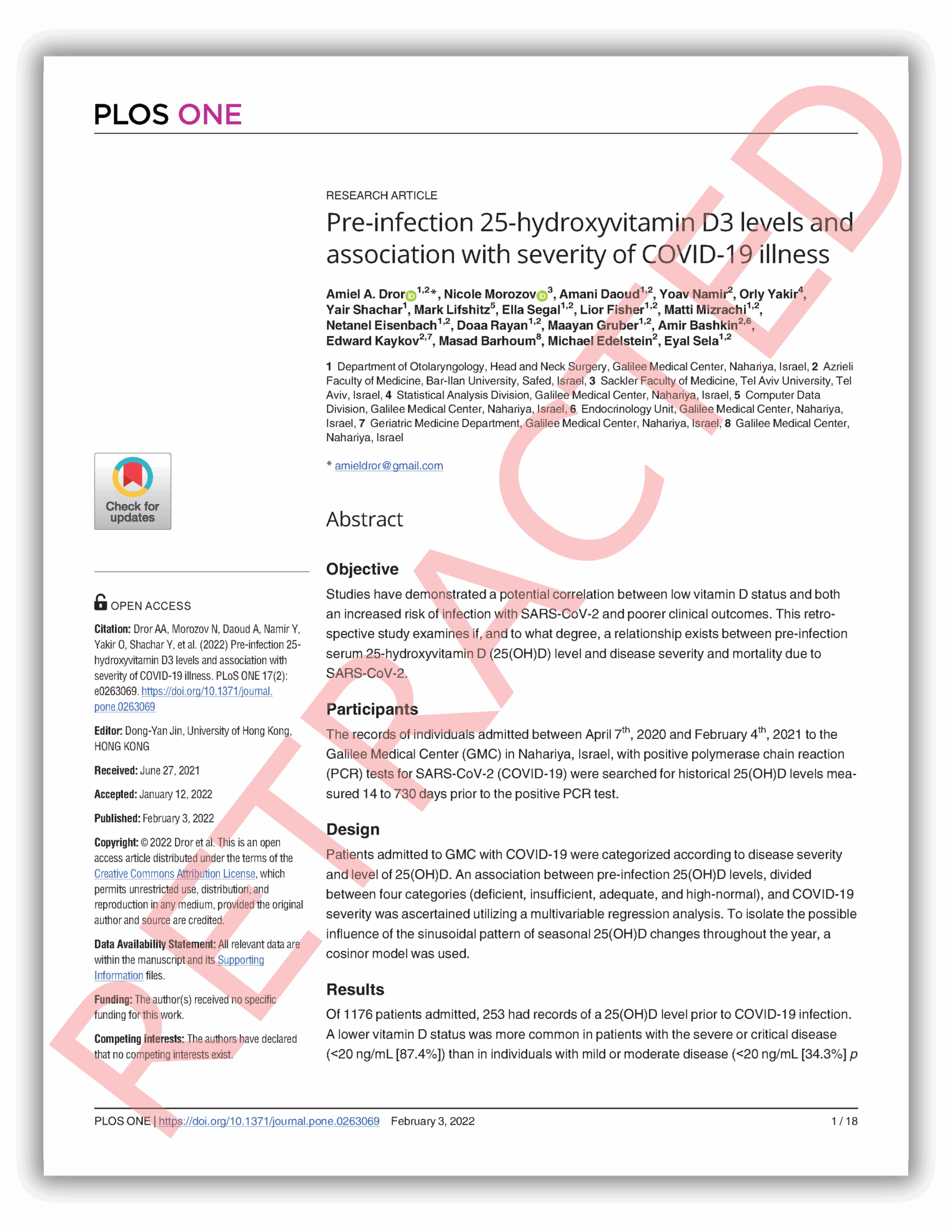
PLOS One has retracted a paper linking vitamin D levels and COVID-19 morbidity three years after a critic flagged the data in the study as “deeply bizarre.” The authors objected to the retraction, with one calling it “outrageous” and pointing to flaws in the published notice.

The article, which appeared in February 2022, claimed people with low levels of vitamin D were at increased risk for severe COVID-19 and were more likely to die of the disease than other patients. It has been cited 65 times, according to Clarivate’s Web of Science. 

The paper had a “huge, immediate impact,” said Gideon Meyerowitz-Katz, a senior research fellow from the University of Wollongong in Australia, citing the fact that the paper had been viewed over 1 million times within six weeks of being published. The article joins others, many also flagged by Meyerowitz-Katz, purporting to find links between vitamin D intake and COVID-19 severity that have been retracted or removed.

Continue reading Authors defend retracted paper on vitamin D and COVID-19 called ‘deeply bizarre’ by critic

Math has publication fraud, too

Ilka Agricola
Credit: Thorsten Richter

Scholarly publishing in mathematics is unlike many other fields, marked by fewer papers, fewer coauthors per paper and fewer citations. But that doesn’t mean the field is immune to fraud and cheating. 

A pair of papers posted to the arXiv addresses the issue of fraudulent publishing in math, particularly metrics gaming, and offers a list of recommendations to help detect and deal with that problem and other fraudulent activities. (The former was also published in the October AMS Notices; the latter will appear in the November issue.) “Fraudulent publishing undermines trust in science and scientific results and therefore fuels antiscience movements,” mathematician Ilka Agricola, lead author of both papers, told Retraction Watch. 

A professor of mathematics at Marburg University in Germany, Agricola was president of the German Mathematical Society in 2021-2022 and is chair of the Committee on Publishing of the International Mathematical Union. The new articles are the products of a working group of the IMU and the International Council of Industrial and Applied Mathematics. 

Continue reading Math has publication fraud, too

Study on apple cider vinegar for weight loss retracted after many raise concerns

Pranithan Chorruangsak/iStock

Easy fixes for complex health problems can be tempting — but they rarely pan out. That seems to be the case for the investigators on one clinical trial who claimed consuming apple cider vinegar caused obese teens and young adults to lose weight. 

Their article appeared in March 2024 in BMJ Nutrition, Prevention & Health. The journal is retracting the paper “because the authors’ analyses could not be replicated and multiple errors were identified,” according to the retraction notice.

The retraction, dated September 23, comes more than a year after sleuths pointed out some of these errors and other problems with the analysis. 

Continue reading Study on apple cider vinegar for weight loss retracted after many raise concerns