Editor-in-chief resigns amid probes of alleged citation manipulation, data errors 

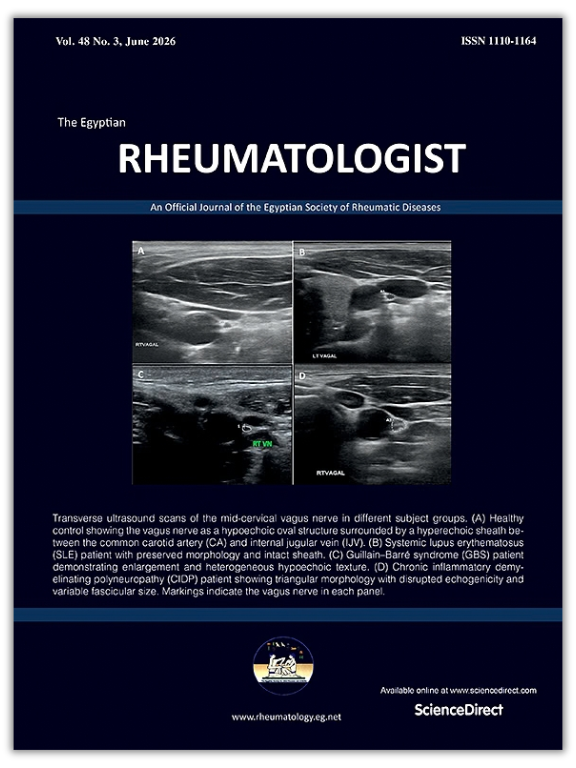
The editor-in-chief of The Egyptian Rheumatologist has resigned following claims of questionable citation practices and improper peer review at the journal. 

At least three publishers are also investigating alleged data errors in papers in other journals by the former journal editor, Tamer Gheita, and his research group. Gheita, a professor of rheumatology at Cairo University in Giza, has denied the claims, calling the complaints “subjective” and “malicious.”

The Egyptian Society of Rheumatic Diseases (ESRd) started investigating Gheita in June following concerns about his editorial practices at the society’s journal, including unusually rapid peer-review timelines and questionable citation patterns, according to Bassel Elzorkany, interim editor-in-chief for the journal. Elzorkany told Retraction Watch the ESRd board temporarily suspended Gheita, and Gheita resigned shortly afterward. 

Continue reading Editor-in-chief resigns amid probes of alleged citation manipulation, data errors 
When open data are misused

Credit: HALUSTD from Popspixel via Canva

When Dorothy Bishop was asked to review a paper for a small neuroscience journal in August, she could tell from the abstract the authors had used a dataset she had first published four years ago on the public repository OpenNeuro. The dataset contained raw functional MRI scans from 50 participants, taken while they completed language-related tasks such as thinking of words and matching words to pictures.

“I was curious that somebody had already analyzed it, because it’s a hefty dataset that would have taken a lot of work to analyze,” Bishop, an emeritus professor of developmental neuropsychology at the University of Oxford, told Retraction Watch. 

She quickly found problems in the manuscript. The description of the dataset didn’t match what she and her colleagues had actually done, and several references didn’t support the claims they were cited for. “There was clearly something seriously wrong,” she said. The editor was also suspicious, Bishop said, and the paper was eventually rejected. But Bishop believed the authors would try to publish the manuscript elsewhere, so she did a broader search of their names. 

Continue reading When open data are misused

Lancet union declares first-ever strike over staff wages

Union members at The Lancet and its affiliated journals will go on strike Sept. 22 for one day with further action planned for the following week, after pay negotiations with parent publisher Elsevier fell apart, The Lancet’s union announced today. 

The strike is the first in The Lancet’s 200-year history. Elsevier was ordered to recognize the union, a chapter of the National Union of Journalists (NUJ), in September 2025, and their collective bargaining agreement was finalized in February. As part of the action the union, which represents 110 employees in various roles across several of The Lancet’s 30 journals, is also calling on members to refuse to work hours outside their contracted amount.

Negotiations on pay and support for workers began in March when the union asked for a 7.5% pay raise in the first year. According to an open letter from the union, workers’ pay had failed to keep up with inflation, leaving them “substantially worse off than they were five years ago despite their growing expertise and responsibilities.”

Continue reading Lancet union declares first-ever strike over staff wages

Elsevier to ‘soon investigate’ two Macchiarini papers more than a year after retraction request

Paolo Macchiarini

Elsevier says it will begin investigating two papers coauthored by disgraced surgeon Paolo Macchiarini “soon,” more than a year after two critics of his work formally requested the publisher retract the articles — and nearly a decade after two institutions found him guilty of misconduct for related work. 

The papers, published in Biomaterials in 2009 and 2010, include descriptions of a 2008 trachea transplant in Barcelona conducted by Macchiarini — described in The Lancet that year, as well as in a five-year follow-up published in 2013. Both Lancet papers reported a successful surgery and that the patient had a “normal social and working life.” In reality, she needed stents, her lung function did not improve and she eventually had a lung removed. 

The Barcelona patient survived, but at least three others who underwent Macchiarini’s synthetic trachea transplants eventually died. In 2023, a Swedish court sentenced Macchiarini to 2.5 years in prison for gross assault related to his failed transplants. So far he has accumulated 13 retractions. 

Continue reading Elsevier to ‘soon investigate’ two Macchiarini papers more than a year after retraction request

Editors of economics journal resign after Elsevier doesn’t renew EIC’s contract

Six editors and nearly 60 advisory editors of Games and Economic Behavior resigned after the journal’s publisher decided not to renew the editor-in-chief’s contract. 

In late July, Elsevier told Hervé Moulin, a business professor of the University of Glasgow, his six-year tenure as editor-in-chief of the journal would end in December. Moulin told Retraction Watch he was disappointed by the news, as he had expressed a desire to continue in his role. 

The journal’s six editors resigned in the weeks following, according to an August 16 email, the text of which is also posted on the website for the Game Theory Society. Games and Economic Behavior is one of the group’s two official journals. As of August 19, 58 of the 62 advisory editors had resigned as well.

Continue reading Editors of economics journal resign after Elsevier doesn’t renew EIC’s contract

Defamation suit demanding Elsevier retract paper heads closer to trial

Westock/Adobe Stock

A trial date has been set in a $1 billion defamation case against Elsevier that alleges the company published what plaintiffs say was a manipulated study about an air purifying technology over objections from peer reviewers. The case has already cost Elsevier a $10,000 sanction from a judge.

Global Plasma Solutions (GPS), which makes air quality products, sued Elsevier in 2022 after the publisher declined to retract a 2021 paper in Building and Environment about GPS’ needlepoint bipolar ionization technology, which it heavily marketed during the COVID-19 pandemic as an air purifier. The complaint claims Elsevier is responsible for the authors’ alleged omission of data and misleading conclusions in the paper that fueled “massive” financial losses for the company, its lawyers claim. Elsevier knew the paper “failed peer review” under its “own standards,” but moved forward with the article despite this knowledge, according to GPS, which now goes by GPS Air.   

The complaint has survived a bid by Elsevier to dismiss the case, and a trial has been set for Dec. 7. In allowing the case to proceed, U.S. Magistrate Judge David Keesler said in a May 2024 opinion that GPS has “plausibly alleged actual malice” by Elsevier defined as “knowledge of falsity or reckless disregard for the truth.” Chief Judge Martin Reidinger of the U.S. District Court for the Western District of North Carolina upheld Keesler’s recommendation in July 2025.  

Continue reading Defamation suit demanding Elsevier retract paper heads closer to trial

Ceramics journal pulls dozens of papers flagged for integrity concerns

A materials science journal has pulled 56 papers so far this year for transgressions including image overlap, concerns about data integrity and “suspicious” changes in authorship. 

Ceramics International began retracting the papers in July. More than 50 of the retractions were requested by an “impartial field expert acting in the role of an independent Publishing Ethics advisor,” according to the notices. 

Most of the retraction notices – 43 – reference PubPeer comments calling out issues with the work. In emails we have seen, scientific sleuth Mu Yang flagged 80 papers from Ceramics International to the journal’s publisher, Elsevier, on April 23, 2025. 

Continue reading Ceramics journal pulls dozens of papers flagged for integrity concerns

Clarivate removes hold on mega-journal Heliyon after internal audit, 650+ retractions

Clarivate has lifted its hold on Heliyon after the journal’s internal audit led to over 1,000 retractions, expressions of concern and corrections. As a result, the journal will receive an impact factor in the coming cycle, a Clarivate spokesperson said. 

Clarivate decided in September 2024 new content from Heliyon would not be indexed in its Web of Science due to concerns about quality. The journal told us at the time it was “investigating,” and since then, it has retracted over 650 articles.

Clarivate lifted the hold on May 14, and Heliyon released a statement shortly after, noting all content published while the journal was on hold will now be indexed. The statement says the audit “revealed behaviors that did not align with our policies.” As we wrote in February, the journal has previously said the concerning practices included compromised peer review, authorship irregularities, tortured phrases and citation manipulation. 

Continue reading Clarivate removes hold on mega-journal Heliyon after internal audit, 650+ retractions

High-profile anesthesiologists earning retractions for data, image problems

Credit: funkenzauber/Adobe Stock

In July 2021, John Loadsman received a manuscript about a clinical trial that immediately roused his suspicion. Then the editor-in-chief of Anaesthesia and Intensive Care, Loadsman asked the authors for the raw data.

They weren’t pretty. “When I looked carefully at the spreadsheet, I could see entire blocks of data that were repeated,” recalled Loadsman, an anesthesiologist and scientific sleuth at the University of Sydney. “It was obvious that this was cooked.”

He rejected the manuscript, informing both the corresponding author, Reyhan Polat of the University of Health Sciences in Ankara and Etlik City Hospital, in Turkey, and her institution about his concerns. He also made a mental note to have a look at the researcher’s published work. Over the following years, that effort drew in another sleuth and eventually prompted inquiries into more than two dozen papers by a network of researchers in Turkey.

Continue reading High-profile anesthesiologists earning retractions for data, image problems

Federal lawsuit accuses four major publishers of extorting article processing charges

iStock

A lawsuit filed under the U.S. False Claims Act accuses four major publishers of perpetrating a decade-long scheme to defraud the government by charging exorbitant article processing charges.  

The case, which became unsealed July 30, claims Elsevier, Springer Nature, Wiley and Informa forced U.S. research institutions to submit false claims to the government for reimbursement through article fees up to 10 times the cost of processing the articles. 

Juan Pablo Alperin, a professor at Simon Fraser University and codirector of the Scholarly Communications Lab based in Vancouver, is represented by two attorneys who have had blockbuster success in FCA cases over the past decade. He and his attorneys originally filed the case under seal in March 2024. The government declined to intervene in the case on July 23 of this year, and a judge ordered the complaint unsealed, which now allows Alperin to pursue the case independently.

Continue reading Federal lawsuit accuses four major publishers of extorting article processing charges