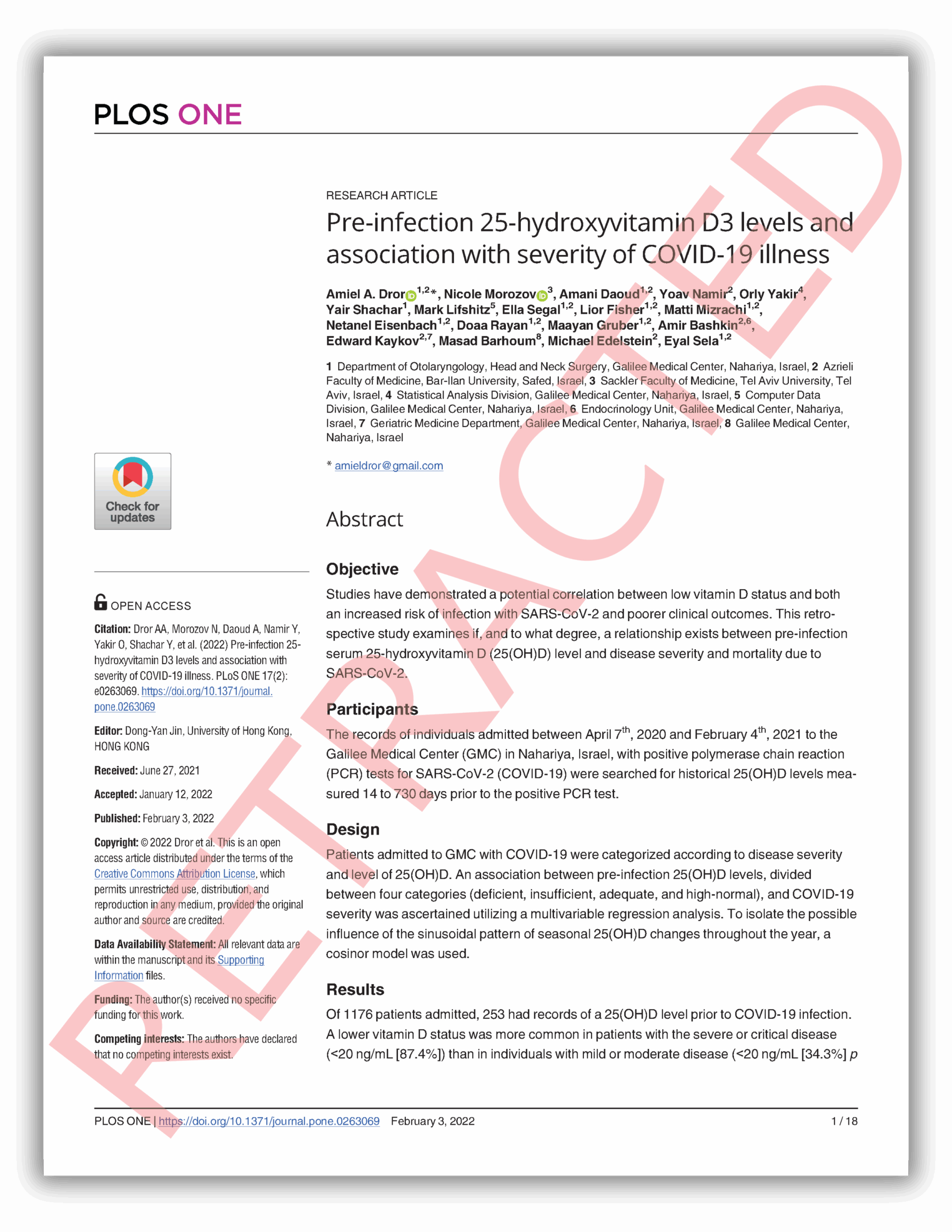
PLOS One has retracted a paper linking vitamin D levels and COVID-19 morbidity three years after a critic flagged the data in the study as “deeply bizarre.” The authors objected to the retraction, with one calling it “outrageous” and pointing to flaws in the published notice.
The article, which appeared in February 2022, claimed people with low levels of vitamin D were at increased risk for severe COVID-19 and were more likely to die of the disease than other patients. It has been cited 65 times, according to Clarivate’s Web of Science.
The paper had a “huge, immediate impact,” said Gideon Meyerowitz-Katz, a senior research fellow from the University of Wollongong in Australia, citing the fact that the paper had been viewed over 1 million times within six weeks of being published. The article joins others, many also flagged by Meyerowitz-Katz, purporting to find links between vitamin D intake and COVID-19 severity that have been retracted or removed.
In an April 2022 thread on X, Meyerowitz-Katz noted the study’s “MASSIVE effect, whereby virtually everyone who died” had vitamin D levels below the normal range, he wrote at the time.
Meyerowitz-Katz also wrote that, while the paper had “no obvious signs of fakery,” the data were “deeply bizarre.” He noted all of the patients with chronic obstructive pulmonary disease in the study also had hypertension, a trend not in itself unusual besides the complete overlap.
The study considered low vitamin D levels to be less than 20 ng/mL, and 15 people had a vitamin D level of exactly 10 ng/mL. Ten of those 15 died, a larger percentage than any other bracket. “This makes having a vitamin D of exactly 10ng/mL the most dangerous range seen in the study,” Meyerowitz-Katz wrote.
The September 8 notice cites a “fatal flaw” with the study design “which prevents testing of the hypothesis.” David Knutson, the head of communications at PLOS, told us the flaw refers to the fact the authors included only patients who had already been tested for vitamin D. The notice states the fact the patients had been previously assessed for vitamin D levels and that that level may have changed prior to COVID-19 infection may have introduced “confounding factors” or bias.
Eyal Sela, director of the Otolaryngology Head & Neck Surgery Department at Galilee University in Israel, and the senior author of the article, called the journal’s decision “outrageous.”
“We did the research during COVID, which put all of us in a position to examine any patient who entered the hospital without any selection,” he told Retraction Watch, maintaining patient selection was unbiased. The research was conducted in Sela’s lab at the university.
After responding to Meyerowitz-Katz’s posts on X, the journal asked a member of the editorial board and an independent statistical expert to reassess the work.
Meyerowitz-Katz had followed up with the journal in March 2023 and was told by Maddy Ghose, an editor at PLOS One, the journal was still investigating. He said he hasn’t heard anything since.
As for why the retraction ultimately took three years, “the case was delayed at different points for various reasons,” Knutson told us.
All but three of the study’s 18 authors disagreed with the retraction. The rest did not respond, the retraction notice states.
An email to Retraction Watch signed by three of the authors — Amiel Dror, Michael Edelstein and Orly Yakir, writing “on behalf of the authors” — says the possibility of “measurement and selection bias is there and acknowledged in the paper.” They also noted the patients’ vitamin D values the researchers used weren’t recorded as part of their study; instead, they included patients who both tested positive for COVID-19 and had existing prior levels available in the hospital database.
Both Dror — the study’s corresponding author — and Yakir are researchers at Galilee University, and Edelstein is a professor of public health and epidemiology at Bar Ilan University in Ramat Gan, Israel.
“Because of these limitations we were very cautious regarding claims of causation, and we also explicitly state that our findings should not be interpreted as evidence for using vitamin D therapeutically for COVID patients,” the authors told us.
The retraction notice also mentions a delay in measurement of vitamin D and COVID-19 infection — anywhere from 14 to 730 days — which the authors said is “relatively short compared to other papers using a similar approach” but was mentioned in the study limitations.
The authors also pointed out what they considered errors in the retraction notice, including the statement “the analyses performed were inadequate to test the association between 25-hydroxyvitamin D3 levels at the time of infection and severity of COVID-19 illness.” The authors told us in their email the “association tested is NOT about levels at the time of infection (since the acute infective process affects vit D levels) but PRE-infection- this is even in the title.”
The researchers continued their “offer to conduct additional analyses to check for the extent of were rejected as coming too late” and the retraction came “without a warning.”
“We think our results have been a useful addition to the literature, especially in the context of the acute phase of a pandemic,” the authors wrote.
Meyerowitz-Katz told us the reasons cited in the retraction notice “make little sense” to him as well and “are very straightforward limitations to the methodology.”
“And yet, the journal has now retracted the paper for reasons that were immediately obvious on a quick perusal of the manuscript, three years too late,” he continued.
Meyerowitz-Katz has flagged several papers from the COVID-19 literature, including attempting to debunk the controversial drug ivermectin as a COVID-19 treatment.
By our count, nearly 600 COVID-19 studies have been retracted so far, bringing into question how robust the publishing process was in the midst of the pandemic.
Correcting COVID-19 literature has been largely slow and laborious. A study published in April in the Cambridge University Press, coauthored by Ferric Fang, who is on the board of The Center for Scientific Integrity, of our parent nonprofit organization, noted more than half of COVID-19 retractions “resulted from problems that could have been detected prior to publication.”
Update, Sept. 29, 2025: The headline of this story was edited for clarity. It previously read, “Authors defend retracted paper on vitamin D and COVID-19 critic called ‘deeply bizarre’”.
Like Retraction Watch? You can make a tax-deductible contribution to support our work, follow us on X or Bluesky, like us on Facebook, follow us on LinkedIn, add us to your RSS reader, or subscribe to our daily digest. If you find a retraction that’s not in our database, you can let us know here. For comments or feedback, email us at [email protected].
Isn’t it obvious that people who spend more time outdoors will have stronger immune systems? We’re all just solar-powered stardust.
No, it’s not obvious at all – I believe this is called the “naturalistic fallacy”. For instance, if you spend all your time outdoors where I live, and you’re Caucasian, you’re extremely likely to develop skin cancer.
Shade due to opaque objects is a thing. Also long sleeves etc.
Yes and sunscreen which is just long sleeves in liquid form.
What is the greatest threat of infection to a human? Other humans. It is not at all clear that being outdoors exercises the immune system more than, say, working in a crowded office or marketplace.
In any case science is not about “obvious”–you actually have to test stuff.
For centuries, people “knew” the Sun revolved around the Earth — until Copernicus challenged that assumption with careful reasoning. Likewise, many believed heavier objects must fall faster than lighter ones — until Galileo’s iron-ball experiment showed they fall at the same rate. These examples remind us that what seems self-evident can be misleading, and that reliable knowledge requires rigorous testing, not intuition alone.
Alex.ng: Could you point to the “rigorous testing” that occurred in this case?
May I suggest that the title should be:
“Authors defend retracted paper on vitamin D and COVID-19 called ‘deeply bizarre’ by critic”
to avoid alternative readings involving a deeply bizarre COVID-19 critic? It bothers me every time I see it.
“Deeply Bizarre” — a legacy rock band of Depeche Mode
Yes, I agree! It took me a while to parse what was meant – the revision would be helpful.
I still don’t get it. Are they calling COVID-19 “deeply bizarre”? Or is the defense of the paper deeply bizarre?
Authors defend [which was] called ‘deeply bizarre’ by critic
It’s a bit of a crash blossom either way, but I find this version slightly easier than the first one. Headlines are hard: the wordiness of English is part of its functionality.
“British Left Waffles on Falkland Islands”
Thanks all. Headline revised!
The retraction of the article is a fatal mistake on the part of the PLOS ONE editorial team, as several other observational studies have confirmed the results of the study.
In the meantime, the results of observational studies, such as the result of thestudy by the University of Heidelberg are no longer are no longer doubted.
“Vitamin D Deficiency and Outcome of COVID-19 Patients ”
https://www.mdpi.com/2072-6643/12/9/2757
„In our patients, when adjusted for age, gender, and comorbidities, VitD deficiency was associated with a 6-fold higher hazard of severe course of disease and a ~15-fold higher risk of death.“
Unfortunately, like many other scientists, the PLOS ONE editorial team doubts the results of the observational studies only because they could not be replicated in intervention studies.
It is more likely that the results of the many intervention studies can be doubted because they did not use the form of vitamin D that was already present in the observational studies.
In observational studies, the storage form of vitamin D calcidiol is already present, which acts quickly. In most intervention studies, however, vitamin D3 in the form cholecalciferol was administered, which must first be converted into calcitriol before it becomes effective through further conversion into calcitriol.
In particular, the initial conversion of D3 to calcidiol can take several days. Since patients are typically only admitted to intervention studies on the day of hospitalisation and sepsis is already present on this day, which has to be treated within a few studies, D3 supplementation can not help much.
If calcidiol levels were measured longitudinally in intervention studies, this could be recognised. However, as this is not common practice, it is not recognised that a severe 25(OH)D deficiency can occur despite D3 supplementation, causing the immune system to fail.
At least calcidiol must therefore be administered, which can be converted into calcitriol within a few minutes
ChatGpt summarised this very aptly after a discussion:
>> The form of vitamin D administered is critical to its effectiveness in acutely ill patients. Cholecalciferol (vitamin D3) may not have the rapid effect required in acute infections and incipient sepsis. Calcidiol and calcitriol, which are more rapidly bioavailable and act directly, have tended to show better results in studies.
For future studies, it is important to consider the choice of vitamin D form and possibly favour fast-acting forms such as calcidiol or calcitriol, especially in patients with acute illness or sepsis.<<
Unfortunately, there are about 140 intervention studies in which vitamin D3 was administered, but only 3 studies in which the fast-acting forms calcidiol or calcitriol were administered. The typical result of these 3 studies was that no patient died and very few had to be ventilated.
The best known of these is this one:
Entrenas Castillo M, Entrenas Costa LM, Vaquero Barrios JM, et al.
“Effect of calcifediol treatment and best available therapy versus best available therapy on intensive care unit admission and mortality among patients hospitalized for COVID-19: A pilot randomized clinical study.”
https://www.ncbi.nlm.nih.gov/pmc/articles/PMC7456194/
However, it will probably take some time before it is recognised that the 140 studies are flawed because the wrong form of vitamin D was used in them, and only the 3 studies with calcidiol or calcitriol delivered correct results.
The main reason why it will still take some time is that it must first be generally recognised that vitamin D is a “negative acute phase reactant” and that the 25(OH)D value can fall by up to 2.5ng/ml per day during an infection because this is used to activate T-cells, which are then used to fight viruses.
More on vitamin D use during an infection
Vitamin D the life insurance against Long Covid and autoimmune diseases
https://www.facebook.com/share/p/LzLmk3ycoXZ568vT/
This sharp drop in 25(OH)D levels cannot be stopped quickly by D3 supplementation, but can be stopped by calcidiol supplementation.
Only when it is recognised that the time factor plays a role due to the high daily vitamin D use will many people realise why the results of intervention studies are so strongly dependent on the form of vitamin D used.
Then hopefully all patients who are hospitalised with signs of sepsis will be given one of the fast-acting forms of vitamin D immediately.