Black marks on published papers don’t change citation rates, new study finds

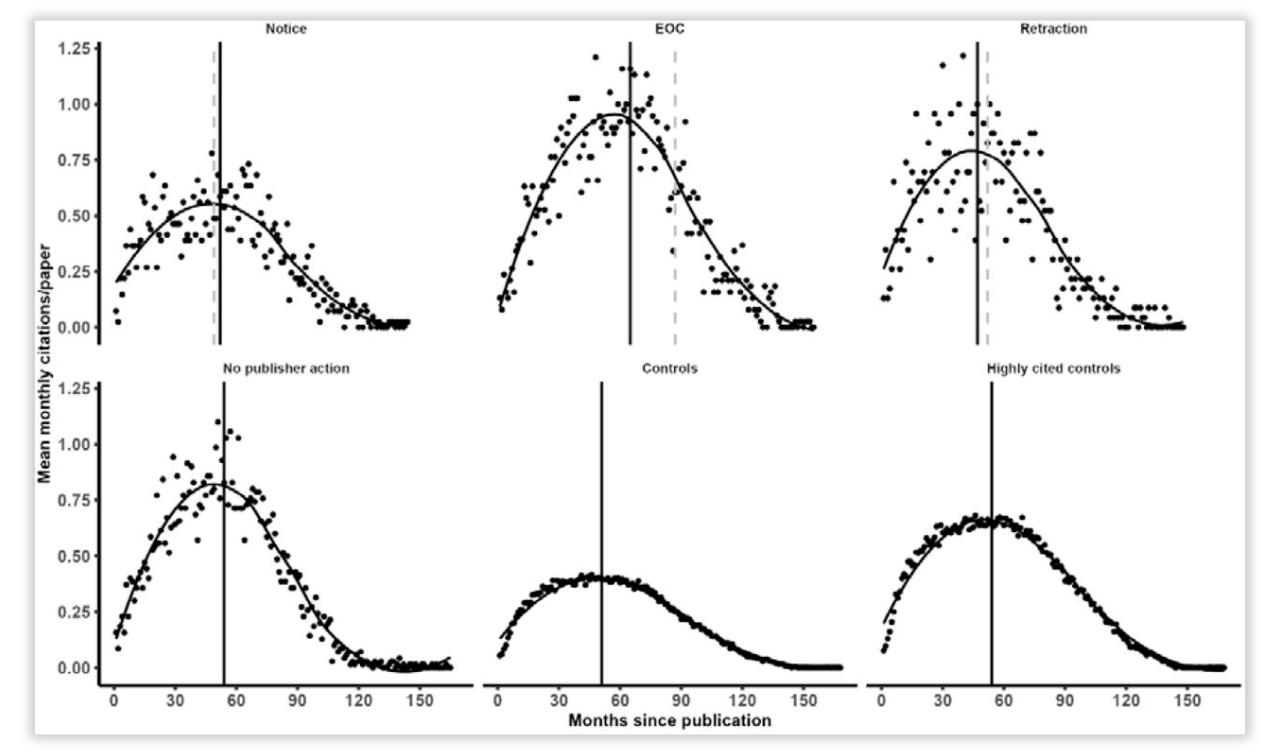
Among the data analyzed were mean monthly citations per article for 151 papers that were retracted or issued some other editorial notice, and for a set of control articles. The solid vertical lines are median time to the peak citation month, and the dashed line is median time to the editorial notice.
H. Studd et al/medRxiv 2026

Neither retractions, expressions of concern, nor other editorial notices seem to keep authors from continuing to cite problematic papers, according to a look at what happened to more than 170 articles by one author.

“After the public notification of integrity concerns about an article, it would be expected that other authors would no longer cite the article because it is unreliable,” write the authors of a new preprint. But that’s not what they found in a limited comparative study. Whether the study is generalizable has yet to be seen, says one other expert.

Four sleuths – the University of Aberdeen’s Hugo Studd and Alison Avenell and the University of Auckland’s Andrew Grey and Mark J. Bolland – charted citation data for 172 papers on clinical trials from Zatollah Asemi, a nutrition researcher at Kashan University of Medical Sciences in Iran, whose work has come under scrutiny

Continue reading Black marks on published papers don’t change citation rates, new study finds

45 editors resign from math journal, former EIC calls Elsevier publisher a ‘mini-dictator’

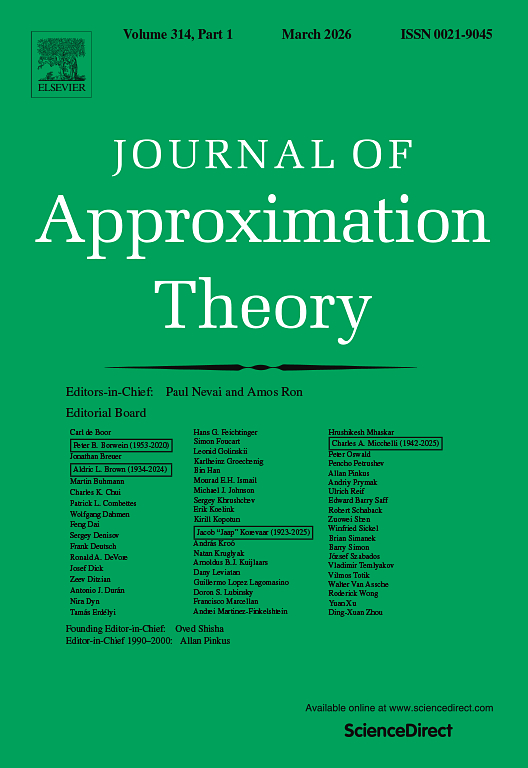
Forty-five of 48 members of the editorial board of the Journal of Approximation Theory resigned earlier this month for what they called Elsevier’s “concerning and potentially detrimental” decisions regarding the publication. 

Paul Nevai, formerly a professor at The Ohio State University, was appointed editor-in-chief of JAT in 1990 and held the position for 35 years until December. That’s when he reached the end of his term and Elsevier informed him they’d be filling the position with someone else. 

The mass resignation came after what Nevai said were several years of bad blood between the editors of the journal (including him) and the publisher, Giampiero Accardo. A representative for Elsevier told us designated publishers like Accardo are Elsevier employees who “oversee a portfolio of academic journals within a subject area, working closely with editors, authors, and research communities to support their development and long-term success.”

Continue reading 45 editors resign from math journal, former EIC calls Elsevier publisher a ‘mini-dictator’

“Game-changer” breast cancer study retracted as Indiana researcher out of his post

A group of cancer researchers whose work has been questioned by sleuths has been hit with their third retraction in less than a year.  

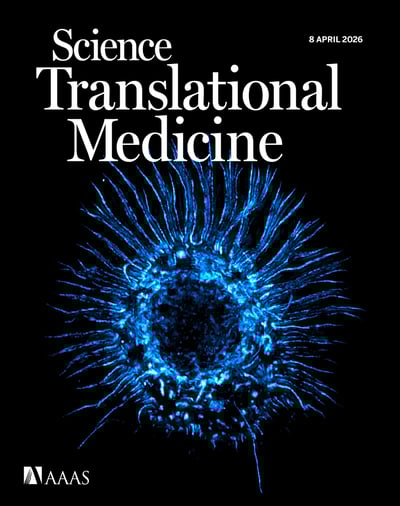
Today, Science Translational Medicine (STM) withdrew a 2021 breast cancer study by former Indiana University researcher Yujing Li and 12 other authors for image falsification. The immunotherapy study had been described by senior author Xiongbin Lu as a “game-changer” for triple negative breast cancer in a 2021 IU press release

The paper’s April 15 retraction notice states that a joint research misconduct investigation involving Indiana University, The Ohio State University, and the University of Maryland, College Park determined “falsification occurred during creation of figure S9C.” The institutions alerted the American Association for the Advancement of Science of the misconduct late last year and requested the paper’s retraction, according to Meagan Phelan, a spokesperson for AAAS, which publishes STM.

Continue reading “Game-changer” breast cancer study retracted as Indiana researcher out of his post

BMJ retracts most of a special issue for ‘compromised’ peer review and ‘improbable device use’

BMJ’s Journal of Medical Genetics has retracted the bulk of a seven-year-old special issue for an “irreparably compromised” review process and “improbable device use.” 

Of the eight papers in the 2019 special issue, seven were retracted, including an editorial that “almost exclusively” referred to the other now-retracted papers, according to a statement from the journal. 

According to the retraction notice published today, the journal’s investigation found the guest editor for the issue selected the peer reviewers, the majority of whom were affiliated with Nanjing University in China. The guest editor is not named in the issue. The publisher’s investigation also found evidence of compromised peer review in almost all articles, the notice states.

Continue reading BMJ retracts most of a special issue for ‘compromised’ peer review and ‘improbable device use’

Scientist who alleged COVID cover-up circulated a faked NIH email, agency says

Ariel Fernández

A scientist charged with research misconduct used a fake email communication with an NIH researcher’s address to support his claims of governmental retaliation, Retraction Watch has learned.  

Last month, we reported on the upholding of a proposed 15-year debarment by a U.S. Department of Health and Human Services appeals judge against Argentine chemist Ariel Fernández for falsifying research while a professor at Rice University in Houston. Administrative law judge Margaret G. Brakebusch based that May 2025 decision on findings by Rice sent to the Office of Research Integrity in 2010 and conclusions from ORI’s independent review completed in 2022. 

Fernández denied the misconduct allegations and told us the findings were retaliation by the government for a 2021 paper he wrote supporting a lab origin of SARS-CoV-2. As evidence of the contention, Fernández showed us an email purportedly from National Institutes of Health researcher Joshua Cherry dated June 2021. The email, which appeared to be from Cherry’s NIH address, threatened to resurrect Fernández’s ORI case if he didn’t remove the paper. We could not independently verify the email’s authenticity at the time.  

Continue reading Scientist who alleged COVID cover-up circulated a faked NIH email, agency says

Judge tosses lawsuit over controversial Paxil ‘Study 329’

A judge has dismissed a legal challenge aimed at forcing Elsevier to retract a long-criticized study that concluded the antidepressant Paxil was safe and effective for teens.

The 2001 paper, published in the Journal of the American Academy of Child & Adolescent Psychiatry (JAACAP), has faced scrutiny for more than 20 years by critics who say the study has led to unwarranted and potentially harmful prescribing of the drug to youth. As we reported last October, the journal placed an expression of concern on the paper shortly after a lawsuit was filed by attorney George W. Murgatroyd III against the journal’s owner, the American Academy of Child and Adolescent Psychiatry (AACAP), and Elsevier, which publishes the title.

In his complaint, filed in the Superior Court of the District of Columbia, Murgatroyd claimed the journal is violating the D.C. Consumer Protection Procedures Act (CPPA) by continuing to “publish, distribute, and sell a fraudulent scientific article that contains material facts” that mislead the public and endanger adolescent mental health and safety. AACAP and Elsevier are profiting from the article by charging readers to buy access to the paper, according to the complaint. 

Continue reading Judge tosses lawsuit over controversial Paxil ‘Study 329’

Why don’t journalists circle back to cover retractions? A conversation with Malgorzata Iwaniec-Thompson

Vertigo3d via Canva

In a paper published last month in the Journal of Documentation, a team of researchers in journalism, social science and data explore how and why journalists report – or don’t report – on scientific retractions. 

The investigators performed an analysis on news coverage of “high-attention retracted articles” identified from the Retraction Watch database and other sources and also interviewed journalists from the U.K. and Finland to gain a cross-cultural perspective. 

The lead author of the paper, Malgorzata Iwaniec-Thompson, of the University of Sheffield’s School of Information, Journalism and Communication, took questions from us about the work.

Continue reading Why don’t journalists circle back to cover retractions? A conversation with Malgorzata Iwaniec-Thompson

Publisher to retract entire conference proceedings, ban editor who wrote most of them

EPJ Web of Conferences will retract the entire volume of conference proceedings for ICEMR 2025.

On Monday, we published a story about a physicist in India who had three papers on superheavy elements retracted after others in his field began flagging his work. Hours later, a publisher decided to retract an entire volume of conference proceedings after one of the critics pointed out the researcher, H.C. Manjunatha, was responsible for the majority of its contents. 

Manjunatha is listed as coordinator of the International Conference on Emerging Frontiers in Material Science and Radiation Physics, which took place in December. Manjunatha was one of four editors for the conference’s proceedings published in EPJ Web of Conferences on March 18. Of the 55 articles in the volume, Manjunatha is an author on 32. 

David Boilley, a physicist at the University of Caen Normandy and researcher at GANIL, emailed EDP Sciences, which publishes EPJ Web of Conferences, on March 22 noting Manjunatha’s position as editor and the large number of papers he authored in the volume. Boilley, whom we interviewed for our story, mentioned the forthcoming article to the journal and also included a copy of his recent preprint calling out Manjunatha’s papers.

Continue reading Publisher to retract entire conference proceedings, ban editor who wrote most of them

Physicists flag over 50 papers on superheavy elements, leading to 3 retractions

A physicist in India has accumulated three retractions and 13 expressions of concern for papers on superheavy elements after three researchers in the field began to flag issues with his work. 

H.C. Manjunatha, the common author on the articles, is with the physics department at the Government First Grade College in Devanahall, according to his most recent papers, including eight published this year. 

The three retracted papers originally appeared in Springer Nature’s The European Physical Journal A in 2017. According to the retraction notices, a post-publication review found “serious flaws in the research methodology, numerical results, and interpretation of findings.” All pertain to the discovery and synthesis of superheavy elements, which are unstable elements with large numbers of protons. 

Continue reading Physicists flag over 50 papers on superheavy elements, leading to 3 retractions

Most editors at math journal resign over multiple reviews, ‘cloak-and-dagger’ removal of EIC

Nearly two dozen editors of a mathematics journal have resigned after its publisher removed the top editor and implemented a multiple review system, “running roughshod over the standard practices of the refereeing process in mathematics.”

Of the 31 members of the Communications in Algebra editorial board, 23 signed a March 10 resignation letter sent to Taylor & Francis, which publishes the journal. In the letter, the editors said the publisher “unilaterally” implemented a system in which more than one reviewer would be expected to look over a paper. 

The peer review process in mathematics is more labor-intensive than for other topics, the editors said, including “not only an assessment of the impact and significance of the results but also a line-by-line painstaking check for correctness of the results. This process is often quite time-consuming and makes referees a valuable commodity.” The letter continues: “Doubling the number of expected reviews will quickly either deplete the pool of willing reviewers or vastly dilute the quality of their reviews, and both of these are unacceptable outcomes.”

Continue reading Most editors at math journal resign over multiple reviews, ‘cloak-and-dagger’ removal of EIC