Above and beyond: An editor wanted authors to know they’d been falsely cited

Credit: tadamichi/iStock

Like many college professors today, Sarah S. Richardson has seen AI-hallucinated citations in work submitted by her students. But she was surprised when an editor recently contacted her about a hallucinated citation involving her own work. 

A March 31 email from the editor in chief of Disability Studies Quarterly explained Richardson was one of six scholars falsely cited in a journal article. The editor apologized for the error and alerted Richardson of the paper’s retraction. 

“The editor took the extra step of informing all scholars who could have been harmed by the hallucinated citation[s] and did so in an exceptionally thoughtful and caring manner,” said Richardson, the Aramont Professor of the History of Science and Professor of Studies of Women, Gender, and Sexuality at Harvard University. “I suspect that most hallucinated citations are never discovered, let alone redressed by a retraction and outreach to those affected.”

Continue reading Above and beyond: An editor wanted authors to know they’d been falsely cited

Wiley investigating book chapter on biodiversity for fake references

While reading a chapter from a 2024 book on restoring biodiversity in post-industrial land earlier this month, an ecologist came across a reference to a study on rewilding she wanted to look up. 

But the ecologist, who has asked to remain anonymous for fear of retaliation from the chapter authors, couldn’t find a record of the 2020 paper, purportedly published in Ambio by “Knijn et al.” She decided to check the other references. She told Retraction Watch she found at least eight that didn’t exist. 

The ecologist flagged the issue to the book’s publisher, Wiley, on September 7 but told us she never heard back, aside from an automated response.

Continue reading Wiley investigating book chapter on biodiversity for fake references

One in 277 PubMed-indexed papers in 2026 shows fabricated references, says analysis

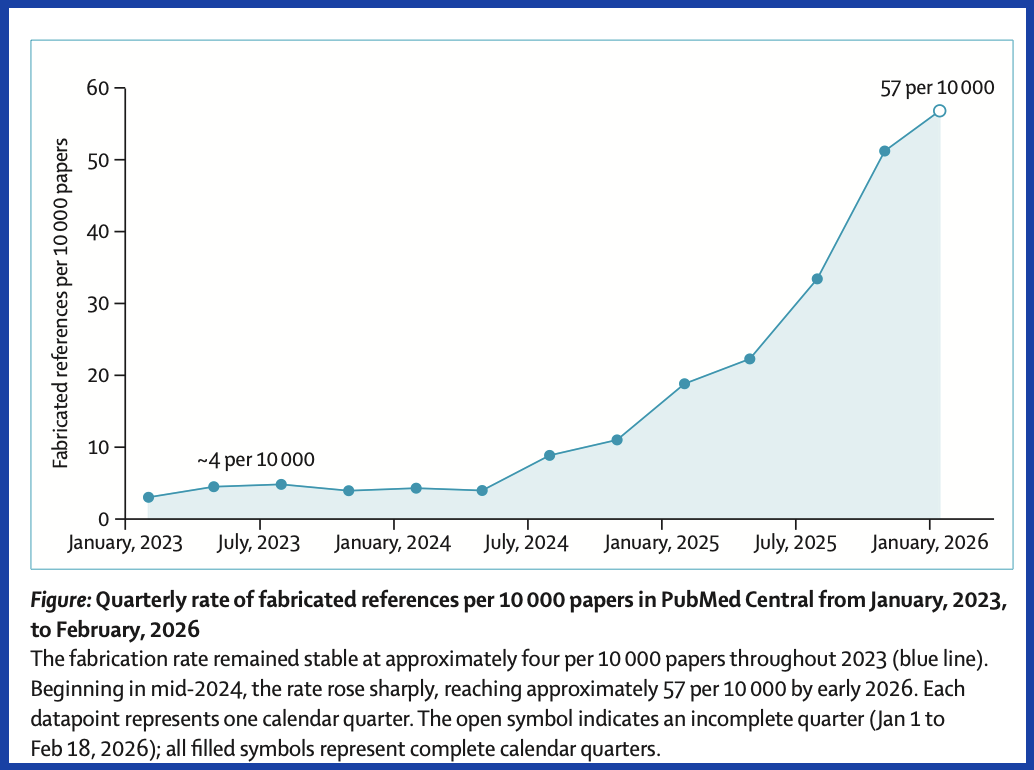
Figure from correspondence to The Lancet by Maxim Topaz and colleagues.

Fabricated citations in the biomedical literature have increased 12-fold in two years, according to an audit of nearly 2.5 million papers published as a letter to The Lancet today. 

The analysis of articles indexed in PubMed found that about one in 277 papers published in the first seven weeks of 2026 referenced a paper that didn’t exist. That was a jump from 2025’s rate of one in 458 and 2023’s one in 2,828. The researchers, led by Maxim Topaz of Columbia University’s Data Science Institute, used AI to “distinguish genuine fabrications from formatting discrepancies such as informally abbreviated titles.”

Topaz’s group located the sharpest increase in hallucinated references in mid-2024, which they note coincided with the rise of AI writing tools. The findings come as Nature reported last month that tens of thousands of publications from 2025 “might include invalid references generated by AI.” Retraction Watch has seen its fair share of reports of hallucinated citations generated by LLMs like ChatGPT.

Continue reading One in 277 PubMed-indexed papers in 2026 shows fabricated references, says analysis

A citation alert led researchers to a network of fake articles. But who is benefiting?

Demianastur/iStock

A few months ago, when Elle O’Brien, a data scientist at the University of Michigan, was checking who had recently cited her work on Google Scholar, she came across something that would take her and her colleagues down “a rabbit hole.” 

When O’Brien opened a publication that had recently cited her, it appeared to be a rewritten version of an arXiv preprint she had co-authored with two colleagues, Grischa Liebel and Sebastian Baltes. Yet this did not seem to be a simple case of theft by other academics. 

For starters, the six authors listed on the fake article didn’t exist, although three had been given the same institutional affiliations as O’Brien, Liebel, and Baltes: the University of Michigan, Reykjavik University and Heidelberg University, respectively. The similarities in the texts read as if someone had typed, “ChatGPT, please rephrase this paper without changing anything else,” Liebel wrote in a post on LinkedIn. But why would fake authors need publications?

Continue reading A citation alert led researchers to a network of fake articles. But who is benefiting?

Medical journal publishes a letter on AI with a fake reference to itself

We’ve seen all kinds of articles that got published despite having references that don’t exist. But this was a new one: a paper with a made-up reference to the journal in which it appears.

While nonexistent references can indicate the use of a large language model in generating text, the authors maintain they used AI according to the journal’s guidelines. 

The letter to the editor, published in December 2024 in Intensive Care Medicine, explored ways AI could help clinicians monitor blood circulation in patients in intensive care units. The 750-word letter included 15 references.

Continue reading Medical journal publishes a letter on AI with a fake reference to itself

World Bank report ‘removed for review’ of nonexistent references after Retraction Watch inquiry

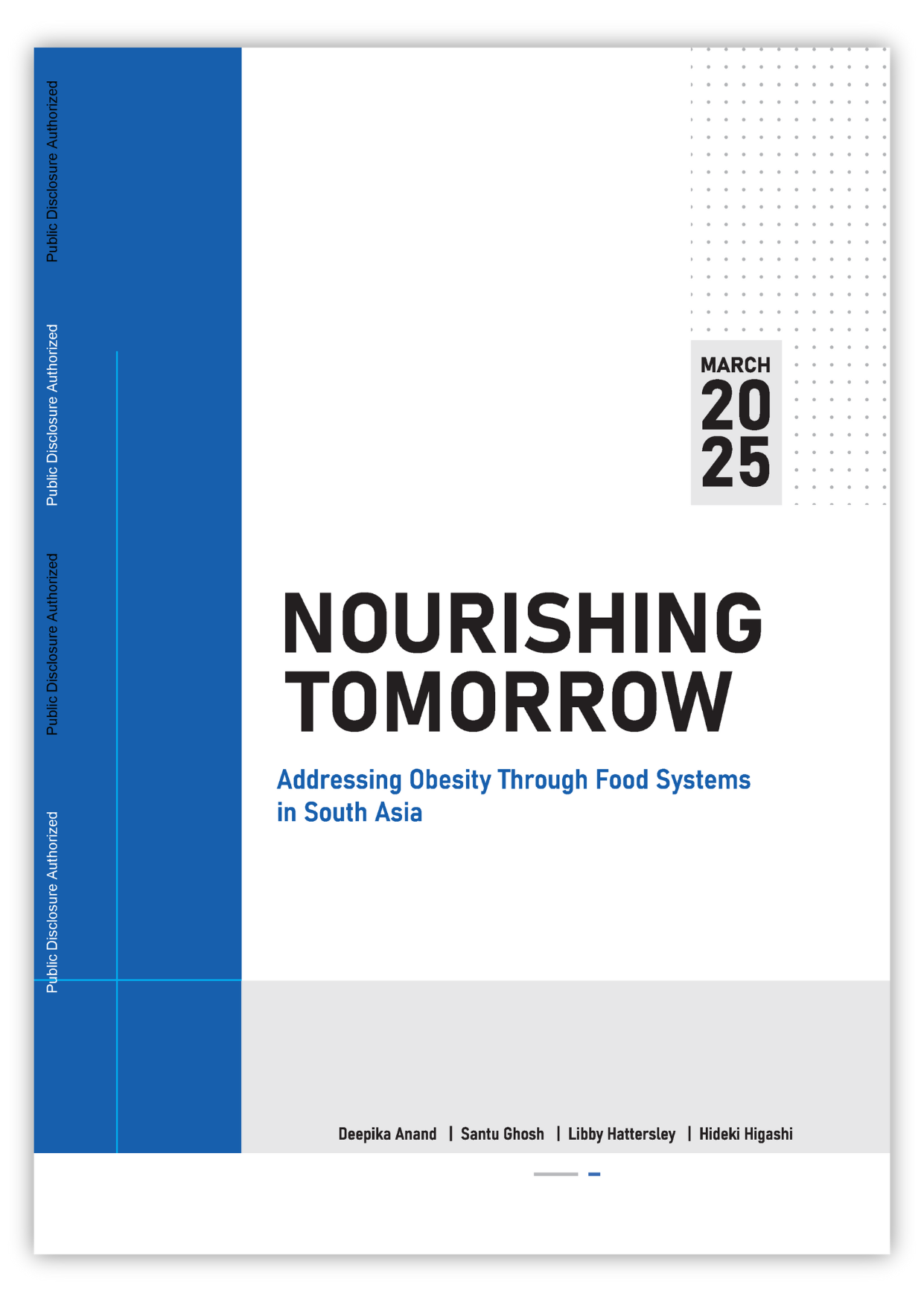
A World Bank report on obesity trends with at least 14 fake references in the text has been removed from the website and is being reviewed by the organization following a Retraction Watch inquiry. 

The report, “Nourishing Tomorrow: Addressing Obesity Through Food Systems in South Asia,” was published in March 2025 in the World Bank Group’s Open Knowledge Repository. The document describes an analysis of how different food systems contribute to rising rates of  obesity in South Asian countries. Three of its four authors are employees of the World Bank.

Muhammad Azam first came across the report in a WhatsApp group for sports science research in Pakistan, he told us. Azam, of the Government College University Lahore, has studied the prevalence of sports science research published in predatory journals in that country. So when a group member shared that some publications Azam knew to be suspect had been cited in the report, he took a closer look and found several “problematic entries,” he told us.

Continue reading World Bank report ‘removed for review’ of nonexistent references after Retraction Watch inquiry

The case of the fake references in an ethics journal

Many would-be whistleblowers write to us about papers with nonexistent references, possibly hallucinated by artificial intelligence. One reader recently alerted us to fake references in … an ethics journal. In an article about whistleblowing.

The paper, published in April in the Journal of Academic Ethics, explored “the whistleblowing experiences of individuals with disabilities in Ethiopian public educational institutions.” 

Erja Moore, an independent researcher based in Finland, came across the article while looking into a whistleblowing case in that country. “I started reading this article and found some interesting references that I decided to read as well,” Moore told Retraction Watch. “To my surprise, those articles didn’t exist.”

Continue reading The case of the fake references in an ethics journal

Springer Nature flags paper with fabricated reference to article (not) written by our cofounder

Update, Nov. 24, 2025, 5:48 p.m. UTC: This story was updated to add comment from Mohammad Abdollahi, the editor-in-chief of the journal and last author of the paper.


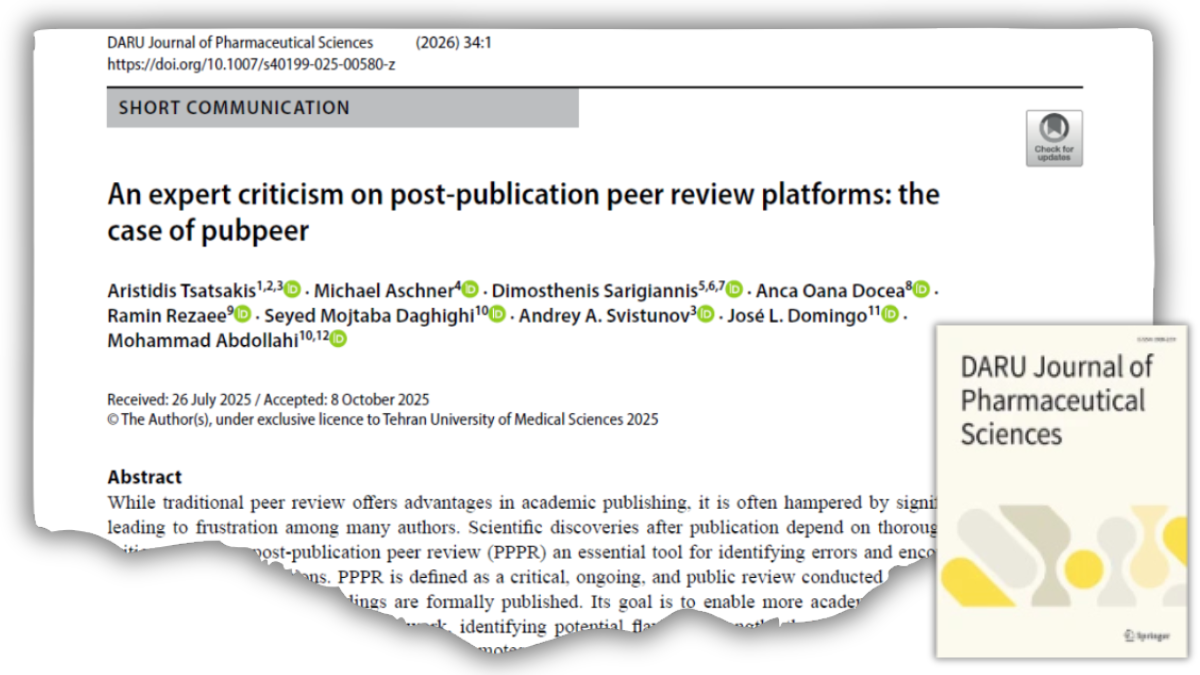
Tips we get about papers and books citing fake references have skyrocketed this year, tracking closely with the rise of ChatGPT and other generative large language models. One in particular hit close to home: A paper containing a reference to an article by our cofounder Ivan Oransky that he did not write.

The paper with the nonexistent reference, published November 13 in DARU Journal of Pharmaceutical Sciences, criticizes platforms for post-publication peer review — and PubPeer specifically — as being vulnerable to “misuse” and “hyper-skepticism.” Five of the paper’s 17 references do not appear to exist, three others have incorrect DOIs or links, and one has been retracted. 

One of the fabricated references credits our cofounder Ivan Oransky with a nonexistent article, “A new kind of watchdog is shaking up research,” purportedly published in Nature in 2019. 

Continue reading Springer Nature flags paper with fabricated reference to article (not) written by our cofounder

Challenge accepted: A reader wrote a program to find fake references in books

Hermann/Pixabay

Following our coverage this summer of a book with citations that did not exist, we asked you to send us examples of other books with similar issues. One reader took the request as an assignment to find problematic texts.

Michał Wójcik, a Ph.D. student at the Free University of Berlin, saw a link to our article about the book on LinkedIn. “I started thinking that it shouldn’t be that hard to check those references automatically,” he said. “I decided to just spend some time on it, and I had a prototype in a few hours.” 

The Python script he wrote searches through books to verify the existence of each citation by checking if the DOI existed in Crossref. He told us he manually checked citations the script couldn’t identify by looking in other databases and searching on Google Scholar, which takes him between an afternoon and a whole day. 

Continue reading Challenge accepted: A reader wrote a program to find fake references in books

Springer Nature to retract machine learning book following Retraction Watch coverage

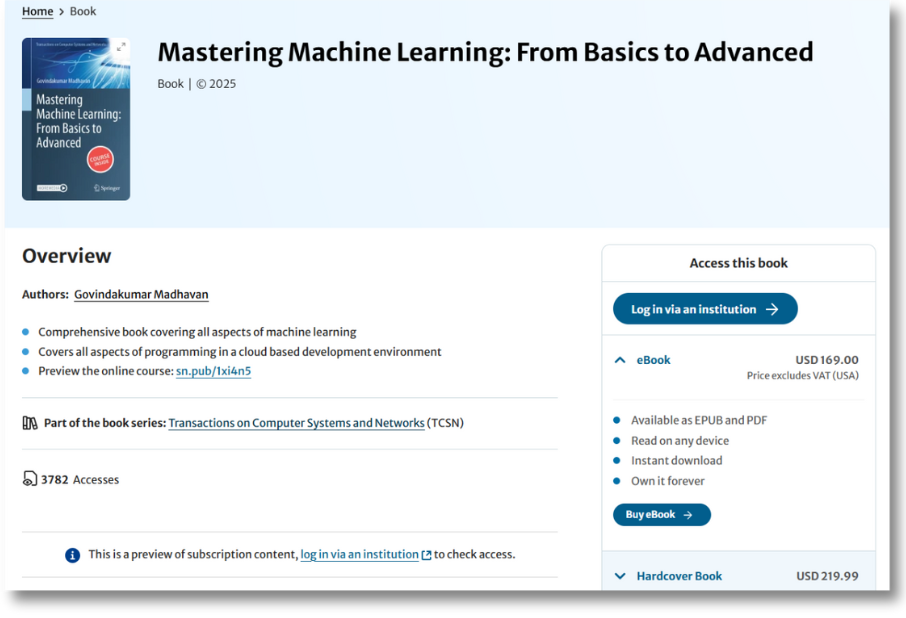
A screenshot from June 26 shows the book had been accessed 3,782 times.

Springer Nature is retracting a book on machine learning that had multiple references to works that do not exist, Retraction Watch has learned. 

The move comes two weeks after we reported on the book’s fake references.

The link to the information page for the book, Mastering Machine Learning: From Basics to Advanced, now returns “Page not found,” and the text is no longer listed under the book series on computer systems and networks. 

Continue reading Springer Nature to retract machine learning book following Retraction Watch coverage