Dutch anthropologist Mart Bax faked 61 papers, says university

free universityA former anthropologist at the Free University in Amsterdam appears to have made up data for at least 61 papers, and invented awards and other parts of his CV, according to a university investigation.

The news was first reported by NRC Handelsblad and the Volkskrant newspaper.

Bax, who studied an Irish town he called Patricksville, a Dutch pilgrimage site he called Neerdonk, and Medjugorje, a Bosnian pilgrimage site, retired from the Free University in 2002. The university began investigating Bax’s work last year Continue reading Dutch anthropologist Mart Bax faked 61 papers, says university

That’ll do it: Physics paper retracted for a “pattern that is unphysical”

j phys dLast December, we brought you the story of a math paper that was retracted because it made “no sense mathematically.” Today, we have that retraction’s cousin: A physics paper retracted because some of the data are “unphysical.”

Here’s the notice for “Room temperature ferromagnetism in pure and Co- and Fe-doped CeO2 dilute magnetic oxide: effect of oxygen vacancies and cation valence,” which was published in April 2011 in the Journal of Physics D: Applied Physics: Continue reading That’ll do it: Physics paper retracted for a “pattern that is unphysical”

Management prof with 12 retractions loses his license to teach

Ulrich Lichtenthaler

Ulrich Lichtenthaler, the management professor at the University of Mannheim who has had a dozen papers retracted, has now lost his license to teach.

The WHU-Otto Beisheim School of Management, where Lichtenthaler earned his PhD, announced the move Friday, saying (courtesy Google Translate): Continue reading Management prof with 12 retractions loses his license to teach

A Cancer Cell mega-correction for highly cited researcher who retracted paper earlier this year

cancer cell 9-13MIT’s Robert Weinberg, a leading cancer researcher who retracted a Cancer Cell paper earlier this year for “inappropriate presentation” of figures, has corrected a different paper in the same journal.

Here’s the correction for “Species- and Cell Type-Specific Requirements for Cellular Transformation:”

We were apprised recently of errors made in the assembly of Figures 2B, 3A, 4A, 4B, and 5G, resulting in the incorporation of incorrect representative images in these figures. These errors occurred during the electronic assembly and have no bearing on the conclusions of the study. The corrected figures are shown below. The authors apologize for any possible confusion this might have caused.

Here’s the original Figure 2 and caption, followed by the new version (read all the way to the end of the post for more details on how this came to light): Continue reading A Cancer Cell mega-correction for highly cited researcher who retracted paper earlier this year

What happened to Joachim Boldt’s 88 papers that were supposed to be retracted?

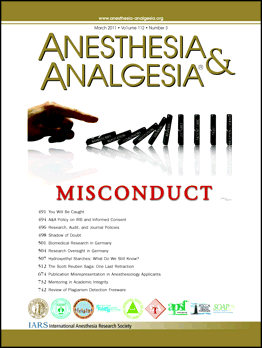
a&amisconductcoverCHICAGO — Almost two years after editors at 18 journals agreed in March 2011 to retract 88 of former retraction record holder Joachim Boldt’s papers, 10% of them hadn’t been retracted.

That’s what Nadia Elia, Liz Wager, and Martin Tramer reported here Sunday in an abstract at the Seventh International Congress on Peer Review and Biomedical Publication. Elia and Tramer are editors at the European Journal of Anaesthesiology, while Wager is former chair of the Committee on Publication Ethics (COPE).

As of January 2013, nine of the papers hadn’t been retracted, Tramer said, while only five — all in one journal — had completely followed COPE guidelines, with adequate retraction notices, made freely available, along with  PDFs properly marked “Retracted.” From the abstract (see page 18): Continue reading What happened to Joachim Boldt’s 88 papers that were supposed to be retracted?

Diederik Stapel speaks

stapel_npcDiederik Stapel, the social psychologist who has now retracted 54 papers, recently spoke as part of the TEDx Braintrain, which took place on a trip from Maastricht to Amsterdam. Among other things, he says he lost his moral compass, but that it’s back.

Here’s the talk, which lasts 17 minutes: Continue reading Diederik Stapel speaks

Are US behavioral science researchers more likely to exaggerate their results?

Daniele Fanelli
Daniele Fanelli

When Retraction Watch readers think of problematic psychology research, their minds might naturally turn to Diederik Stapel, who now has 54 retractions under his belt. Dirk Smeesters might also tickle the neurons.

But a look at our psychology category shows that psychology retractions are an international phenomenon. (Remember Marc Hauser?) And a new paper in the Proceedings of the National Academy of Sciences (PNAS) suggests that it’s behavioral science researchers in the U.S. who are more likely to exaggerate or cherry-pick their findings.

For the new paper, Daniele Fanelli — whose 2009 paper in PLoS ONE contains some of the best data on the prevalence of misconduct — teamed up with John Ioannidis, well known for his work on “why most published research findings are false.” They looked at Continue reading Are US behavioral science researchers more likely to exaggerate their results?

Author with six recent corrections retracts JBC paper questioned on PubPeer

jbc 8-23-13Rakesh Kumar, a professor at the George Washington University, has retracted a paper in the Journal of Biological Chemistry (JBC) that was recently questioned on PubPeer.

Here are Peer1’s comments from PubPeer about the paper, “Mechanism of MTA1 Protein Overexpression-linked Invasion:” Continue reading Author with six recent corrections retracts JBC paper questioned on PubPeer

Retraction appears for Harvard scientist who had two mega-corrections last year

molecular cellSam Lee, a Harvard biologist who had two mega-corrections published last year, has retracted a paper in Molecular Cell because some of the figures were “inappropriately assembled.”

Here’s the notice for “GAMT, a p53-Inducible Modulator of Apoptosis, Is Critical for the Adaptive Response to Nutrient Stress:” Continue reading Retraction appears for Harvard scientist who had two mega-corrections last year

Journal to feature special issue on scientific misconduct, seeks submissions

steen
Grant Steen

It would be difficult to read the recent scientific literature on retractions and miss Grant Steen’s contributions. Retraction Watch readers are no doubt familiar with his work by this point, and if they’re not, we’d recommend spending some time with it. The journal Publications — an MDPI title — has asked him to guest-edit a special issue on scientific misconduct, and Steen asked us to get the word out, so we’re happy to post this introduction from him: Continue reading Journal to feature special issue on scientific misconduct, seeks submissions