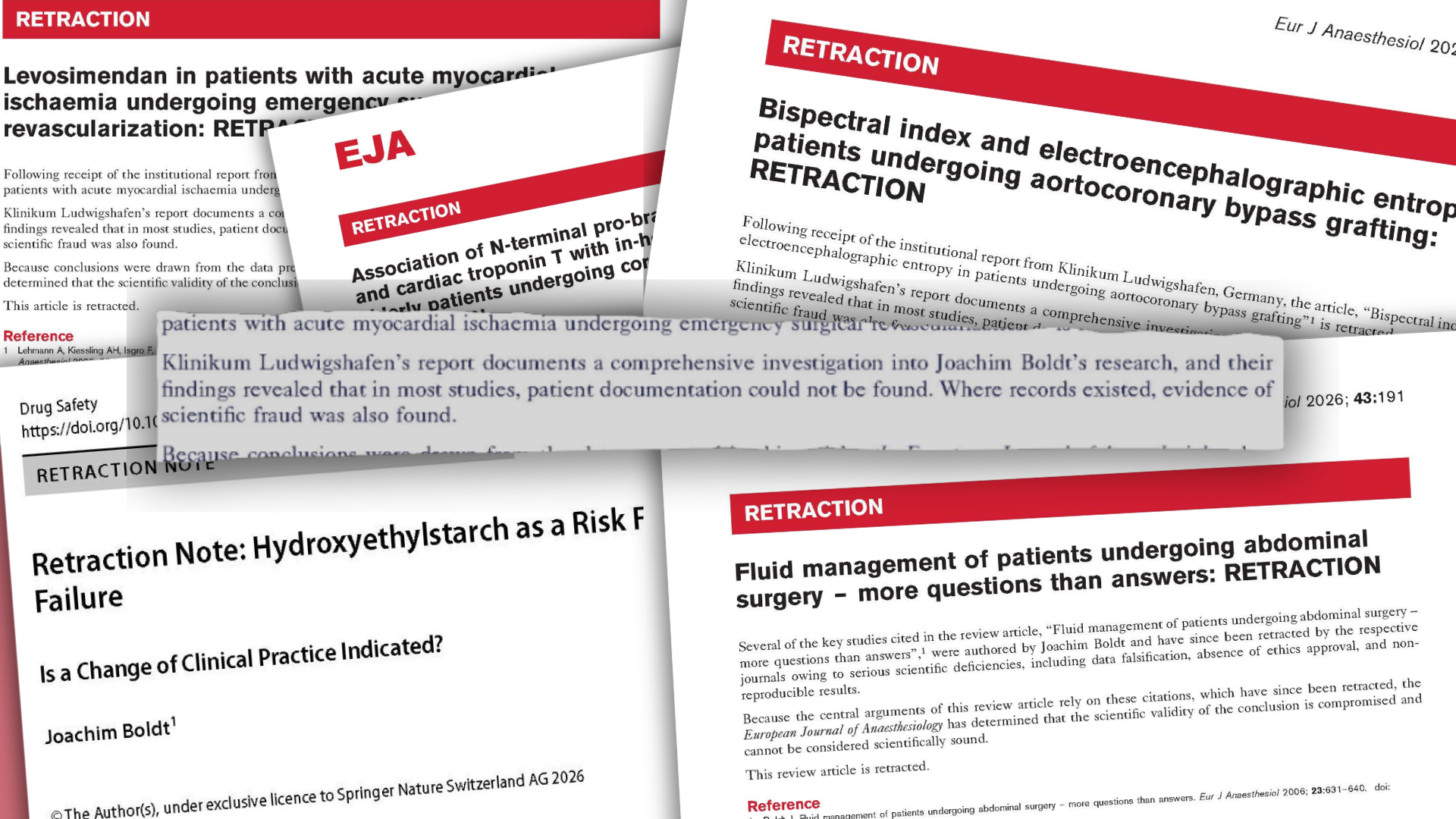
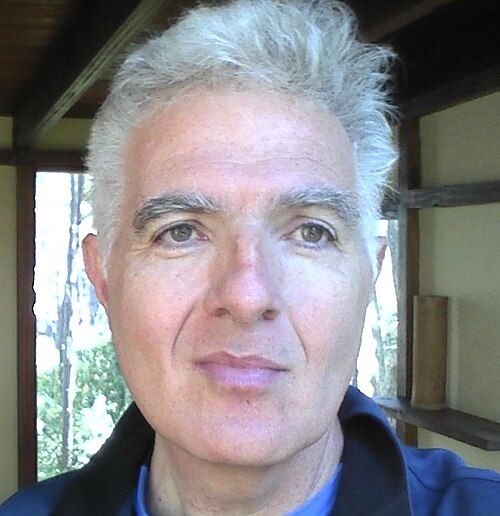
Martin Tramèr was editor-in-chief of the European Journal of Anaesthesiology during what he once called in print “The Boldt debacle.”
The misconduct scandal involving hundreds of papers by Joachim Boldt broke to the surface in 2010, but journals continue to retract papers by the disgraced German anesthesiologist – and researchers have continued to cite the work.
Tramèr, who described the story as “sad,” said he was “surprised that, so long after the Boldt debacle, articles still are being retracted again, including eight from his former journal – articles he and his colleagues specifically exempted from retraction 15 years ago: “What has happened since then? Why were these additional articles retracted after all, albeit very late? It’s a mystery.”
The U.S Office of Research Integrity has formally announced a 15-year funding debarment against a former Rice University scientist for research misconduct, resolving allegations that arose 17 years ago.
Chemist Ariel Fernández intentionally fabricated data in 12 grant-supported papers, four unpublished manuscripts, one presentation and three grant applications while a professor at Rice University in Houston, according to a notice posted May 1 on ORI’s website and to be published in the Federal Register on May 5. As part of the sanctions, Fernández is barred from receiving federal research funds for 15 years. The announcement is the third finding this year from ORI.
The notice follows a decision nearly a year ago by administrative law judge (ALJ) Margaret G. Brakebusch upholding ORI’s findings and recommended debarment, issued in 2022, after an appeal by Fernández. We reported on that ALJ decision after it was made public in February of this year. An exclusion record posted the same day our story ran shows Fernández’s debarment started on March 25. (We reached out to ORI about the case on March 5.)
A scientist charged with research misconduct used a fake email communication with an NIH researcher’s address to support his claims of governmental retaliation, Retraction Watch has learned.
Last month, we reported on the upholding of a proposed 15-year debarment by a U.S. Department of Health and Human Services appeals judge against Argentine chemist Ariel Fernández for falsifying research while a professor at Rice University in Houston. Administrative law judge Margaret G. Brakebusch based that May 2025 decision on findings by Rice sent to the Office of Research Integrity in 2010 and conclusions from ORI’s independent review completed in 2022.
Fernández denied the misconduct allegations and told us the findings were retaliation by the government for a 2021 paper he wrote supporting a lab origin of SARS-CoV-2. As evidence of the contention, Fernández showed us an email purportedly from National Institutes of Health researcher Joshua Cherry dated June 2021. The email, which appeared to be from Cherry’s NIH address, threatened to resurrect Fernández’s ORI case if he didn’t remove the paper. We could not independently verify the email’s authenticity at the time.
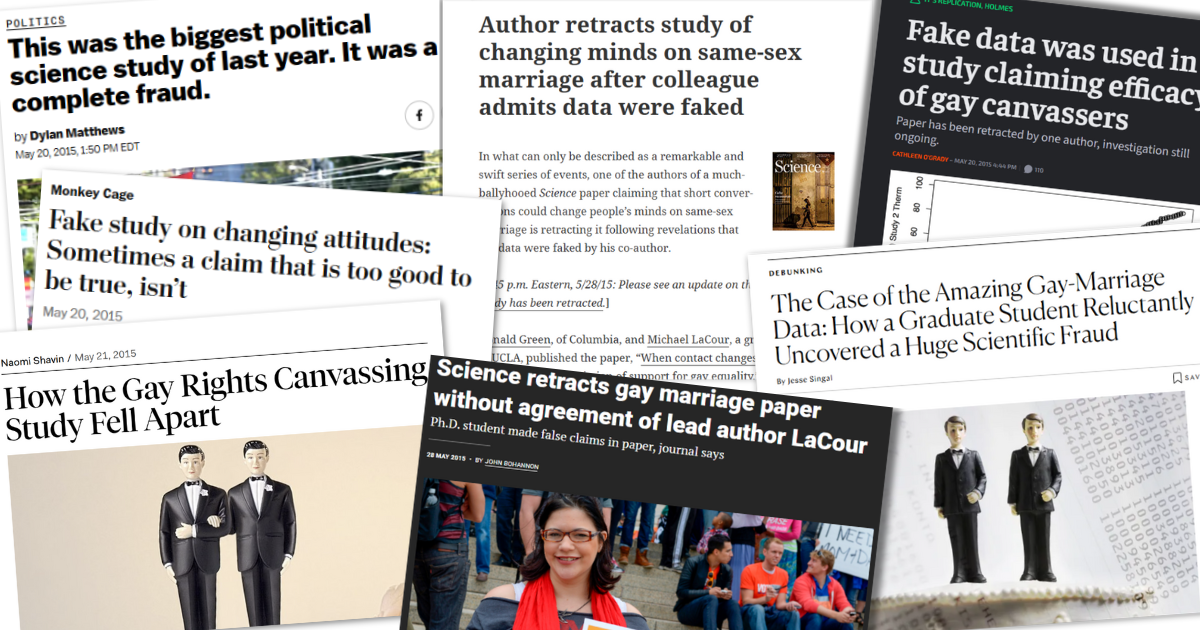
Driving those headlines was a December 2014 study in Science, by Michael J. LaCour, then a Ph.D. student at the University of California, Los Angeles, and Donald Green, a professor at Columbia University.
Researchers praised the “buzzy new study,” as Slate called it at the time, for its robust effects and impressive results. The key finding: A brief conversation with a gay door-to-door canvasser could change the mind of someone opposed to same-sex marriage.
By the time the study was published, David Broockman, then a graduate student at the University of California, Berkeley, had already seen LaCour’s results and was keen to pursue his own version of it. He and fellow graduate student Joshua Kalla had collaborated before and wanted to look more closely at the impact canvassing could have on elections. But as the pair deconstructed LaCour’s study to figure out how to replicate it, they hit several curious stumbling blocks. And when they got a hold of LaCour’s dataset, or replication package, they quickly realized the results weren’t adding up.
Readers who have checked the Retraction Watch leaderboard lately may have picked up on something notable: One researcher, Joachim Boldt, has now been credited with 210 retractions – making him the first author (to our knowledge) with more than 200 retractions to his name.
Boldt’s new tally – representing about half of his roughly 400 publications – admittedly is an accounting change rather than new problems being identified. Some journals have only now come around to acting on the corrupt articles. In that sense, it reflects both progress and a frustrating lack of concern-slash-urgency on the part of the journals that have taken more than a decade to resolve the case.
One incident illustrates just how determined the leaders of the Karolinska Institute were to protect Paolo Macchiarini. In November of 2014, a leaked copy of the whistleblowers’ report came into the hands of the New York Times, which published an article titled “Leading Surgeon Is Accused of Misconduct in Experimental Transplant Operations.” The article detailed several of the most serious allegations against Macchiarini: that he had never obtained ethical permission to conduct his experiments, that his 2011 study in The Lancet had misrepresented the outcome of Beyene’s implant, and that of the three patients at the Karolinska Institute that Macchiarini had given synthetic implants, only Beyene had signed a consent form— and the form was dated two weeks after his surgery. The publicity generated by the article all but forced the Karolinska Institute to act. Anders Hamsten, the vice-chancellor, said he would ask for an external inquiry.
Retaliation against the whistleblowers came quickly. According to Simonson, the whistleblowers were told that they had violated patient privacy and would be fired immediately. That didn’t happen, but in December the Karolinska Institute informed the whistleblowers that the head of the cardiothoracic clinic would deliver a formal warning, the last step before an employee is terminated.
The Karolinska Institute also reported the whistleblowers to the police. “I was called down to the police and put in a room with no windows, with a tape recorder and a lawyer and a policeman in front of me, and interrogated. That was pretty scary,” Matthias Corbascio, a cardiothoracic surgeons says. “It was exactly what it’s like on television. And you know, it’s hard to be a tough guy in that room.”
A diabetes researcher who lost a defamation suit against a journal that marked four of his papers with expressions of concern now has four more papers flagged – by the same journal.
Diabetes, a journal of the American Diabetes Association (ADA), placed expressions of concern on four papers led or co-authored by Mario Saad, of the University of Campinas (Unicamp) in Brazil on October 23.
Saad sued the ADA in 2015 after Diabetes marked four other papers with similar notices. A judge dismissed the suit, and the journal later retracted the papers (for which we recognized them with a DiRT — Doing the Right Thing — award). Saad is now up to 19 retractions, by our count.
The German anesthesiologist Joachim Boldt has lost 20 more papers since January 2023, earning him the top spot in our leaderboard, with 184 retractions.
Boldt, readers may recall, was once one of the leading international figures in perioperative medicine. His work, particularly studies involving the use of fluid management during surgery, helped inform clinical guidelines that, thanks to his misdeeds, some experts believe may have put patients at risk for serious harm and even death.
Boldt has vaulted over another anesthesiologist, Yoshitaka Fujii, to take the crown (more on that in a moment) – although one might fairly ask: Why did it take so long?
In 2018, the journal Respiration was adamant that it wouldn’t retract a 2015 paper co-authored by once-respected transplant surgeon Paolo Macchiarini. Now, the editors at Respiration seem to have changed their mind.
Macchiarini is most well known for his controversial artificial windpipe implants. Seven out of the eight patients who had artificial windpipes implanted from Macchiarini suffered complications after the surgery.