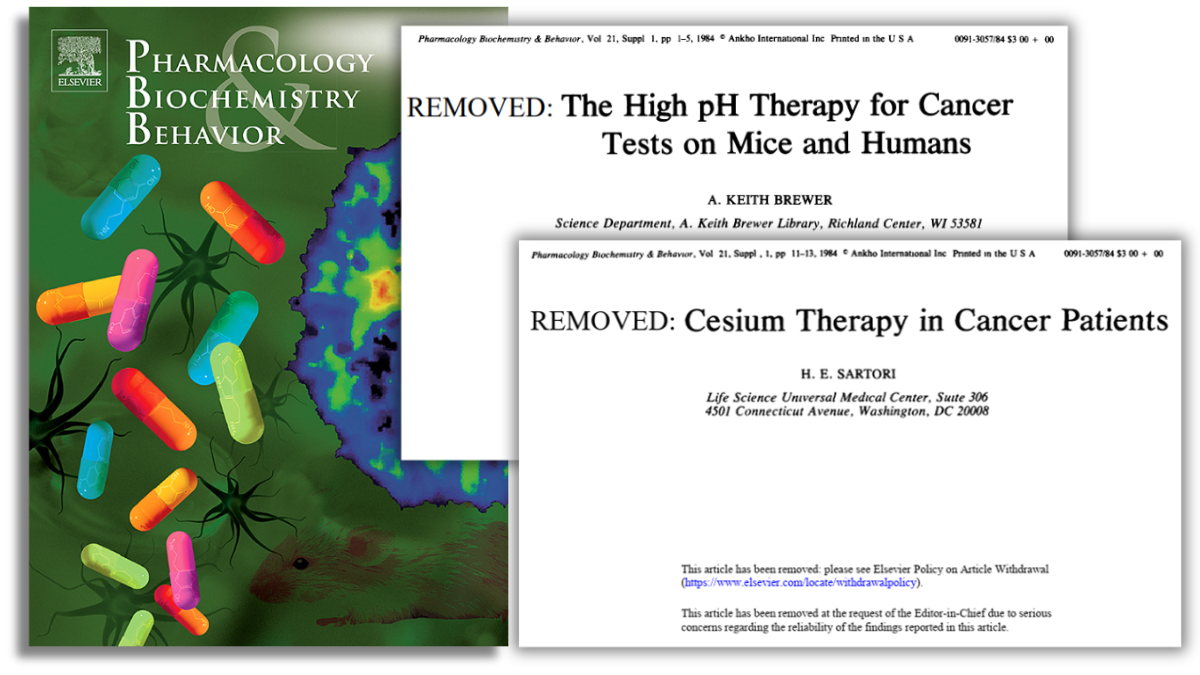
An Elsevier journal has removed two papers on a discredited alternative treatment for cancer nearly half a century after they were published, after researchers found a quarter of patients in case reports of the therapy, cesium chloride, died from taking the substance.
Some alternative medicine advocates marketed cesium chloride as a cancer treatment in the 1980s and 1990s, although the risks and ineffectiveness of the therapy have been known for decades. In 2018, the U.S. Food and Drug Administration issued a warning about “significant safety risks” associated with the salt.
Marcel van der Heyden, a professor at the University Medical Center Utrecht in The Netherlands, told Retraction Watch he and his students came across the articles while writing a review of case reports on the use of cesium. Although the therapy was supported online and in health books, he said, all pointed to two 1984 papers in Pharmacology Biochemistry and Behavior: “Cesium therapy in cancer patients” by Hellfried Sartori and “The high pH therapy for cancer tests on mice and humans” by Aubrey Keith Brewer.
For their analysis, published in Cardiovascular Toxicology in January, van der Heyden and eight students found case reports on 20 patients treated with cesium salts. Five of the 20 patients died as a result of the therapy, according to the case reports they analyzed.
The abstract of the Sartori paper states autopsies of patients treated with cesium found “absence of cancer cells in most cases and the clinical impression indicates a remarkably successful outcome of treatment.” The Brewer paper found mice who were treated with cesium “showed marked shrinkage” in cancer tumor mass. The journal’s website says the papers have been cited 39 and 45 times, respectively.
“Neither Brewer’s nor Sartori’s results were presented with robust data, long-term follow-up or have ever been independently verified in other studies,” van der Heyden and colleagues wrote. “Nonetheless, their claims have remained influential and are frequently cited in support of cesium therapy for cancer.”
The text for the Brewer and Sartori papers has been replaced with: “This article has been removed at the request of the Editor-in-Chief due to serious concerns regarding the reliability of the findings reported in this article.” However, the abstracts for both are still available on PubMed.
Guy Griebel, the editor-in-chief of Pharmacology Biochemistry and Behavior, told us the investigation into the papers began last July when van der Heyden reported his concerns to the journal.
According to Elsevier’s website, the publisher removes articles in “an extremely limited number of cases.” Reasons for removal include if the article is “defamatory, or infringes others’ legal rights, and retraction is not a sufficient remedy,” and if the paper, “if acted upon, might pose a serious health risk.”
Sartori lost his license to practice medicine in Washington, D.C. in 1985, and ultimately in 14 other states as well. He was convicted of practicing medicine without a license after injecting a patient with ozone, according to The Washington Post. In 2006, he was arrested in Thailand for similar reasons. A 60 Minutes Australia segment in 2011 dubbed him “Doctor Death” after five patients died within two weeks following treatment at his hands.
Sartori published another paper in the same issue as the now-removed paper, which Griebel told us was currently not being investigated by the journal. That article, “Nutrients and cancer: An introduction to cesium therapy,” discusses oral cesium as a therapy for cancer.
The only other paper by Sartori listed in PubMed appeared in another Elsevier journal, Alcohol, in 1986. It describes the use of lithium orotate, an over the counter supplement, to treat alcoholism.
On the website for the Brewer International Science Library in Wisconsin, an alternative health center, Brewer is credited with creating the “High pH Cancer Therapy” theory, which “grew out of his understanding of the physics of the cell membrane.” He died in 1986, according to the website.
An Elsevier spokesperson told us they “attempted to contact the authors, without success.”The spokesperson did not respond to our question regarding whether Sartori’s paper in Alcohol was under investigation.
van der Heyden told us the articles “should not be available anymore as a scientific source to the so-called positive effects of the cesium based high pH therapy,” and he agreed with the journal’s decision to remove the papers rather than retract them.
While the 42 years it took for the articles to be removed isn’t a record — a paper from the 1920s retracted 80 years after it was published holds that distinction — the two cesium therapy papers sit in our top 10 longest retractions and removals. According to the Retraction Watch Database, 193 papers from the 1980s have been retracted.
Like Retraction Watch? You can make a tax-deductible contribution to support our work, follow us on X or Bluesky, like us on Facebook, follow us on LinkedIn, add us to your RSS reader, or subscribe to our daily digest. If you find a retraction that’s not in our database, you can let us know here. For comments or feedback, email us at [email protected].
The Retraction Watch database (RWDB) is a super useful source that is curated by hand to validate and enrich each record.
I develop the PPS Annulled detector that harvests various sources (including RWDB) with no manual curation and tabulates retractions. There might be some extra retractions of articles published in the 1980s to consider: https://dbrech.irit.fr/pls/apex/f?p=9999:33::::RIR:IRLIKE_YEAR:198%25
The treatment works, apart from killing the patients.
‘The abstract of the Sartori paper states autopsies of patients treated with cesium found “absence of cancer cells in most cases and the clinical impression indicates a remarkably successful outcome of treatment.”’
https://xkcd.com/1217/
Articles may be commented or retracted. Erasing them is a blatant damage to the world research record
Shame on you, Elsevier!