Publisher to retract entire conference proceedings, ban editor who wrote most of them

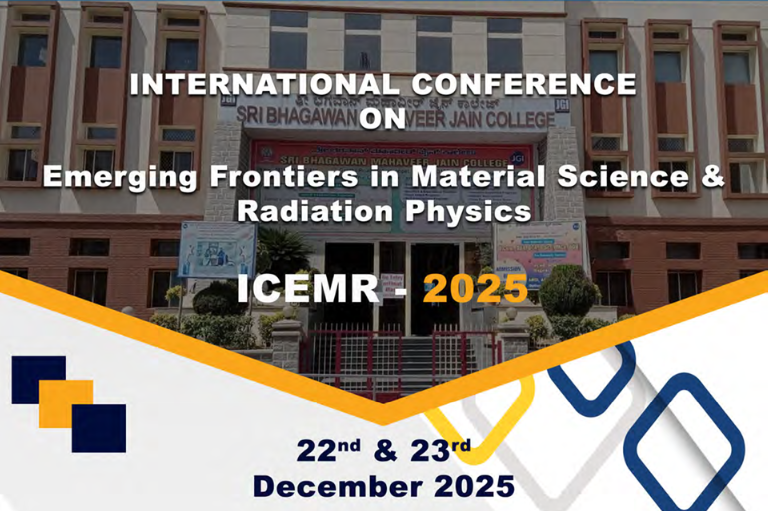
EPJ Web of Conferences will retract the entire volume of conference proceedings for ICEMR 2025.

On Monday, we published a story about a physicist in India who had three papers on superheavy elements retracted after others in his field began flagging his work. Hours later, a publisher decided to retract an entire volume of conference proceedings after one of the critics pointed out the researcher, H.C. Manjunatha, was responsible for the majority of its contents. 

Manjunatha is listed as coordinator of the International Conference on Emerging Frontiers in Material Science and Radiation Physics, which took place in December. Manjunatha was one of four editors for the conference’s proceedings published in EPJ Web of Conferences on March 18. Of the 55 articles in the volume, Manjunatha is an author on 32. 

David Boilley, a physicist at the University of Caen Normandy and researcher at GANIL, emailed EDP Sciences, which publishes EPJ Web of Conferences, on March 22 noting Manjunatha’s position as editor and the large number of papers he authored in the volume. Boilley, whom we interviewed for our story, mentioned the forthcoming article to the journal and also included a copy of his recent preprint calling out Manjunatha’s papers.

Continue reading Publisher to retract entire conference proceedings, ban editor who wrote most of them

Physicists flag over 50 papers on superheavy elements, leading to 3 retractions

A physicist in India has accumulated three retractions and 13 expressions of concern for papers on superheavy elements after three researchers in the field began to flag issues with his work. 

H.C. Manjunatha, the common author on the articles, is with the physics department at the Government First Grade College in Devanahall, according to his most recent papers, including eight published this year. 

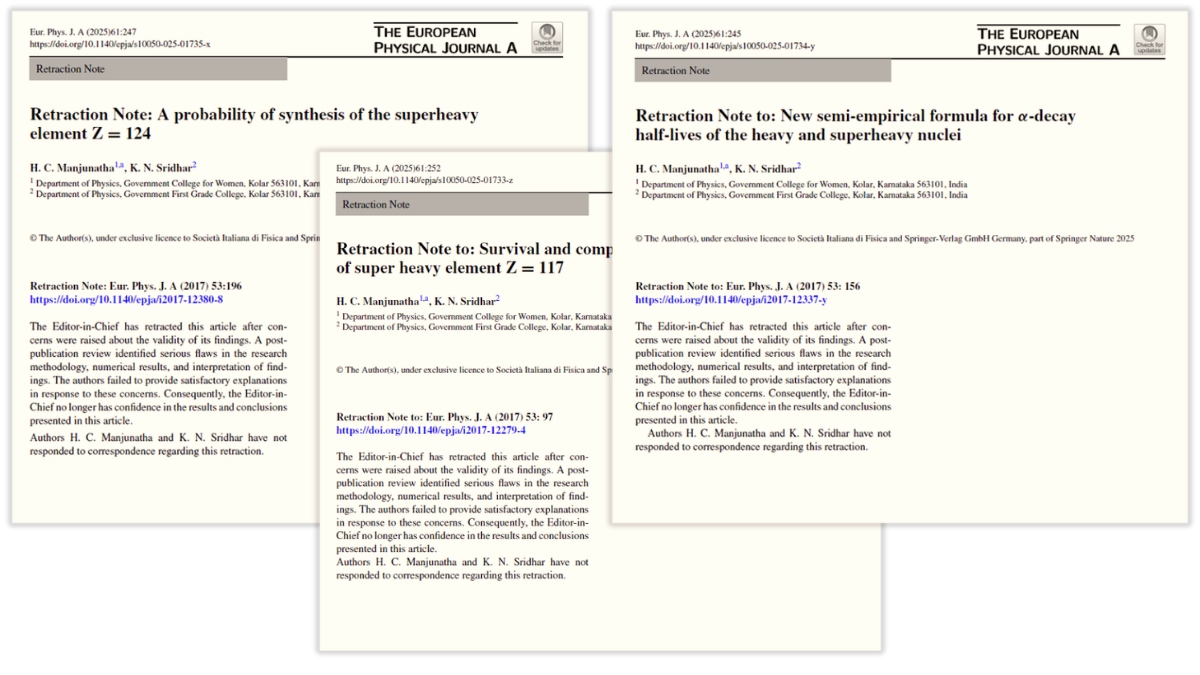
The three retracted papers originally appeared in Springer Nature’s The European Physical Journal A in 2017. According to the retraction notices, a post-publication review found “serious flaws in the research methodology, numerical results, and interpretation of findings.” All pertain to the discovery and synthesis of superheavy elements, which are unstable elements with large numbers of protons. 

Continue reading Physicists flag over 50 papers on superheavy elements, leading to 3 retractions

One of Kazakhstan’s top nuclear physicists also leads his nation in retractions

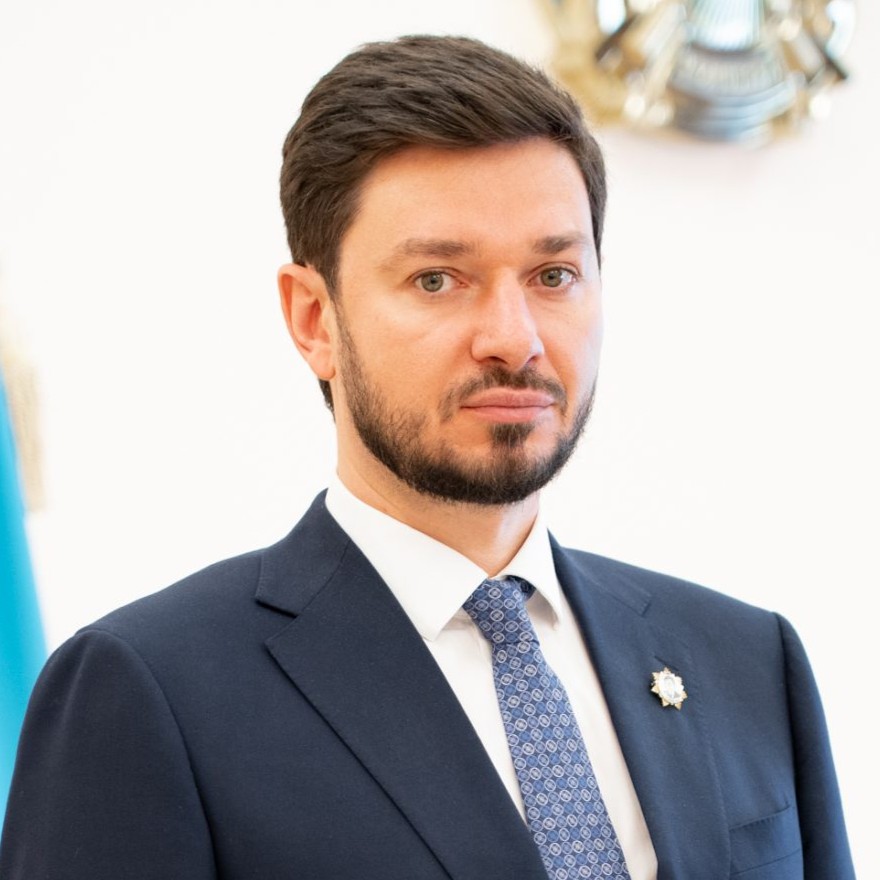
Maxim Zdorovets
Source

The head of a nuclear physics institute in Kazakhstan now has 21 retractions to his name — most of them logged in the past year — following dozens of his papers being flagged on PubPeer for data reuse and images showing suspiciously similar patterns of background noise, suggesting manipulation.

Maxim Zdorovets, director of the Institute of Nuclear Physics in Astana, has written or coauthored 480 papers indexed on Scopus, and one analysis puts him as the third most cited researcher in Kazakhstan. His prolific publication record has been linked to Russian paper mills, though those claims are unverified. Zdorovets has defended his work in a series of online posts, arguing the imaging similarities come from technical issues and that his own analyses prove image manipulation did not occur. He did not respond to Retraction Watch’s request for comment. 

The latest retraction for Zdorovets came last month when Crystallography Reports retracted a study containing electron microscope images “highly similar” to those published a year earlier in a now-retracted paper in the Russian Journal of Electrochemistry by a similar group of authors. Both papers also included images that closely resemble ones Zdorovets and his colleagues presented at a nanomaterials conference in Ukraine in 2017. In each instance, the images were meant to be showing different materials. 

Continue reading One of Kazakhstan’s top nuclear physicists also leads his nation in retractions

Superconductor researcher loses fifth paper

Ranga Dias

Ranga Dias, the physics researcher whose work on room-temperature superconductors has been retracted after coauthors raised concerns about the data, has lost another paper for the same reason. 

This retraction brings Dias’ total to five, by our count

The University of Rochester in New York, where Dias is an assistant professor, is investigating his work, Science has reported. Washington State University, where Dias obtained his PhD, is also investigating allegations of plagiarism in his thesis. 

Dias has not responded to our request for comment about his latest retraction, of a 2021 paper in Physical Review Letters titled “Synthesis of Yttrium Superhydride Superconductor with a Transition Temperature up to 262 K by Catalytic Hydrogenation at High Pressures.” The article has been cited 178 times, according to information presented on its abstract page. 

In December, the journal published an expression of concern for the paper, stating it was investigating concerns “regarding the origins and integrity of the transport data” in several of the paper’s figures “with the cooperation of the authors.” 

On June 13, the journal retracted the paper. The notice states: 

Continue reading Superconductor researcher loses fifth paper

14 retractions for researchers who falsely claimed US physicist as co-author

Groups of researchers from around the world have racked up a total of 14 retractions for faked authorship. And one author seems to have been up to those and other shenanigans for a decade.

All of the 14 papers include David Ross, a physicist at the University of Texas at Austin. There was just one problem: Ross retired in 2003.

We first reported on two of the retractions in March 2021. At the time, we noted that two papers in journals published by Emerald also included Ross’ name somewhat improbably. Emerald apparently retracted those two articles in June of this year, along with four others. (Emerald does not date the retraction notices, nor does it give the notices their own DOIs. Both steps are considered best practice.)

All of the notices include this passage:

Continue reading 14 retractions for researchers who falsely claimed US physicist as co-author

“Confrontation is an important element of physics progress:” Paper on black holes retracted

Amrit Srečko Šorli

A Springer Nature journal has retracted a 2019 article by a Slovenian physicist who claims that both Creationism and Big Bang theory are wrong, and that black holes are the engines driving the universe.

The paper, in Scientific Reports, was titled “Mass-energy equivalence extension onto a superfluid quantum vacuum,” and was written by Amrit Srečko Šorli. It has yet to be cited, according to Clarivate Analytics’ Web of Science, and four posts by Šorli’s institute that refer to it have been removed by Medium because the institute’s “account is under investigation or was found in violation of the Medium Rules.”

In 2010, Šorli founded the Bijective Physics Institute, whose proponents — we’re not sure how many there are beyond him and a few others named on the site — believe: 

Continue reading “Confrontation is an important element of physics progress:” Paper on black holes retracted

30 years later, physics journal retracts paper that blamed feminism for many of society’s ills

Gordon Freeman

For those of you who think that critiques of feminism have no place in journals about physics, the Canadian Journal of Physics agrees. But it took them 30 years to get there. 

The journal has retracted a 1990 article by a notorious male chauvinist who claimed, among other things, that feminism was responsible for an increase in cheating in school, psychological damage in young children and an overall decay in society. 

The case has echoes of the controversy over Thomas Hudlicky, another Canadian chemist who recently lost a 30-year-old paper for sexism and anti-diversity views. 

This time, the author was Gordon Freeman, a now-emeritus professor of chemistry at the University of Alberta, in Canada. Its title is one of those science-y-sounding strings of words that say both very little and, on reflection, quite a lot: “Kinetics of nonhomogeneous processes in human society: Unethical behaviour and societal chaos.” 

Continue reading 30 years later, physics journal retracts paper that blamed feminism for many of society’s ills

Exclusive: University of Arizona says former researcher committed misconduct by plagiarizing figure

Palash Gangopadhyay

A former researcher in the University of Arizona’s optics school engaged in “a serious case of research misconduct,” Retraction Watch has learned.

Palash Gangopadhyay, who until 2019 was a research scientist at Arizona, used a figure from a 2003 paper by other authors when he co-authored a 2018 paper in Optics Letters titled “High sensitivity magnetometer using nanocomposite polymers with large magneto-optic response,” Wyant College of Optical Sciences dean Thomas Koch wrote to colleagues in an email obtained by Retraction Watch. The 2003 paper appeared in an obstetrics journal.

Figure 4b of 2018 paper
From Figure 3 of 2003 paper

The 2018 paper has been cited nine times, according to Clarivate Analytics’ Web of Science.

Koch wrote:

Continue reading Exclusive: University of Arizona says former researcher committed misconduct by plagiarizing figure

Publisher retracts nearly two dozen articles, blocks nearly three dozen more, from alias-employing author who plagiarized

IOP Publishing has retracted nearly two dozen conference proceedings which had been cribbed from other articles, translated into English and festooned with citations to the authors’ own work. 

According to the publisher, 12 of the 29 authors on the papers come from the same institution, Universidad de la Costa, in Barranquilla, Colombia. IOP says the institution is investigating. 

The first author on most of the papers is Jesus Silva, who appears to be affiliated with the Universidad Peruana de Ciencias Aplicadas, in Lima, Peru — and has now joined our leaderboard with 23 retractions. For some, the first author is Amelec Viloria, of Universidad de la Costa. 

Except, according to IOP Publishing, Silva and Viloria are the same person, using an alias on some of the articles. 

Continue reading Publisher retracts nearly two dozen articles, blocks nearly three dozen more, from alias-employing author who plagiarized

A physics paper claimed the Koran had predicted the discovery of the Higgs Boson. Now it has an expression of concern.

Large Hadron Collider, via Flickr

A paper on how the Koran anticipated the discovery of the Higgs Boson — aka the “God particle” — has been hit with an expression of concern.

The article, “God particles in the perspective of The AlQuran Surah Yunus: 61 and modern science,” appeared in the Journal of Physics: Conference Series, which in 2017 published submissions to the 2016 International Conference on Science and Applied Science (Engineering and Educational Science), held in Indonesia. It was authored by Sri Jumini, of the Physics Department Program of Sains AlQuran University in Java.

Being neither particle physicists nor scholars of world religions, we’re not well-equipped to summarize Jumini’s theory, so here’s how he describes the work in the abstract

Continue reading A physics paper claimed the Koran had predicted the discovery of the Higgs Boson. Now it has an expression of concern.