Heard about the study claiming men who carry guitar cases are more attractive? It’s been retracted.

via PickPik

A controversial psychologist has lost a bizarre paper which claimed that men who carry guitar cases do better with the ladies.

The article, which had appeared in the journal The Psychology of Music in 2014, was one of many papers by Nicholas Guéguen that have raised eyebrows among his peers and some data sleuths — notably James Heathers and Nick Brown — who believe the results don’t withstand scrutiny

Guéguen, of the Université Bretagne-Sud, in France, was the subject of a misconduct investigation that in 2019 cleared him of wrongdoing. That finding came shortly after, as we reported nearly a year ago to the day, he lost a 2014 paper in the Archives of Sexual Behavior on how high heels really do make women sexier:  

Continue reading Heard about the study claiming men who carry guitar cases are more attractive? It’s been retracted.

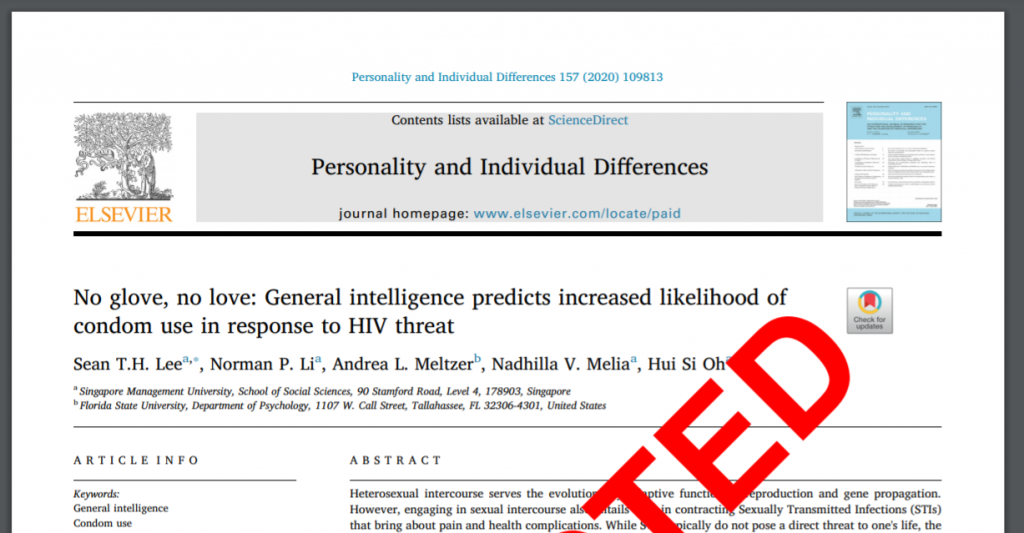
Journal retracts paper claiming smarter people are more likely to use a condom to avoid HIV

A psychology journal has retracted a 2020 paper purporting to find that smarter people are more likely to use a condom during sex to avoid HIV. 

The new study, by researchers from Singapore and the United States led by Sean Lee of the Singapore Management University School of Social Sciences, appeared in Personality and Individual Differences.

The paper claimed to find that: 

Continue reading Journal retracts paper claiming smarter people are more likely to use a condom to avoid HIV

Major indexing service rejects appeals by two suppressed journals

Journals hoping that Clarivate Analytics — the company behind the Impact Factor — would reverse their decision to suppress their titles from the closely watched metric are batting .500.

In July, as we reported, Clarivate suppressed 33 journals from its Journal Citation Reports (JCR), which means they will not have a 2019 Impact Factor, because of what Clarivate said was excessive self-citation. As affected journals have noted, suppression from the list can have a major impact on journals and researchers, many of whom are judged based on where they publish, using Impact Factor as a key metric.

Two journals —  Zootaxa and the International Journal of Systematic and Evolutionary Microbiologysuccessfully appealed the decision, and have been reinstated in the 2019 JCR. But appeals by two others — Body Image and Forensic Science International: Genetics (FSIGEN) — have been denied, Retraction Watch has learned.

Between August 18 and August 26, nearly 500 forensic scientists from 49 countries signed a petition objecting to Clarivate’s move, according to Ulises Toscanini, director of the Laboratory PRICAI-Fundación Favaloro and a professor at Favaloro University in Buenos Aires. Toscanini,  president of the executive committee of the Spanish and Portuguese Speaking Working Group of the International Society for Forensic Genetics, said FSIGEN “is a ‘niche’ journal,” and is “broadly recognized as the top journal of the area.” He continued:

Continue reading Major indexing service rejects appeals by two suppressed journals

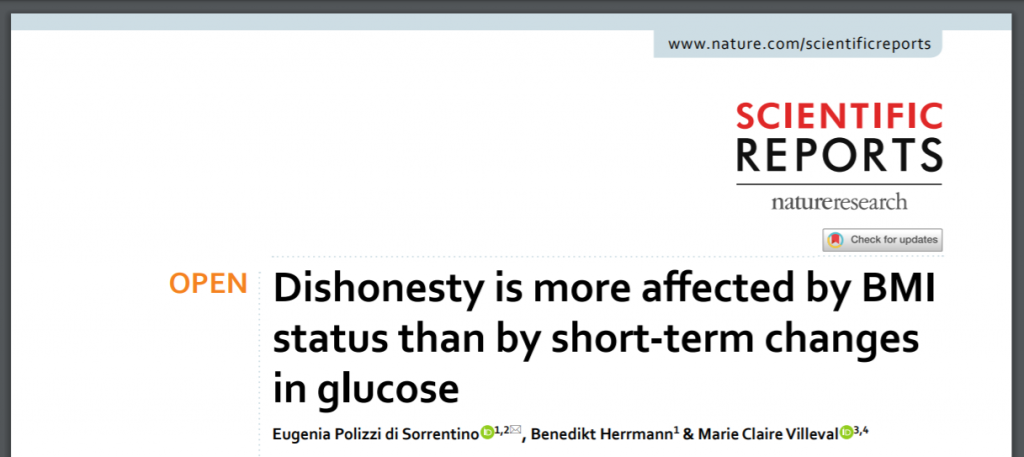
Springer Nature ‘continuing to investigate the concerns raised’ about paper linking obesity and lying

What’s the link between obesity and dishonesty? 

If that question seems preposterous on its face, you’re probably among the critics of a 2020 paper in Scientific Reports which claimed to find that obese people were more deceptive than thinner folk. 

The researchers, led by Eugenia Polizzi di Sorrentino, of the Institute of Cognitive Science and Technologies at the National Research Center in Rome: 

explore[d] the link between energy, obesity and dishonesty by comparing the behaviour of obese and lean subjects when hungry or sated while playing an anonymous die-under-cup task.

They found that: 

Continue reading Springer Nature ‘continuing to investigate the concerns raised’ about paper linking obesity and lying

Journal calls 2012 paper “deeply offensive to particular minorities”

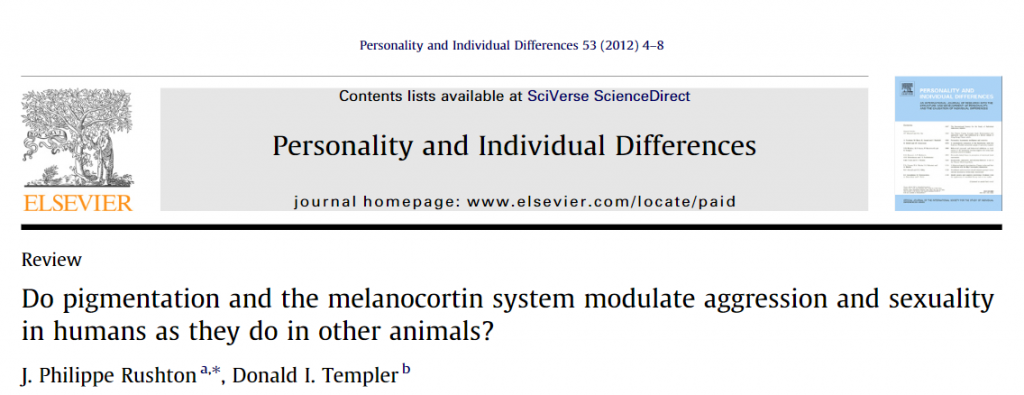
An Elsevier journal plans to issue a retraction notice this week about a widely criticized 2012 paper claiming to find links between skin color, aggression, and sexuality.

Earlier this month, we reported that the journal, Personality and Individual Differences (PAID), would retract the study “Do pigmentation and the melanocortin system modulate aggression and sexuality in humans as they do in other animals?” by the late authors Philippe Rushton and Donald Templer, published in 2012.

The paper was the subject of a highly critical Medium post in November 2019, and of a petition with more than 1,000 signatures sent to Elsevier earlier this month.

The four-page retraction notice, provided to Retraction Watch by Elsevier, begins with a description of the history, policies and procedures at the journal, then launches into a litany of issues with the paper:

Continue reading Journal calls 2012 paper “deeply offensive to particular minorities”

‘A long and lonely process:’ Whistleblowers in a misconduct case speak out

Last week, we reported on a case at the University of Leiden in which the institution found that a former psychology researcher there had committed research misconduct. In the anonymized report — which we were able to confirm regarded Lorenza Colzato, who is listed as a faculty member at Ruhr University in Bochum and at TU Dresden — the university found a lack of ethics approval for some studies and fabricating results in some grant applications. We asked the three whistleblowers in the case — Bryant Jongkees, Roberta Sellaro, and Laura Steenbergen — to reflect on their experiences. (We should note that they did not confirm it was Colzato named in the report.)

Retraction Watch (RW): What prompted you to come forward?

Continue reading ‘A long and lonely process:’ Whistleblowers in a misconduct case speak out

61 retractions for controversial psychologist Hans Eysenck? That’s a significant underestimate, says his biographer

Rod Buchanan

In a recent Retraction Watch guest post on the “Eysenck affair,” James Heathers notes the extraordinary possibility that as many as 61 Hans Eysenck publications might be retracted. I believe this figure is a significant underestimate.

This reckoning has been a long time coming. The issues surrounding Eysenck’s 1980s/1990s collaboration with Ronald Grossarth-Maticek and their unbelievable results linking personality to health outcomes have been known for decades. Many eminent researchers, including Tony Pelosi and Louis Appleby, had lined up to criticise this research even while it was still ongoing. 

In 2010, I published a lengthy biography of Eysenck, Playing with fire, that detailed the context for this collaboration. In the final full chapter, I explained what prompted Eysenck to team up with this outsider figure and laid bare the extent of Eysenck’s deep and longstanding relationship with the tobacco industry. It was backed by extensive archival research and interviews with key players (including two days with Grossarth-Maticek). I had hoped it would provoke a reappraisal and remedial action. But the impact was minimal.

Continue reading 61 retractions for controversial psychologist Hans Eysenck? That’s a significant underestimate, says his biographer

Former Northwestern psychology prof has paper subjected to an expression of concern

A paper by Ping Dong, a former researcher at Northwestern who left her post less than a year after having a paper retracted from Psychological Science, has been subjected to an expression of concern.

The 2017 paper, in the Journal of Consumer Research, claimed to show that “Witnessing Moral Violations Increases Conformity in Consumption.” It has been cited just twice, according to Clarivate Analytics’ Web of Knowledge.

The expression of concern reads:

Continue reading Former Northwestern psychology prof has paper subjected to an expression of concern

“I decline to respond” but “take this history to undermine”

via Flickr

There are various ways to respond to criticism of one’s work. There is the “well, that’s not pleasant news, but thank you, I’ll correct that straightaway” approach. There’s the “I guess we’ll correct this but hope no one notices” approach. There’s the “I’m suing you” approach — often followed by “never mind.”

And then there’s the approach taken by Barbara Fredrickson of the University of North Carolina at Chapel Hill.

Fredrickson is perhaps best known for her work on the “positivity ratio,” around which she has built a significant brand. The idea, in a nutshell, is that you’ll be more successful if you have three positive emotions for every negative one. It is a compelling and bite-sized idea, and has been turned into a book.

Continue reading “I decline to respond” but “take this history to undermine”

“Do we have the will to do anything about it?” James Heathers reflects on the Eysenck case

James Heathers

We have a tension about resolving inaccuracies in scientific documents when they’re past a certain age.

Specifically, what should we do with old papers that are shown to be not just wrong, which is a fate that will befall most of them, but seriously misleading, fatally flawed, or overwhelmingly likely to be fabricated, i.e. when they reach the (very high) threshold we set for retraction?

To my way of thinking, there are three components of this:

Continue reading “Do we have the will to do anything about it?” James Heathers reflects on the Eysenck case