Chemist nears three dozen retractions for image duplication, self-citation and more

A screenshot of Louis’ LinkedIn profile before we reached out to him.

Racking up 35 retractions in just 24 months, chemist Hitler Louis has scored a place on our leaderboard

The papers at issue, most of them published in Elsevier and Royal Society of Chemistry journals, exhibit a variety of problems, according to the retraction notices: identical plots supposedly representing different chemical systems, self-citations multiplying between manuscript submission and publication, compromised peer review and fundamental errors in chemical analyses. 

Louis – who also goes by Louis Hitler Muzong – did not respond to Retraction Watch’s requests for comment. Until recently, his LinkedIn page named him as a Ph.D. student in computational chemistry at the University of Leeds in the United Kingdom, with an expected completion date of October 2027. But retraction notices for two papers say Louis requested his Leeds affiliation be removed. One states “the research described in the article is not associated with that institution,” and the other that the affiliation “was given incorrectly.” The University of Leeds did not respond to a request to verify whether he was a student there.

Continue reading Chemist nears three dozen retractions for image duplication, self-citation and more
Journal retracts GLP-1 study after researcher questions central finding 

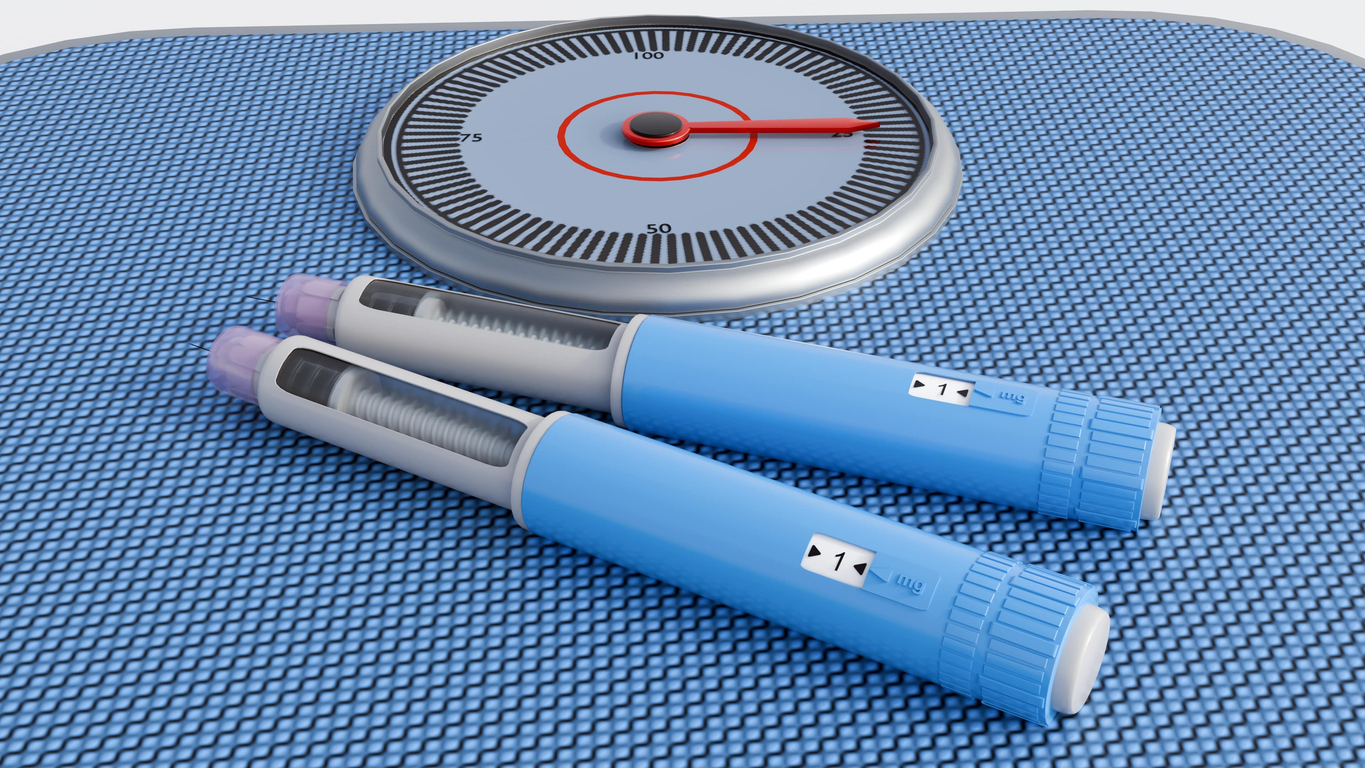
Image: iStock

After reading a recent study about GLP-1 treatment in the International Journal of Obesity, David B. Allison immediately became skeptical about the paper’s analysis. The article, published in May 2024, found people who combined a GLP-1 therapy with another weight loss drug lost more weight than patients on a GLP-1 therapy alone.  

“I could not really comprehend exactly what analysis they did,” Allison, chief of nutrition and director of the Children’s Nutrition Research Center at Baylor College of Medicine in Houston, told Retraction Watch. “And more so, I could not comprehend how the analysis they did would give results that would be informative of the conclusions they drew. So I was scratching my head a little bit.”

The IJO paper was a retrospective cohort study of adults with obesity who had been prescribed a GLP-1 therapy, specifically Saxenda and Ozempic. The study compared patients who received a GLP-1 alone with those receiving the GLP-1 therapy and then had bupropion/naltrexone added to their regimen. The Food and Drug Administration approved bupropion/naltrexone in 2014 for chronic weight management in obese adults. 

Continue reading Journal retracts GLP-1 study after researcher questions central finding 

As journal’s retraction count nears 170, it enhances vetting 

A journal is implementing tighter controls for guest editors and peer reviewers after an investigation led to the retraction of more than 160 articles. 

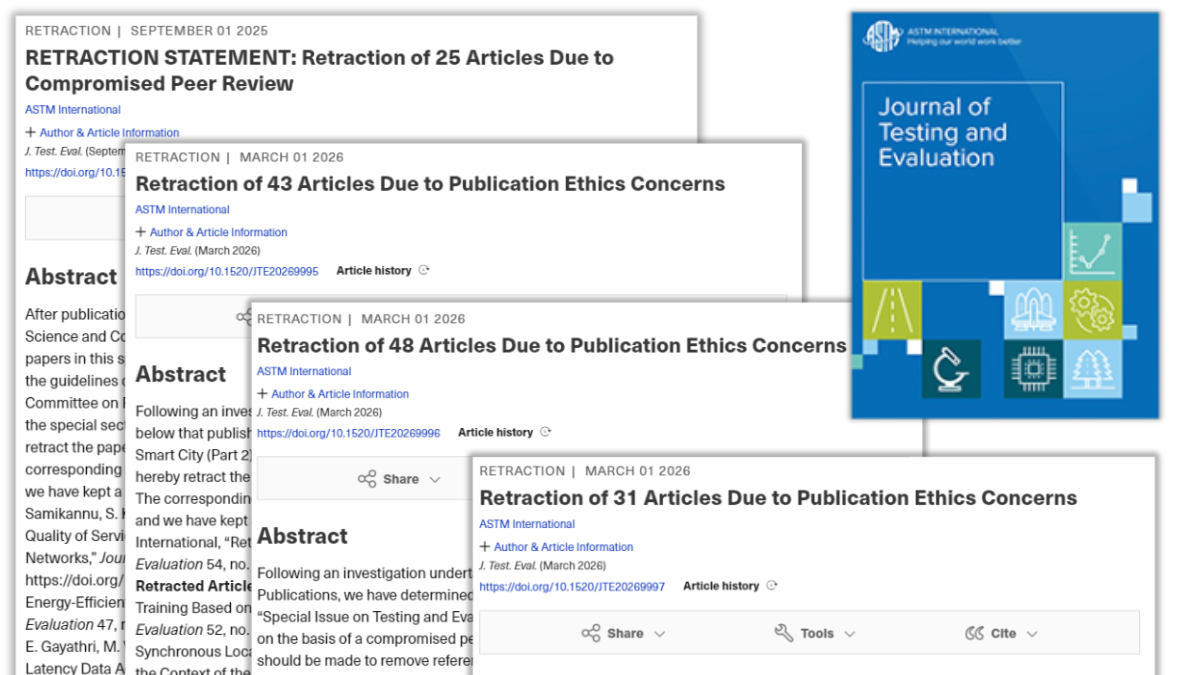
As we reported last month, the American Society For Testing And Materials (ASTM) International started an investigation into its Journal of Testing and Evaluation after an ASTM vendor noticed some “irregular patterns in the peer review” of a special issue. The investigation revealed the peer review process in four special sections or issues had been compromised, resulting in the retraction of 147 articles.

The journal has since pulled 19 more papers, this time from a special section on human-centered artificial intelligence published in 2021.

Continue reading As journal’s retraction count nears 170, it enhances vetting 

Journal silently removes paper for plagiarism, author claims identity theft 

If a plagiarized paper by an author who claims he didn’t write it disappears from a journal’s website with no notice, did it ever exist in the first place? It’s not just a philosophical question for the researcher whose published paper turned up in another journal under someone else’s name.

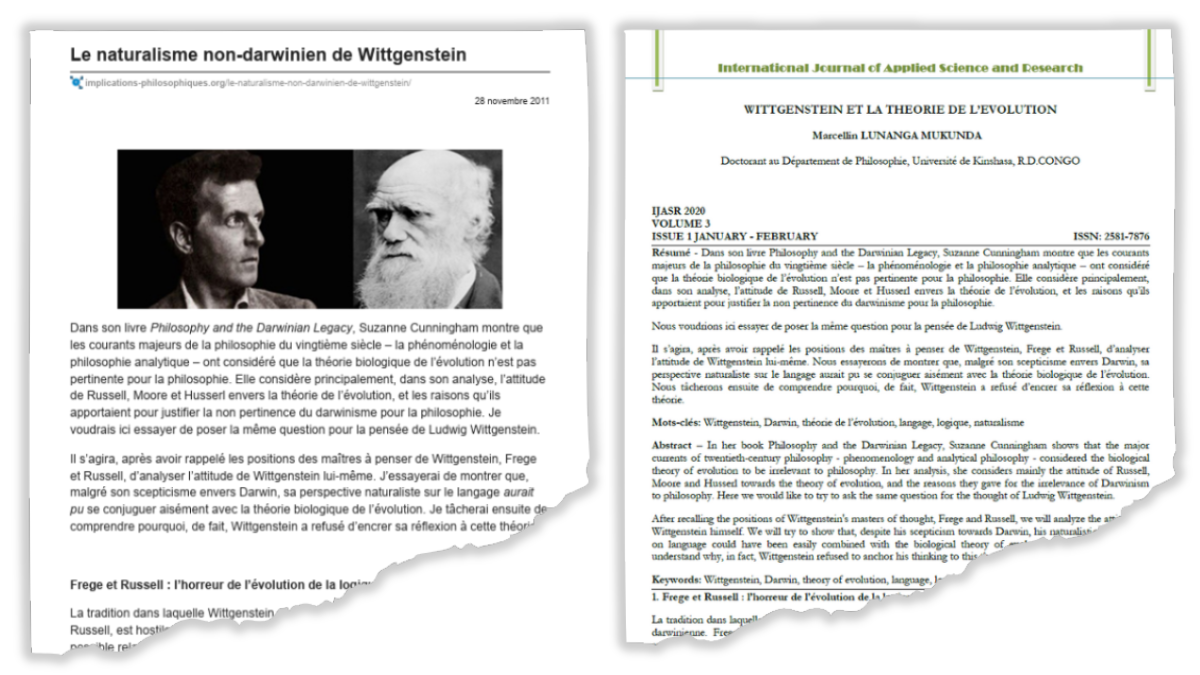
As a master’s student in 2011, researcher Silvia De Cesare published a paper in Implications Philosophiques analyzing a 20th century philosopher’s skepticism of the theory of evolution despite its compatibility with his philosophical views. Now with two doctorates — in ecology and in philosophy — De Cesare is a postdoctoral scholar at Utrecht University in the Netherlands and studies the relationships between evolutionary theory and the idea of progress. 

In June last year, De Cesare learned that someone had published a version of her article in the International Journal of Applied Science and Research (IJASR) in 2020. The paper, a near-verbatim copy of De Cesare’s article apart from the omission of a few footnotes, listed Marcellin Lunanga Mukunda, of the University of Kinshasa in the Democratic Republic of the Congo, as its sole author. But Mukunda denies publishing the paper, telling us he had been hacked, or perhaps robbed, as an explanation for how his name appeared on the paper. 

Continue reading Journal silently removes paper for plagiarism, author claims identity theft 

Journal retracts nearly 150 articles for compromised peer review   

A journal published by an organization that develops technical standards is retracting 147 papers for problematic peer review — and the publisher expects more to follow. 

The American Society For Testing And Materials  (ASTM) International started an investigation into its Journal of Testing and Evaluation after an ASTM vendor noticed some “irregular patterns in the peer review” in a special issue, spokesperson Gavin O’Reilly told Retraction Watch. When the publisher confirmed those patterns, ASTM decided to investigate several related issues, he said.  

The investigation revealed the peer review process in the special sections or issues had been compromised, each of the retraction notices says. 

Continue reading Journal retracts nearly 150 articles for compromised peer review   

Engineering journal plucks poultry paper for plagiarism

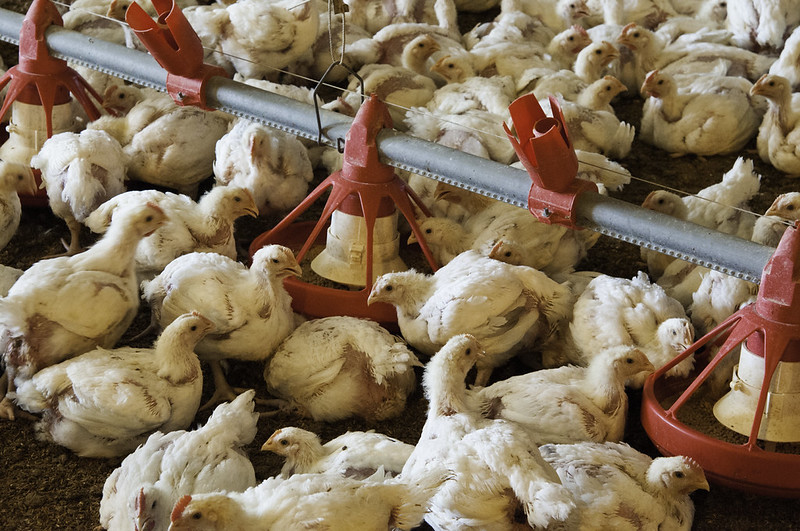
Bob Nichols/USDAgov/Flickr

While plagiarism can sometimes be difficult to prove, stolen figures and identical metadata were the death knell for a recent article involving chicken mortality.

In September, the authors of a 2022 paper in the American Society of Agricultural and Biological Engineers’ journal Applied Engineering in Agriculture discovered a version of their article published by different authors in the International Journal of Engineering Research & Technology. Both papers, which had identical titles, describe the development of a robot designed to assist with detecting and removing dead chickens from farms. 

Although some of the text in the 2025 IJERT paper was altered, the images are the same as those from the ASABE paper, which has been cited 13 times, according to Clarivate’s Web of Science. The IJERT paper also replaced the word “broiler,” a chicken raised for meat production, with “grill,” including paraphrasing “broiler mortality” as “grill mortality” and “U.S. broiler industry” as “American grill business.” Such tortured phrases, which occur when common phrases are transformed into nonsensical ones, can indicate plagiarism

Continue reading Engineering journal plucks poultry paper for plagiarism

‘Kicking the can down the road’: Science flags insect meta-analysis based on allegedly buggy database

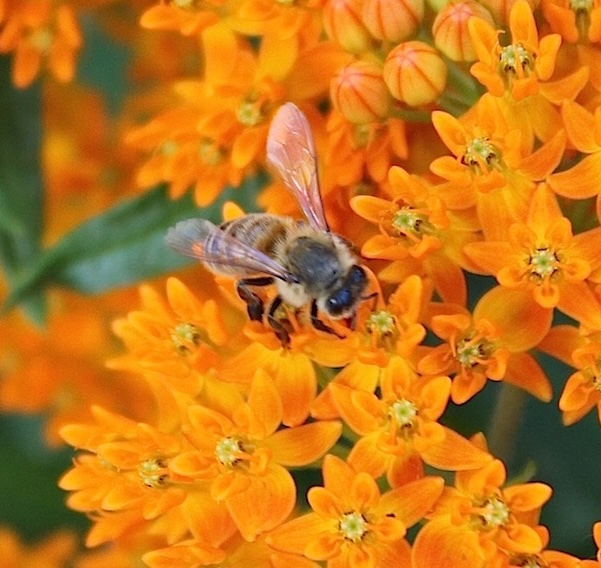
An insect meta-analysis published in Science in 2020 has been hit with an EOC. (Photo credit: Aron Sousa)

Science has issued a permanent expression of concern for a paper reporting a meta-analysis of a database including studies critics have said were “experimentally manipulated.” 

The notice, published today, applies to a 2020 meta-analysis measuring population patterns of freshwater and terrestrial insects and predicting what might drive changes in population numbers. According to the notice, the move comes after critics raised concerns about a database, called InsectChange, on which the meta-analysis was based. The database itself was published in 2021 in Ecology, a journal of the Ecological Society of America. 

The Science article has been cited 820 times, according to Clarivate’s Web of Science. The Ecology paper has been cited 23 times. 

Continue reading ‘Kicking the can down the road’: Science flags insect meta-analysis based on allegedly buggy database

Lawsuit fails to block retraction of paper claiming to link heart-related deaths to COVID-19 vaccines

Greg J. Marchand in a photo from his research institute’s website.

A Taylor & Francis journal has retracted a widely-read paper linking cardiac-related mortality to COVID-19 vaccines after an unsuccessful legal attempt by the lead author to block the withdrawal. That author says he is considering further legal action against the publisher.

The article, “Risk of all-cause and cardiac-related mortality after vaccination against COVID-19: A meta-analysis of self-controlled case series studies,” drew swift criticism when it was published in Human Vaccines & Immunotherapeutics in August 2023. At the time, critics and sleuths were quick to challenge the data and methods used in the paper, which now has more than 143,000 views on the Taylor & Francis website and has been cited 15 times, including by two letters to the editor of the journal and a response from the authors, according to Clarivate’s Web of Science. 

The retraction notice, posted online January 16, states the retraction resulted from concerns that arose about the methodology of the study and the integrity and availability of the data. The authors provided a full response to the queries; however, the publisher determined the validity of the findings remained in question, the notice states. It continues:

Continue reading Lawsuit fails to block retraction of paper claiming to link heart-related deaths to COVID-19 vaccines

Up in smoke: Publisher pulls vaping paper nearly two years after complaint

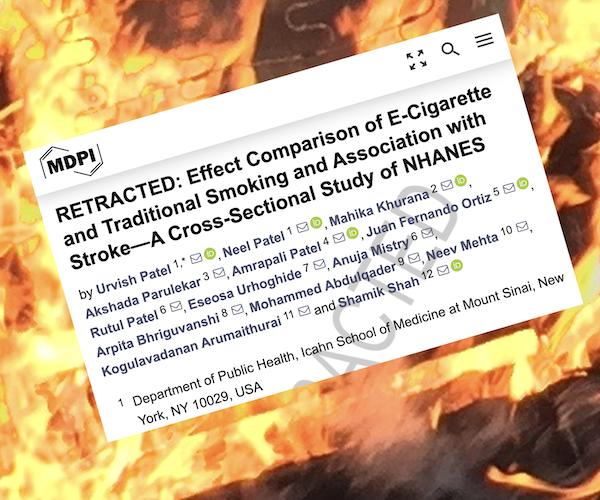
MDPI has retracted a study about vaping that one expert said seemed “like a joke” almost two years after the publisher received a complaint about the flawed work.

The paper, published in Neurology International in 2022, reported e-cigarette users had a higher risk of early stroke than traditional tobacco users. It has been cited 22 times, according to Clarivate’s Web of Science, and was covered in the media, featured in a public campaign against vaping and included in a contestedmeta-analysis.

But the study contained critical errors, as we reported in 2024 in a story for Science that investigated paper mill-like businesses dangling quick-and-dirty publications for international medical graduates looking for residency positions in the United States.

Continue reading Up in smoke: Publisher pulls vaping paper nearly two years after complaint

Business management journal holds researcher’s paper hostage 

A “scholarly business and management publication” is holding a researcher’s paper for ransom, requesting the author pay to withdraw the article. 

The researcher submitted a manuscript in August to the Academy of Strategic Management Journal in August, thinking he had sent it to the Academy of Management Journal. He asked to remain anonymous for fear of seeming careless “rather than recognizing the real predatory nature” of the journal.

The journal’s homepage notes it is indexed in Scopus, but it was delisted in 2021, nor is it indexed in Clarivate’s Web of Science. Its most recent volume contains five single-author articles from nonexistent universities. None of the articles has a DOI or provides an email for the author. 

Continue reading Business management journal holds researcher’s paper hostage