Sage issues dozens of retractions from two journals it acquired

In recent weeks Sage has retracted batches of articles published in two journals it acquired from IOS Press in 2023. In each case, the retractions were for manipulation of, and concerns about, peer review.

The first tranche of papers was retracted July 15 from Journal of Intelligent and Fuzzy Systems (JIFS) and constituted 43 papers, some of which had been presented at a conference in Türkiye. According to the retraction notice, after an internal investigation, Sage “became aware that the submissions contain indicators of third-party involvement and attempts to manipulate the peer-review process” in the special issue.

The second batch of retractions applied to 34 papers in the International Journal of Knowledge-Based and Intelligent Engineering Systems from 2017 to 2025. The August 5 notice cites suspicion of third party involvement, peer review issues, citation manipulation and non-standard language, including tortured phrases, as reasons for retracting the articles. Tortured phrases can indicate plagiarism.

Continue reading Sage issues dozens of retractions from two journals it acquired

Biology journal pulls 100+ articles and counting from special issues for peer review manipulation

Elsevier’s International Journal of Biological Macromolecules has issued more than 100 retractions and counting for manipulated peer review in guest-edited special issues. The publisher has said one more retraction is coming. 

Since June the publisher has retracted 120 papers. According to the retraction notices, the journal identified “[s]ystematic, coordinated, and widespread manipulation of the peer-review process.”

A spokesperson for Elsevier told Retraction Watch the publisher “became aware of possible systematic manipulation and other issues such as plagiarism, image duplication, and authorship issues in a number of articles published in Special Issues” in 2025, which led them to conduct a wider investigation into more recent special issues. 

Continue reading Biology journal pulls 100+ articles and counting from special issues for peer review manipulation

As journal’s retraction count nears 170, it enhances vetting 

A journal is implementing tighter controls for guest editors and peer reviewers after an investigation led to the retraction of more than 160 articles. 

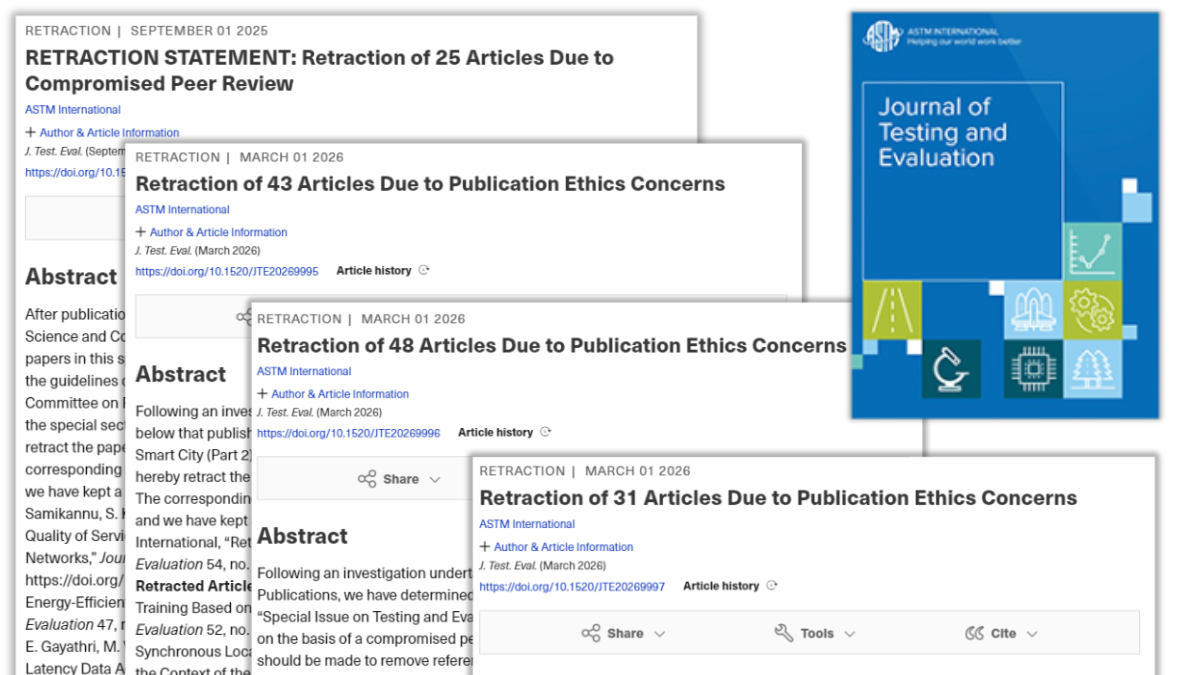
As we reported last month, the American Society For Testing And Materials (ASTM) International started an investigation into its Journal of Testing and Evaluation after an ASTM vendor noticed some “irregular patterns in the peer review” of a special issue. The investigation revealed the peer review process in four special sections or issues had been compromised, resulting in the retraction of 147 articles.

The journal has since pulled 19 more papers, this time from a special section on human-centered artificial intelligence published in 2021.

Continue reading As journal’s retraction count nears 170, it enhances vetting 

Journal retracts nearly 150 articles for compromised peer review   

A journal published by an organization that develops technical standards is retracting 147 papers for problematic peer review — and the publisher expects more to follow. 

The American Society For Testing And Materials  (ASTM) International started an investigation into its Journal of Testing and Evaluation after an ASTM vendor noticed some “irregular patterns in the peer review” in a special issue, spokesperson Gavin O’Reilly told Retraction Watch. When the publisher confirmed those patterns, ASTM decided to investigate several related issues, he said.  

The investigation revealed the peer review process in the special sections or issues had been compromised, each of the retraction notices says. 

Continue reading Journal retracts nearly 150 articles for compromised peer review   

Sage journal retracts more than 40 papers over concerns with peer review, author contributions

Sage has retracted 45 papers from one of its journals for questionable authorship and peer review.  

The publisher began an investigation into Clinical Hemorheology and Microcirculation last year to address citation concerns, a Sage spokesperson told Retraction Watch. The journal was one of 20 titles that lost their impact factors in Clarivate’s 2025 Journal Citation Reports for excessive self-citation and citation stacking.

Sage retracted the articles due to “concerns around the peer review process underlying these articles and author contributions to these articles, as well as the integrity of the research process,” according to the retraction notice, published November 23. The publisher detected “one or more” issues in each of the papers, including patterns of citation manipulation, indicators of third-party involvement and problems with peer review.

Continue reading Sage journal retracts more than 40 papers over concerns with peer review, author contributions

New COPE retraction guidelines address paper mills, third parties, and more

Be-Art/iStock

New retraction guidelines from the Committee on Publication Ethics include more specific details about when to retract a paper, many of which address paper mill activity. For instance, journals should retract articles when “authorship of the publication cannot be verified or there are serious concerns about accountability for the research,” according to the updated guidance, released today. 

COPE also recommends retracting papers with “any form of misrepresentation,” including “deception; fraud (eg, a paper mill); identity theft or fictitious authorship; or undisclosed involvement of artificial intelligence (AI).” 

The organization has also released a new, separate guidance for expressions of concern. Both documents reiterate the as-soon-as-possible timeframe for notices and give more specific details on what information should be included in each type of notice.

Continue reading New COPE retraction guidelines address paper mills, third parties, and more

Sage journal retracts nearly 50 papers for signs of paper mill activity

Sage has retracted four dozen papers from one of its journals for suspected paper mill activity.

The publisher started an investigation into the European Journal of Inflammation “after we noticed signs of papermill activity in one of the articles,” Laura West, a corporate communications and public affairs manager at Sage, told Retraction Watch. 

The investigation found the papers “contain indicators of third-party involvement,” according to the retraction notice, published August 5. Sage and the editor of the journal decided to retract the articles due to “concerns around author contributions to these articles, as well as concerns around the integrity of the research process.” 

Continue reading Sage journal retracts nearly 50 papers for signs of paper mill activity

Frontiers to retract 122 articles, links thousands in other publishers’ journals to “unethical” network

The publisher Frontiers has begun retracting a batch of 122 articles across five journals after an investigation found a network of authors and editors engaged in “unethical actions” such as manipulating citations and reviewing papers without disclosing conflicts of interest. 

The publisher’s research integrity team has identified more than 4,000 articles linked to the network in journals owned by seven other companies, according to a company statement. The team said it is willing to share details and the methodology of their investigation with other publishers upon request. The company is a member of the STM Hub, a platform publishers use to share such information. 

Continue reading Frontiers to retract 122 articles, links thousands in other publishers’ journals to “unethical” network

A new journal record: Sage title retracts 678 more papers, tally over 1,500

The retraction of “a final batch” of 678 articles concludes Sage’s investigation into questionable peer review, citation manipulation, and other signs of paper mill activity at one of its journals, according to the publisher. 

Sage has been investigating the Journal of Intelligent and Fuzzy Systems (JIFS) since early 2024 for “indicators that raised concerns about the authenticity of the research and the peer review process underlying these articles,” a Sage spokesperson told us. We reported in August on Sage’s retraction of 467 articles from the journal. The publisher retracted another 416 papers in January. With this latest batch, “our investigation into JIFS is now concluded,” the spokesperson said.

Sage acquired JIFS in November 2023 when it bought IOS Press. The indexing company Clarivate raised concerns about the quality of the articles in the journal shortly after and put the journal’s indexing on hold. Its entry on the Clarivate website still shows the “on hold” flag.

Continue reading A new journal record: Sage title retracts 678 more papers, tally over 1,500

Wiley journal retracts over 200 more papers

The International Wound Journal has retracted 242 papers so far this year as part of an ongoing investigation into manipulated peer review.

We reported in December the journal, a Wiley title, had retracted 27 papers as part of an investigation. A Wiley spokesperson told us the 2025 retractions are part of the same ongoing investigation, and that the editors “anticipate additional retractions in the weeks to come.” 

All the retraction notices list manipulated peer review and share similar text, like the notice from this retraction of a 2023 paper: 

Continue reading Wiley journal retracts over 200 more papers