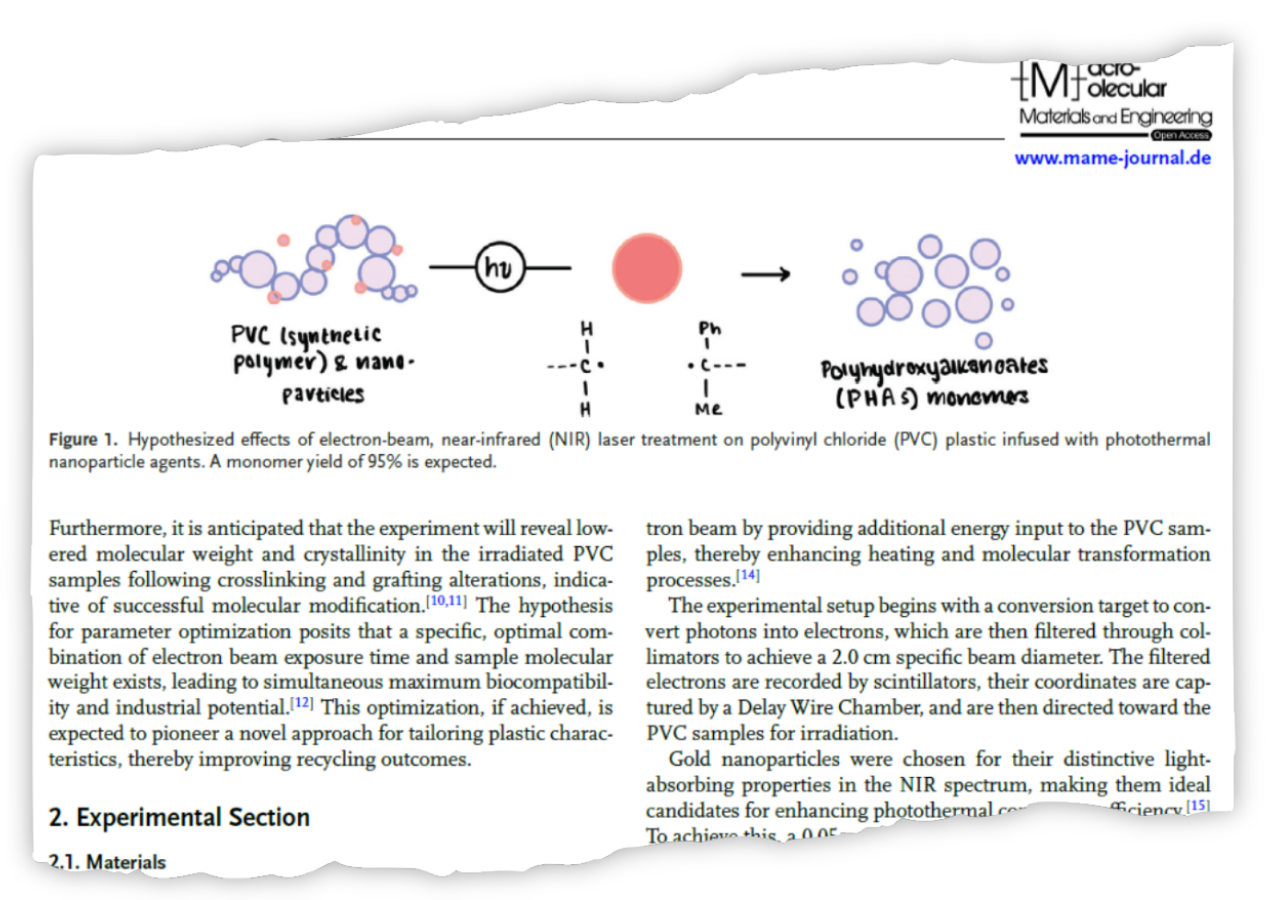
Earlier this week, Retraction Watch reported on a Princeton student’s decision to retract her own paper from an engineering journal due to “significant methodological errors.” The student, Rishika Porandla, now tells us she never conducted the experiments described in the study.
“The beam experiment described in the paper was a proposed experimental workflow with associated calculated results,” she wrote in an email. “Public confusion led me to recognize and regret that this is not clear in the retracted publication, and I have included detailed clarification in an updated retraction statement to Wiley.”
Porandla’s original article, published in 2024 in Macromolecular Materials and Engineering based on work she did while in high school, claimed to show it was possible to enhance the biodegradation of polyvinyl chloride, or PVC, by mixing it with gold nanoparticles and blasting it with an electron beam.
Continue reading Princeton student says she did not conduct the experiments described in her now-retracted paper


 Last month, a colleague of emergency medicine doctor
 A biologist is crying foul at a journal’s decision to correct (and not retract) a paper he claims plagiarized his work — and one of his colleagues has resigned from the journal’s editorial board as a result.
 The
The