Publisher retracting 68 articles suspected of being paper mill products

via Pixy

It appears to be Paper Mill Sweeps Week here at Retraction Watch. 

On Tuesday, we reported on an editor who believes one such operation was responsible for the withdrawals of at least two articles in her journal. 

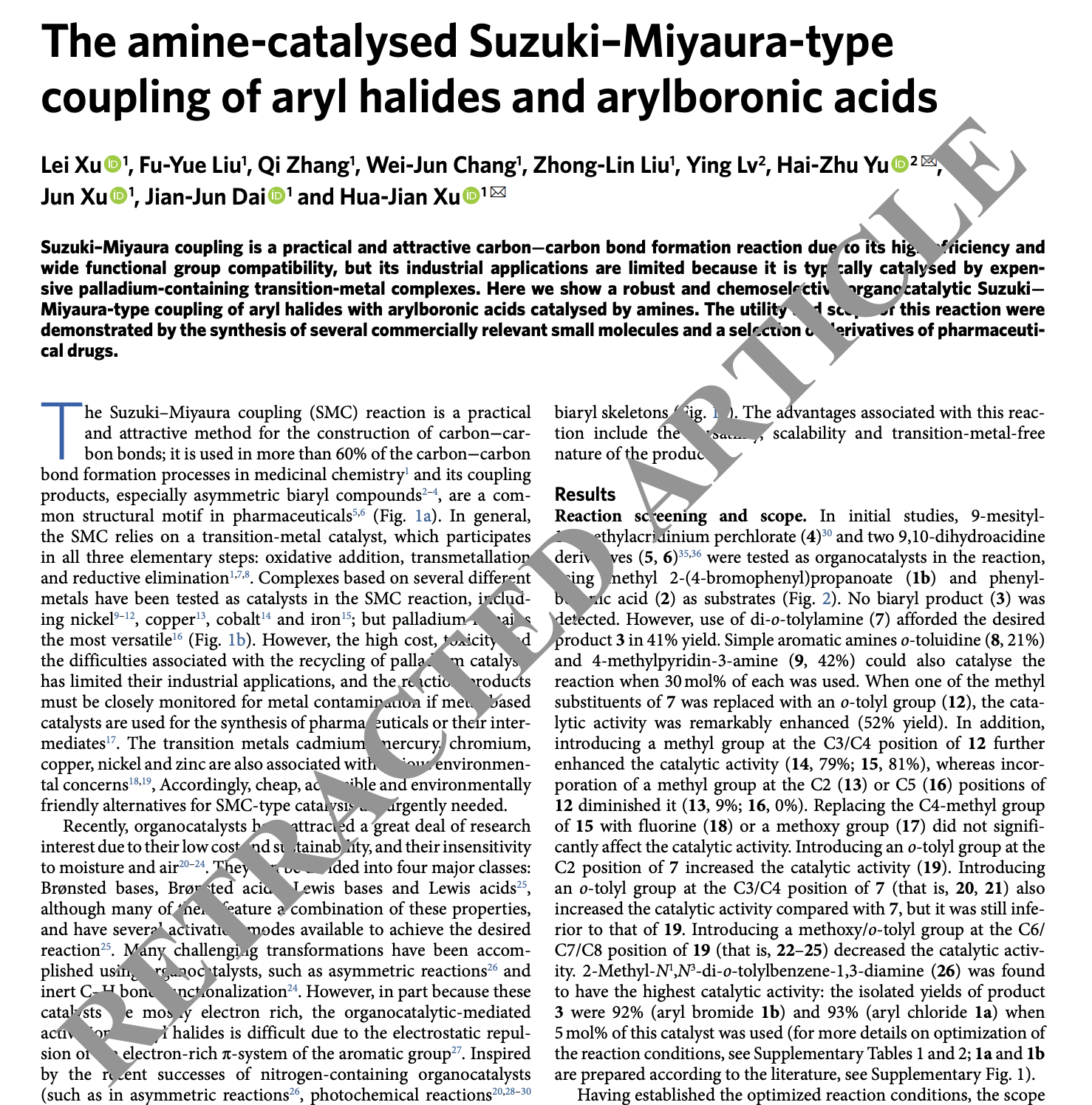
Now, the Royal Society of Chemistry is retracting 68 articles, across three of its titles, after an investigation turned up evidence of what it suspects was the “systemic production of falsified research.” The society said it is in the process of beefing up its safeguards against milled papers and plans to train its editors to have “extra vigilance in the face of emerging, sophisticated digital fraud.” 

Continue reading Publisher retracting 68 articles suspected of being paper mill products

Nanoscience researcher loses four papers for image manipulation, forged authors

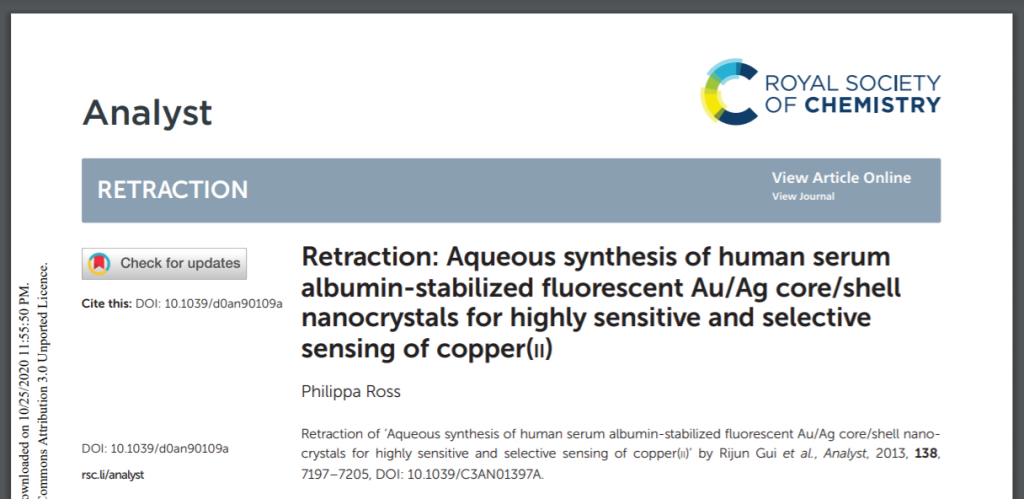
Journals published by the Royal Society of Chemistry have retracted four articles by a researcher in China for a range of misconduct, including manipulation of images, fabrication of authors and more. 

The papers were written by Rijun Gui, of Qingdao University and formerly of the School of Chemistry and Molecules Engineering at East China University of Science and Technology, in Shanghai, and published in 2013 and 2014. Gui has a sizable entry on PubPeer, where many of his studies have come under scrutiny for years. Together, the four papers have been cited nearly 150 times, according to Clarivate Analytics’ Web of Science.

It’s not quite Rashomon, but each of the retraction notices adds a bit of detail to the story. 

Continue reading Nanoscience researcher loses four papers for image manipulation, forged authors

Top chemistry journal retracts paper for faked data

A leading chemistry journal has retracted a 2019 paper by a pair of researchers in Switzerland after determining that it contained fabricated data. 

The article, “The manganese(I)‐catalyzed asymmetric transfer hydrogenation of ketones: disclosing the macrocylic privilege,” was written by Alessandro Passera and Antonio Mezzetti, of the ETH Zurich in Switzerland. It appeared in Angewandte Chemie International Edition.  

Readers might remember Angewandte Chemie from this post in June about a controversial article it published — and then removed — in the wake of a mass outcry that prompted much of its editorial board to resign and led to the suspension of two of its editors. Fallout from the scandal — in the form of “the journal’s interim Editor-in-Chief Committee” — is evident in the retraction notice, which reads

Continue reading Top chemistry journal retracts paper for faked data

Controversial essay at German chemistry journal leads to suspensions, mass resignations

Facing a storm of criticism on social media, a chemistry journal in Germany has suspended two editors who handled a controversial essay that it said “highlights the bias displayed in our field and many others” to women and minority researchers.

And the 16 members of the journal’s international advisory board — which includes Nobel Laureates — resigned while denouncing the essay.

The article, “Organic synthesis-where now?’ Is thirty years old. A reflection on the current state of affairs,” by Tomas Hudlicky, of Brock University in St. Catharines, Ontario, had appeared in Angewandte Chemie, the flagship publication of the German Chemical Society. Hudlicky’s argument included several statements that suggested a hostility to efforts on university campuses to promote diversity.

The journal initially removed the essay without a notice, which isn’t best practice for retractions. It has since issued this statement from Neville Compton, the editor-in-chief: 

Continue reading Controversial essay at German chemistry journal leads to suspensions, mass resignations

Following outrage, chemistry journal makes a paper decrying diversity efforts disappear

The New York Times isn’t the only outlet that has walked back a commentary this week amid reader outrage. 

Following a flood of criticism on social media, a chemistry journal in Germany has disappeared an essay by Canadian researcher who argued that efforts to promote diversity in the field were hurting science. [See an update on this post.]

Continue reading Following outrage, chemistry journal makes a paper decrying diversity efforts disappear

Peer review bandits purloin again, this time in chemistry

A pair of researchers in India have lost a 2017 paper published by the UK’s Royal Society of Chemistry after an inquiry found that they’d stolen the guts of the work from an unpublished manuscript one of them had reviewed for another journal. 

The article in question, “Tri-s-triazine (s-heptazine), a novel electron-deficient core for soft self-assembled supramolecular structures,” appeared in Chemical Communications was submitted on August 4, 2017 and published on September 25, 2017, and was written by Irla Kumar and Sandeep Kumar, of the Raman Research Institute in Bangalore.

Sandeep Kumar, who is now retired, was a leading figure in the field of  liquid crystals. The Royal Society of Chemistry feted him as one of the “most cited” researchers in Chemical Communications and another of its journals in 2006 and 2007. He also served on the editorial boards of several journals, including Liquid Crystals — a post that is particularly relevant in light of what follows. 

According to the retraction notice

Continue reading Peer review bandits purloin again, this time in chemistry

Nobel winner retracts paper from Science

Frances Arnold

A Caltech researcher who shared the 2018 Nobel Prize in Chemistry has retracted a 2019 paper after being unable to replicate the results.

Frances Arnold, who won half of the 2018 prize for her work on the evolution of enzymes, tweeted the news earlier today:

Continue reading Nobel winner retracts paper from Science

Two spectrometry papers retracted, one for “intolerable” mistakes. The authors don’t agree.

Saudi researchers have lost a pair of papers in a spectrometry journal for errors the editors found fatal but the authors apparently dismiss as trivial. 

The articles appeared in the Journal of Analytical Atomic Spectrometry, published by the Royal Society of Chemistry in the United Kingdom. The principal author on both papers is Mohammad Gondal, of the King Fahd University of Petroleum and Minerals in Dharhan. According to his website, Gondal is a highly decorated physicist, with 

Continue reading Two spectrometry papers retracted, one for “intolerable” mistakes. The authors don’t agree.

After ten years of being in limbo, a chemistry paper is retracted

In May of this year, François-Xavier Coudert, a chemist at PSL University in Paris, had a question about a paper in Chemistry: A European Journal.

Several days later, he had an answer — sort of — along with an apology for readers from Haymo Ross, the journal’s editor in chief.

Continue reading After ten years of being in limbo, a chemistry paper is retracted

‘Miracle’ on ice as chemists pull nanocatalyst paper that fizzled

Image by Fathromi Ramdlon from Pixabay

God giveth miracles … and it seems she taketh them away as well.

A group of chemists in China has lost a 2018 paper which described a “miraculous” discovery that wasn’t. 

The paper was titled “A miraculous chiral Ir–Rh bimetallic nanocatalyst for asymmetric hydrogenation of activated ketones,” and it appeared in Organic Chemistry Frontiers, a publication of the Royal Society of Chemistry.  

The authors, from the State Key Laboratory of Fine Chemicals at Dalian University of Technology, purported to show that: 

Continue reading ‘Miracle’ on ice as chemists pull nanocatalyst paper that fizzled