Coauthor’s past misconduct prompts dep’t chair to retract Diabetes study

A department chair of a Swedish university asked to retract a 2010 study in Diabetes after none of the authors could explain image-related ambiguities.

The matter prompted particular attention because the paper’s first author, Pontus Almer Boström, had been found guilty of scientific misconduct by the University of Gothenburg in 2012, after Jan Borén noted some irregularities in data calculated by Boström. At that point, the research group combed the data to identify further issues arising from Boström’s work, and didn’t find any.

But last summer, when a user on PubPeer raised questions about some of the images in the 2010 paper, the matter was brought back into focus. According to Borén, they found “no evidence of scientific misconduct in this study.” But Boström had left the university in 2009 and could not be reached, the corresponding author had passed away, and the remaining co-authors hadn’t stayed in the field. So Borén decided it would be best to retract the study to avoid any “lingering questions.”

Here’s the retraction notice for “The SNARE Protein SNAP23 and the SNARE-Interacting Protein Munc18c in Human Skeletal Muscle Are Implicated in Insulin Resistance/Type 2 Diabetes,” in which Borén thanks “Peer 1″ on PubPeer for “detecting the ambiguities and bringing them to our attention:” Continue reading Coauthor’s past misconduct prompts dep’t chair to retract Diabetes study

“I placed too much faith in underpowered studies:” Nobel Prize winner admits mistakes

Daniel Kahneman

Although it’s the right thing to do, it’s never easy to admit error — particularly when you’re an extremely high-profile scientist whose work is being dissected publicly. So while it’s not a retraction, we thought this was worth noting: A Nobel Prize-winning researcher has admitted on a blog that he relied on weak studies in a chapter of his bestselling book.

The blog — by Ulrich Schimmack, Moritz Heene, and Kamini Kesavan — critiqued the citations included in a book by Daniel Kahneman, a psychologist whose research has illuminated our understanding of how humans form judgments and make decisions and earned him half of the 2002 Nobel Prize in Economics.

According to the Schimmack et al blog, Continue reading “I placed too much faith in underpowered studies:” Nobel Prize winner admits mistakes

“Social science isn’t definitive like chemistry:” Embattled food researcher defends his work

Brian Wansink

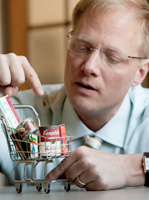
It’s been a busy few months for Brian Wansink, a prominent food researcher at Cornell University. A blog post he wrote in November prompted a huge backlash from readers who accused him of using problematic research methods to produce questionable data, and a group of researchers suggested four of his papers contained 150 inconsistencies. The scientist has since announced he’s asked a non-author to reanalyze the data — a researcher in his own lab. Meanwhile, criticisms continue to mount. We spoke with Wansink about the backlash, and how he hopes to answer his critics’ questions.

Retraction Watch: Why not engage someone outside your lab to revalidate the analysis of the four papers under question? 

Continue reading “Social science isn’t definitive like chemistry:” Embattled food researcher defends his work

Backlash prompts prominent nutrition researcher to reanalyze multiple papers

Brian Wansink

To Brian Wansink of Cornell University, a blog post he wrote in November, 2016, was a meant as a lesson in productivity: A graduate student who was willing to embrace every research opportunity submitted five papers within six months of arriving to his lab, while a postdoc who declined two chances to analyze a data set left after one year with a small fraction of the grad student’s publications.

But two months and nearly 50 comments on the post later, Wansink — known for so much high-profile nutrition research he’s been dubbed the “Sherlock Holmes of food” — has announced he’s now reanalyzing the data in the papers, and will correct any issues that arise. In the meantime, he had to decline requests to share his raw data, citing its proprietary nature.

As Wansink writes in the second addendum to the November blog post, “The Grad Student Who Never Said ‘No’:”

Continue reading Backlash prompts prominent nutrition researcher to reanalyze multiple papers

“Boom, headshot!” Disputed video game paper retracted

After a years-long dispute over a 2012 paper which suggested there might be some effects of first-person shooter video games on players, the journal has retracted the paper.

The stated reason in the notice: Some outside researchers spotted irregularities in the data, and contacted the corresponding author’s institution, Ohio State University, in 2015. Since the original data were missing, Communication Research is retracting the paper, with the corresponding author’s okay.

But as our story last month about this years-long dispute reported, there is a bit more to it.  Continue reading “Boom, headshot!” Disputed video game paper retracted

Journal retracts surgery study with data “not intended for use in research”

A journal has retracted a surgery study by researchers at Brown University after noticing it included data that was not intended for research purposes. (Incidentally, the data were collected by the publisher of the journal.)

Ingrid Philbert, managing editor of the Journal of Graduate Medical Education — which published the paper — told Retraction Watch that senior staff at the publisher alerted the journal that they suspected the authors had used data from a confidential source:

This is a fairly new set of case log data, and as the collector [of] the data, the [Accreditation Council for Graduate Medical Education (ACGME)] gets to determine the use and it has decreed that this data be used solely for accreditation decisions.

Philbert said the journal asked the authors where they got the data:

Continue reading Journal retracts surgery study with data “not intended for use in research”

Nature paper with massive correction can’t be reproduced, says independent group

In 2011, authors of a Nature letter caught some flak for issuing a lengthy correction to a neuroscience paper that had raised eyebrows within days of publication — including some suggestions it should be retracted.

The correction notice, published months after the original letter, cited errors in image choice and labeling, but asserted the conclusions remained valid.

Now, those conclusions appear up for debate. In a recent Nature Brief Communications Arising (BCA) article, a team that raised concerns about the paper five years ago says they are unable to reproduce the results. But the authors of the original paper aren’t convinced: They argue that the BCA fails to cite important evidence, has a “complete absence or low quality of analysis,” and the scientists disregard some of their data.

Continue reading Nature paper with massive correction can’t be reproduced, says independent group

Journal retracts all papers by education researcher, bringing his total to 21

jaasepA journal has followed through on its promise to retract all articles by an education researcher, after an investigation raised questions about the validity of the data in some of his work with children with special needs.

The latest notice — which includes a list of 11 papers — brings the total number of retractions for Noel Kok Hwee Chia to 21.

Last spring, The Journal of the American Academy of Special Education Professionals (JAASEP) pulled nine articles by Chia that were the subject of an investigation at the National Institute of Education in Singapore, part of Nanyang Technological University, where he worked until April. As we reported in June, editors explained in a 3,000-word notice that they planned to pull every article that Chia had published in JAASEP.

The new retraction notice quotes from the reasoning presented in the previous one, from last spring:

Continue reading Journal retracts all papers by education researcher, bringing his total to 21

EMBO journals retract figures in two papers missing source data

Journals published by the European Molecular Biology Organization (EMBO) have retracted a handful of figures in two papers with the same last and first authors.

After some figures in the 2005 and 2007 papers were flagged on PubPeer and the authors couldn’t provide the original data, the journals decided to retract parts of the papers, since other data supported the remaining conclusions, according to the Head of Scientific Publications at EMBO.

The partial retractions are labeled as corrigenda by the journals. Earlier this year, the U.S. National Library of Medicine (NLM) announced it would be classifying partial retractions as errata, noting they had been used so rarely by journals.

Both lengthy corrigenda (also reported by Leonid Schneider) contain statements from the authors and the editors. The statements from the authors provide detailed explanations about the problems with the figures in question; here’s an excerpt from the editor’s statement in The EMBO Journal corrigendum: Continue reading EMBO journals retract figures in two papers missing source data

Harvard biologist retracts diabetes breakthrough in Cell

2013 probably felt like it was going to be a great year for stem cell biologist Douglas Melton at Harvard. He had published a buzz-worthy paper in Cell about a new way to potentially boost insulin in diabetics, attracting significant media attention, and eventually gathering nearly 200 citations.

But 2016 is closing out on a less positive tone for Melton — today, he and his colleagues are retracting the paper, after multiple labs (including his own) couldn’t reproduce the findings.

Although the lab has itself already published two articles casting doubt on the original findings, Melton told Retraction Watch he chose to retract the paper to ensure there was no confusion about the original paper’s validity: Continue reading Harvard biologist retracts diabetes breakthrough in Cell