Study of air quality around Damien Hirst’s artwork retracted — against most authors’ wishes

via Flickr Commons
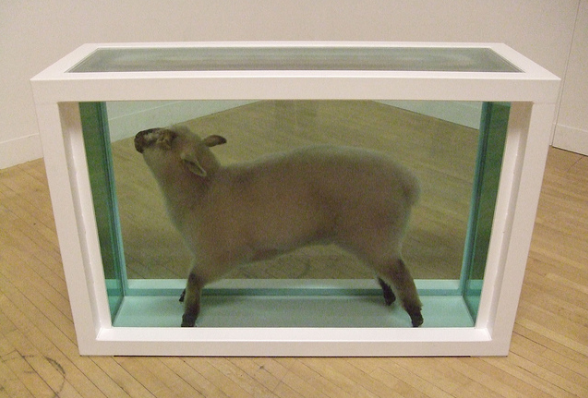
Damien Hirst’s “Away From The Flock” — exhibited at Tate Britain, via Flickr Commons

The corresponding author of the study that detected toxic leaks from the work of prominent British artist Damien Hirst has now retracted it — but most of his co-authors disagree with the decision.

The April Analytical Methods study was covered extensively by the media when it suggested staff at Damien Hirst’s 2012 exhibition at Tate Gallery in London of dead animals embalmed in formaldehyde were being exposed to higher than recommended levels of the carcinogen. 

Tate and Hirst’s company, Science Limited, immediately objected to the results; we’ve obtained what appears to be letter from a lawyer for Science Limited to the corresponding author of the paper — Pier Giorgio Righetti of the Polytechnic University of Milan in Italy — saying it was “deeply concerned and troubled by the claims” in the paper.

Last month, the journal issued an expression of concern (EOC) for the paper, nothing the data may not be reliable, and on July 15, Righetti announced in a joint statement with Hirst’s company that he will be retracting his study.

Now, the paper has been officially retracted, noting more recent measurements show formaldehyde levels to be much lower than originally reported. But most of Righetti’s co-authors disagree with the decision, the notice says:  Continue reading Study of air quality around Damien Hirst’s artwork retracted — against most authors’ wishes
Does dose matter? Tumor killer paper thought so, now must retract

Molecular Medicine ReportsAfter questions from a reader, researchers took a second look at their data about the effects of a vitamin A metabolite on tumor cells, and realized their key finding was inaccurate.

They’re now retracting the paper, from Molecular Medicine Reports, because it originally reported that higher concentrations of retinoic acid (RA) were more effective in curbing the proliferation of brain tumor cells. But it seems that the RA dose made less of a difference than they originally believed, according to the retraction notice:

Continue reading Does dose matter? Tumor killer paper thought so, now must retract

Five more retractions for researcher who sued PubPeer commenters brings tally to 18

Fazlul Sarkar
Fazlul Sarkar

A cancer researcher who tried to sue PubPeer commenters for criticizing his work has earned five more retractions, bringing his total to 18. 

All of the new retractions for Fazlul Sarkar, formerly based at Wayne State University in Michigan, appear in the International Journal of Cancer. All cite an institutional investigation, and relate to issues with images.

With 18 retractions, Sarkar has now earned a spot on our leaderboard.

We first encountered Sarkar when he subpoenaed PubPeer to reveal the names of anonymous commenters that potentially cost him a job at the University of Mississippi. Earlier this month, a Wayne State spokesperson confirmed to us that Sarkar has now retired from the university. (To get up to speed, check out our timeline on the major events in this case.)

Here’s the first of the retraction notices, issued today: Continue reading Five more retractions for researcher who sued PubPeer commenters brings tally to 18

Where was chem research conducted? Not here, say two of three listed author affiliations

ChemosphereA researcher has retracted two 2016 papers after discovering problems with the data that negated the findings — and after one of his three listed affiliations denied the research was conducted there.

According to the retraction notices issued by Chemosphere, Hong-Wei Luo incorrectly claimed to be affiliated with the Oak Ridge National Laboratory (ORNL) in Tennessee in one of his three affiliations. His other institutions listed on the papers include universities in Singapore and China.

However, an official from the Nanyang Technological University (NTU) in Singapore, told us the work in the now-retracted papers was not carried out at the NTU either.

Here’s the first of the retraction notices, issued on August 8: Continue reading Where was chem research conducted? Not here, say two of three listed author affiliations

Doing the right thing: Authors pull psych review after finding inaccuracies

Two psychology researchers are retracting a meta-analysis after discovering errors they believe may affect the conclusions.

We’re giving this a “doing the right thing” nod, as last author Pankaj Patel of Villanova University in Pennsylvania contacted us about his plan to retract the paper, and resubmit for publication once he and co-author Sherry Thatcher — at the University of South Carolina — have performed all their recalculations.

Here’s the retraction notice for “Demographic faultlines: A meta-analysis of the literature,” published in the Journal of Applied Psychology: Continue reading Doing the right thing: Authors pull psych review after finding inaccuracies

Researcher in Brazil earns 12th retraction for recycling text and figures

Thermochimica ActaA scientist in Brazil has gained his twelfth retraction for reusing text and figures from previously published papers.

In 2011, Elsevier announced that it would retract 11 papers by Claudio Airoldi, a researcher at the State University of Campinas (UNICAMP) in Brazil. Subsequently, he was suspended for 45 days, and his co-author on the 11 previously pulled papers, Denis de Jesus Lima Guerra, lost his post at the Federal University of Mato Grosso (also in Brazil).

Now, a 12th retraction has appeared for Airoldi — this time in Thermochimica Acta.

Here’s the latest retraction notice, issued earlier this year: Continue reading Researcher in Brazil earns 12th retraction for recycling text and figures

Journal blacklists authors for plagiarizing case report about hypersexuality in dementia

Advances in Human BiologyA biology journal has blacklisted authors from publishing their work after finding their case report about a dementia patient with hypersexuality was plagiarized from a previously published report.

The retraction notice, issued by Advances in Human Biology (AIHB) in June, recognizes the case as “scientific misconduct.” The journal launched an investigation after the plagiarism was flagged by the author of the original report, the editor-in-chief of the journal told us. Eventually, the journal retracted the report — and removed it entirely from their website.

Additionally, the journal posted this notice on their site, blacklisting the authors from publishing in AIHB again: Continue reading Journal blacklists authors for plagiarizing case report about hypersexuality in dementia

Researcher notches fourth retraction, has left university

Plant Ecology

A researcher with four retracted papers has left his former institution in Malaysia, according to an official at the university.

In March, we reported on the retractions of two studies in Environmental Geochemistry and Health co-authored by Muhammad Aqeel Ashraf. Both papers were pulled citing a “compromised” peer review process. The now-retracted work was carried out at the University of Malaya in Kuala Lumpur, Malaysia, where Ashraf was previously based.

However, Ashraf later moved to University Malaysia Sabah (UMS) in Kota Kinabalu, Malaysia; but now, according to an official at the institution, Ashraf is no longer based at UMS after “suspicion” arose into his work.  Continue reading Researcher notches fourth retraction, has left university

Author loses five papers, most for “compromised” peer review

PLOS OnePLOS ONE has retracted three papers after the first author admitted to submitting the manuscripts without co-authors’ consent, and an investigation suggested that two out of the three papers had received faked reviews.

Last August, the same author — Lishan Wang of the Shanghai Jiao Tong University — lost two more papers (one in Tumor Biology and the other in Gene), also after the peer review process was found to be compromised. All five papers — which share other authors in common — were originally published in 2013, and four list Wang as the first author. The retractions follow an investigation by Shanghai Jiao Tong University.

Here’s the retraction notice for two of the PLOS ONE papers, issued on July 26: Continue reading Author loses five papers, most for “compromised” peer review

Authors retract study with contaminated cell lines

MBoCAuthors of a molecular biology paper have pulled it after realizing that their cell lines were contaminated.

According to the notice in Molecular Biology of the Cell (MBoC), the contamination occurred by “unknown means” in the senior authors’ laboratory, who told us the mistake was a difficult one to catch. He added that they discovered the problem after other researchers published conflicting results.

He also noted that the contaminated cell lines were not used for experiments in any other papers.

Here’s the retraction notice, issued on August 1: Continue reading Authors retract study with contaminated cell lines