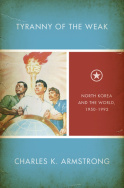
A historian based at Columbia University has returned a 2014 prize after criticisms prompted him to issue more than 70 corrections to his prominent book about North Korea.
Charles Armstrong told Retraction Watch he returned the 2014 John K. Fairbank Prize he received for “Tyranny of the Weak” due to “numerous citation errors.” The book has faced heavy criticism, including allegations of plagiarism and using invalid sources.
The American Historical Society, which issues the Fairbank Prize, released a statement last week:
It started as a simple email exchange over authorship. But it angered one researcher so much that it ended a 20-year collaboration.
In January 2017, a chemist based in Mexico had finished writing a paper describing the structure of a molecule. Sylvain Bernès, at the Instituto de Física Luis Rivera Terrazas, asked his co-author—the head of the lab where the molecule had been synthesized 10 years ago—to review the draft and include any co-authors involved in the initial work.
A Cornell food researcher who has pledged to re-analyze his papers following heavy criticism of his work has issued a major correction to a 2005 paper.
The correction tweaks two tables, a figure, and the description of the methodology — and notes in two instances the correct findings are unknown, since the original data are unavailable. Andrew Gelman, a statistician at Columbia University and critic of Brian Wansink’s work, has dubbed the notice the “best correction ever.”
Two molecular biologists have withdrawn two 2015 papers published in the same journal, citing image duplication and manipulation, among other issues.
One notice — published in June — explains that, after further investigation, the Journal of Biological Chemistry (JBC) found certain experiments “were not performed appropriately.” The other notice cites “missing data” and notes that certain data “did not accurately represent experimental conditions.”
The authors of the papers—Daniel L. Kaplan, associate professor at Florida State University who heads a genomics lab, andIrina Bruck, assistant scholar scientist in Kaplan’s lab—also received a correction in JBC this month, which cites image duplication.
The three notices, all published this month in JBC, may reveal a pattern, but there’s still a lot we don’t know. One of the two papers was questioned on PubPeer. Several commenters flagged duplicated images and had questions about the antibody used.
An exercise scientist who ran a study of the CrossFit exercise program without an approved human subjects protocol has lost two more papers to retraction.
Both papers were retracted on June 26 by the editors of the International Journal of Exercise Science (IJES) with the agreement of last author Steven Devor, a former professor at The Ohio State University. Both have been retracted because the studies were carried out without proper IRB approval.
Earlier in June, another paper from the CrossFit study — which is still at the center of a legal battle between CrossFit and a competitor in the market for exercise instructor licensing — was retracted by the Journal of Strength and Conditioning Research (JSCR) for improper IRB approval. Devor resigned from OSU the day after the first retraction.
Only one of the newly retracted papers had anything to do with the CrossFit study: Published in April 2014, this paper suggested that the so-called “paleo” diet — a diet focused on meat and vegetables — is associated with “unfavorable” changes in cholesterols and other blood-based cardiovascular biomarkers. In addition to following the diet, subjects also participated in a CrossFit exercise program.Continue reading Researcher who tangled with CrossFit loses two more papers
Hearsay is not admissible as evidence in court — and it doesn’t seem to go very far in science, either.
A pair of researchers in the field of human evolution have lost a paper which contained data from “personal correspondence” that the providing party apparently did not enjoy seeing in print.
In 2013, Frank Sauer blamed “visual distortion” for problems with the images in his papers and grant applications. That explanation gave way to the production in 2016 of a mysterious and ominous letter from an unnamed researcher claiming that they’d sabotaged Sauer’s work in a plot of revenge. Soon after, Sauer was claiming that a mysterious cabal was plotting to undermine the output of German researchers.
Whatever Sauer was selling, Leslie Rogall, an administrative law judge for the U.S. Department of Health and Human Services’ Departmental Appeals Board, wasn’t buying.
Rogall has concluded that the Office of Research Integrity acted properly in 2016 when it found Sauer — a former faculty member in biochemistry at the University of California, Riverside — guilty of misconduct. His offense: doctoring images in three published papers and seven grant applications to the National Institutes of Health.
A former researcher at Duke University has admitted to faking data that allegedly were used to secure hundreds of millions of dollars in federal grants.
Duke has also admitted that it knew Erin Potts-Kant, a pulmonary scientist, faked data, but it’s unclear whether that was discovered prior to using those data to apply for grants, as a lawsuit alleges.
The admissions come from court documents submitted by Potts-Kant, her supervisor — former Duke researcher William Michael Foster — and Duke itself, responding to allegations in a whistleblower suit that says they defrauded the government.
Regular readers may recall that Joseph Thomas, a former colleague of Potts-Kant and Foster, has filed a False Claims Act suit against the three defendants on behalf of the U.S. government. The responses, submitted separately by the three defendants, are the latest development in what could be a landmark case for research misconduct. The lawsuit has survived motions to dismiss and is moving through the discovery process, which is likely to reveal more than the defendants have already said.
Two authors who had a paper retracted for fake peer review in 2015 have lost another for the same reason.
Elsevier recently retracted the second paper by the duo, a 2015 paper in a cancer journal, after finding evidence of fake peer review. The paper was submitted in October 2014 and accepted just a week before our piece on fake peer review appeared in Nature.
According to the notice, after investigating the paper, which appeared in Cancer Letters, the publisher concluded that it was accepted “based upon the positive advice of at least two faked reviewer reports.” The notice also explained that the identities of several authors “could not be confirmed.”Continue reading Fake peer review strikes again for pair of authors
 A historian based at Columbia University has returned a 2014 prize after criticisms prompted him to issue more than 70 corrections to his prominent book about North Korea.
 A Cornell food researcher who has pledged to re-analyze his papers following heavy criticism of his work has issued a major correction to a 2005 paper.


 In 2013, Frank Sauer blamed “visual distortion” for problems with the images in his papers and grant applications. That explanation gave way to the production in 2016 of a mysterious and ominous letter from an unnamed researcher claiming that they’d sabotaged Sauer’s work in a plot of revenge. Soon after, Sauer was claiming that a mysterious cabal was plotting to undermine the output of German researchers.