The authors of a 2015 study have retracted it after discovering that several Western blots in their paper “do not represent the experiments that were reported.”
They couldn’t check some of the original blots, because — according to the retraction notice in the American Journal of Physiology – Renal Physiology — they could not be located. The ones that could be found, however, are “inconsistent with what is presented in the figures.”
Two remaining charges against a Parkinson’s researcher recently convicted of fraud have been dropped by an Australian court.
In October, Caroline Barwood, formerly at the University of Queensland (UQ) in Brisbane, was found guilty of five out of seven charges. Subsequently, Barwood was handed two suspended sentences: one for two years, and another for 15 months, both to be served concurrently. She will not serve jail time.
Barwood was found guilty of five charges against her, but the jury could not reach a majority verdict on one count of fraud and another of attempted fraud. She was asked to re-attend court for a “mention.”
The University of Tokyo is investigating a 2011 stem cell paper in Cell Cycle, recently retracted over irregularities in four figures.

The university has confirmed there is an investigation, but would not specify which paper it concerned; the corresponding author on the paper, however, confirmed to us that it is the focus of the investigation.
That’s the sound of learning that a third scientist you worked with committed misconduct.
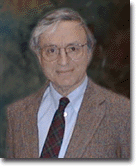
In the last two years, we reported on two retractions for neuroscientist Stanley Rapoport, the result of misconduct by two different first authors. We’ve since discovered more retractions resulting from those cases — and a new retraction stemming from the actions of yet another co-author.
Although the latest retraction notice doesn’t reveal the reason for retraction, both the journal editor and Rapoport — based at the National Institute on Aging (NIA), part of the National Institutes of Health (NIH) — confirmed to us that it is the result of misconduct by the last author, Jagadeesh Rao. According to Rapoport, a “number of retractions [for] Rao are still in the works.”
We asked Rapoport for his reaction to multiple cases of misconduct by his colleagues, including the two first authors we’ve already reported on, Fei Gao and Mireille Basselin:
Last year, a cancer researcher wrote to the Journal of Biological Chemistry, asking to correct one of his papers. The journal responded by requesting the raw data used to prepare his figures. Then, in a follow-up request, it asked for raw data behind the figures in 20 additional published articles.
And when all was said and done six months later, Jin Cheng ended up with far more than just a single correction: Last month, the journal issued withdrawals for 19 of his papers — including the paper he originally asked to correct — along with one correction.
We’ve pieced together some clues about what happened after reviewing correspondence between representatives of JBC and Moffitt Cancer Center, where Cheng conducted his research. A spokesperson for Moffitt confirmed that the retractions did not initiate from an institutional investigation — but that the institution is now conducting one.
That’s not the way retractions typically happen: Often, journals don’t have the resources to conduct investigations themselves, so institutions mostly take the lead in double-checking papers and, if necessary, contacting the journal to initiate a retraction. Here, it seems the opposite took place.
Nature Biotechnology has issued an editorial expression of concern (EOC) for a widely criticized study describing a potentially invaluable new lab tool.
The EOC mentions the lack of reproducibility of the gene-editing technique, known as NgAgo. Alongside it, the journal has published a correspondence which includes data from three separate research groups that cast doubt on the original findings.
According to a spokesperson for the journal, some of the paper’s authors have objected to the decision to issue an EOC.
Earlier this month, we reported on a letter signed by 20 researchers which also raised concerns about the genome-editing activities of NgAgo — and alleged the lab that produced the initial results turned away investigators when they attempted to validate the tool in mammalian cells.
A study linking vaccines to autism and other neurological problems has been removed by a Frontiers journal after receiving heavy criticism since it was accepted last week.
The abstract — published online in Frontiers in Public Health after being accepted November 21 — reported findings from anonymous online questionnaires completed by 415 mothers of home-schooled children 6-12 years old. Nearly 40 percent of children had not been vaccinated, and those that had were three times more likely to be diagnosed with neurodevelopmental disorders such as autism, the study found.
In March, 2013, a graduate student joined the lab of a prominent researcher in Australia, investigating new therapies for Parkinson’s. A few months later, everything fell apart.
In September 2013, the University of Queensland (UQ) announced it was retracting one of the lab’s papers, returning the money used to fund the research and launching a fraud investigation. Since then, the scandal has grown to the point where the lead researcher and his co-author have been convicted of fraud in an Australian court.
Now, the graduate student is fighting back. After losing her research project and being escorted off campus for allegedly erratic behavior, she has appealed to UQ to reimburse her for tens of thousands of dollars in tuition, and is now awaiting a verdict from a government ombudsman. The graduate student goes by “Dominique,” which is not her real name; Retraction Watch is keeping her identity confidential to protect her privacy.Continue reading A grad student was caught in the crossfire of fraud — and fought back
Last week, we learned a 2016 paper heavily discussed on PubPeer might be retracted — today, we learned that Nature Cell Biology has indeed pulled the paper, citing inappropriate image modifications.
As we reported last week, a comment on PubPeer flagged as coming from an author said they had requested a retraction. A representative of National Taiwan University (NTU) told us the first author had resigned, and the paper was under investigation — an investigation which included the last author, a prominent researcher who is also a vice president at another institution in Taiwan.