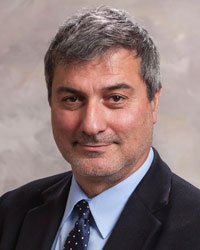
The secretary general of the Nobel Assembly, the body responsible for choosing the Nobel Prizes, has resigned from his post because “he may be involved” in the Karolinska Institutet investigation of trachea surgeon Paolo Macchiarini.
An investigation at the University of New South Wales in Australia has led to a fifth retraction for a cancer researcher long accused of misconduct, due to “unresolvable concerns” with some images.
As we reported in December, UNSW cleared Levon Khachigian of misconduct, concluding that his previous issues stemmed from “genuine error or honest oversight.” Now, Circulation Research is retracting one of his papers after an investigation commissioned by UNSW was unable to find electronic records for two similar images from a 2009 paper, nor records of the images in original lab books.
Again, the retraction note affirms that this is not a sign of misconduct:
UNSW has not attributed any instance of research misconduct or responsibility for the unavailability of the original data to Professor Khachigian or to any of the authors of the publication.
The Karolinska Institutet University Board announced today it was issuing a new external investigation of trachea surgeon Paolo Macchiarini, looking into questions about his recruitment and the handling of previous allegations of misconduct.
The University Board deems such an inquiry to be an important part of restoring the confidence of the public, the scientific community, staff and students in the university.
The board hopes to appoint the investigative team, which will not consider “matters of a medical-scientific nature,” next week. The goal is to conclude the investigation by the summer.
Karolinska Institutet announced today it would not extend the contract of star surgeon Paolo Macchiarini. He has been instructed to “phase out” his research from now until November 30.
The name Yoshitaka Fujii should ring a bell — an alarm bell, in fact — for our readers. He’s firmly listed in the number one spot on our leaderboard, with more than 180 retractions.
Karolinska Institutet may reopen its misconduct investigation into acclaimed surgeon Paolo Macchiarini following new allegations revealed during a documentary series by Swedish Television.
EMBO has taken back an award given to beleaguered plant biologist Olivier Voinnet in 2009, and is investigating a recent grantee who had a paper retracted from Nature Genetics yesterday.
The European Molecular Biology Organization (EMBO) “promotes excellence in the life sciences” in Europe, in part by awarding prizes to promising young scientists. Voinnet and Sonia Melo earned their awards by exhibiting potential as young scientists studying genetics — of plants and cancer, respectively — but now EMBO is skeptical of the papers that formed the basis of their applications.
Melo’s Installation Grant from EMBO was announced just last month, and consists of 50,000 Euros annually for three to five years. She is currently based at the University of Porto, in Portugal.
Last week, the International Committee of Medical Journal Editors proposed requiring authors to share deidentified patient data underlying the published results of clinical trials within six months of publication. The proposal has earned much support but also some concerns – for example that other scientists might poach the findings, acting as the New England Journal of Medicinedubbed “research parasites.”Elizabeth Wager, a member of the board of directors of our parent organization, disagrees with that concern, but raises another issue – namely, the unintended consequences of data sharing on other, more effective initiatives to make reporting more transparent.
The recent proposal from the ICMJE may appear, at first glance, a positive step towards better clinical trial reporting. However, I’m concerned that this new requirement might undermine other more effective initiatives to increase the efficiency of research, such as the publication of protocols and full study reports. Here’s why.
All actions have costs, risks, and benefits: Making partial data sharing a condition of publication is no exception. The costs are hard to quantify but undoubtedly not trivial. Putting clinical data into a usable format and making it meaningful to other researchers requires considerable time and effort by knowledgeable people. To this must be added the costs of establishing and maintaining suitable repositories and of checking compliance.
A paper claiming genetically modified corn may be toxic over long periods has disappeared one day after it was presented at a press conference, after the journal’s domain name expired.