1st retraction for ex-Pitt postdoc who admitted to doctoring data

American Journal of Physiology Renal Phsyiology

A former postdoctoral researcher at the University of Pittsburgh has issued his first retraction after an investigation by the Office of Research Integrity (ORI) concluded he had falsified and/or fabricated data in two published papers.

The ORI investigation into the work of Kenneth Walker, determined that he had

falsified and/or fabricated quantitative real-time polymerase chain reaction (qPCR) data to demonstrate a statistically significant or “trend” of statistical difference in the expression of renal or bladder urothelium and muscle developmental markers between control and experimental (mutant) mice, when there was none.

The ORI report said that Walker has agreed to retract or correct a 2013 PLOS ONE paper and a 2015 study published in American Journal of Physiology – Renal Physiology (AJPRP).

Here’s the first retraction notice, issued by AJPRP: Continue reading 1st retraction for ex-Pitt postdoc who admitted to doctoring data

Author loses 2nd paper on supposed dangers of chemtrails

Frontiers in Public HealthAgainst the author’s wishes, a journal has retracted a paper about chemtrails, a long-standing conspiracy theory about the dangers of cloud trails released from jet planes.

After the paper was scrutinized on librarian Jeffrey Beall’s blog and social media last week, Frontiers in Public Health issued an expression of concern (EOC). The paper was published June 30, and retracted yesterday, in a relatively rare case of rapid action by a journal. 

Last year, we reported on another retraction of a paper about chemtrails by the same author — J. Marvin Herndon, a geophysicist and self-described “independent researcher” at the Transdyne Corporation in San Diego, California.

Here’s the retraction notice: Continue reading Author loses 2nd paper on supposed dangers of chemtrails

Controversial chemtrails paper flagged by journal

Frontiers in Public HealthA journal has published an expression of concern (EOC) for a 2016 paper providing evidence for a long-standing conspiracy theory about the dangers of cloud trails from jet planes.

A similar paper by the same author was retracted last year by another journal.

Both papers focused on the “chemtrails” emitted from jet planes, which conspiracy theorists have long believed contain toxic coal fly ash rather than harmless ice crystals, as the government claims. According to a press release about the 2016 paper, released by author J. Marvin Herndon, a geophysicist and “independent researcher” at the Transdyne Corporation in San Diego, California, the paper presents evidence the chemtrails contain coal fly ash, linked to a number of health problems.

But many people disagree with the findings — Jeffrey Beall, a librarian at the University of Colorado, Denver, criticized the paper on his blog.

Here’s the EOC, published today by Frontiers in Public Health: Continue reading Controversial chemtrails paper flagged by journal

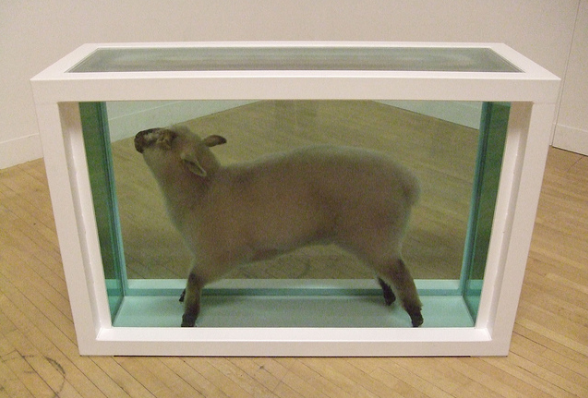
Study warning of toxic leaks from Damien Hirst’s work may not be reliable, says author

via Flickr Commons
Damien Hirst’s “Away From The Flock” — exhibited at Tate Britain, via Flickr Commons

A study that found high levels of the carcinogen formaldehyde leaking from an exhibition by a prominent British artist may have unreliable data, according to its corresponding author.

The 2016 study about Damien Hirst’s exhibition at the Tate gallery in London in 2012 — which involved keeping dead animals in formaldehyde in glass cases — sparked concern in the mainstream media over the exhibition’s potential hazards to visitors.

But now the corresponding author of the paper —  Pier Giorgio Righetti of the Polytechnic University of Milan in Italy — has alerted the journal, Analytical Methods, of the paper’s shortcomings. The journal has issued an expression of concern (EOC), and is investigating.

Here’s the EOC, issued this week: Continue reading Study warning of toxic leaks from Damien Hirst’s work may not be reliable, says author

1st retraction for cancer researcher who doctored data in 11 studies

LeukemiaA cancer journal has retracted a paper co-authored by a researcher who falsified or fabricated data in 11 studies, according to an investigation by the Office of Research Integrity (ORI).

In December 2015, an ORI probe into the work of Girija Dasmahapatra concluded that he had

…duplicated, reused, and/or relabeled Western blot panels and mouse images and claimed they represented different controls and/or experimental results…

Dasmahapatra left the Virginia Commonwealth University (VCU) in July 2015.

Here’s the retraction notice, issued in April 2016: Continue reading 1st retraction for cancer researcher who doctored data in 11 studies

Harvard researcher’s PhD revoked, former group earns three more retractions

Journal of Biological ChemistryA research fellow at Harvard has lost his PhD from a university in Singapore after being found guilty of falsifying data, and his former group leader’s contract has been terminated by his institution.

But that’s not the whole story. This tangled mess involves not only the Harvard researcher, Sudarsanareddy Lokireddy, and his former boss, Ravi Kambadur at the Nanyang Technological University (NTU) in Singapore, but an as-yet unnamed colleague of theirs who, we’re told, has admitted making up data in three papers, on which Lokireddy and Kambadur are co-authors. Bear with us as we walk you through this tale.

Two of those papers have been retracted by The Journal of Biological Chemistry (JBC); one in Molecular Endocrinology has yet to be pulled. Kambadur, who held joint appointments at the NTU and the Agency for Science, Research and Technology (A*STAR) in Singapore, has now had his contract terminated at both institutions.  Continue reading Harvard researcher’s PhD revoked, former group earns three more retractions

Second retraction for researcher who faked 70+ experiments

Journal of Biological ChemistryTwo researchers found to have faked data by the U.S. Office of Research Integrity (ORI) have lost a paper that they co-authored.

According to the ORI report issued on May 25, Ricky Malhotra, one of the researchers in question, admitted to fabricating 74 experiments, and falsifying well over 100 Western blots while at the Universities of Michigan (UM) and Chicago (UC). One week later, the ORI issued additional findings about Karen D’Souza, a colleague of Malhotra’s at the UC, concluding that she had also falsified some data.

Both researchers agreed to the retraction of a 2010 paper published in The Journal of Biological Chemistry (JBC), the reports note.

Here’s the retraction notice, issued on July 1: Continue reading Second retraction for researcher who faked 70+ experiments

A prominent psychiatry researcher is dismissed. What’s happening to his papers?

neumeister
Alexander Neumeister. Source: Yale School of Medicine

After a prominent researcher was dismissed due to multiple instances of misconduct in his studies, how are journals responding?

When an investigation by the U.S. Food and Drug Administration (FDA) found multiple issues with the work of psychiatry researcher Alexander Neumeister, New York University (NYU) Langone Medical Center shut down eight of his studies. (Disclosure: The author of this post is an NYU journalism student, but has no relationship with the medical school.) The agency concluded the studies, which involved using experimental drugs to relieve symptoms of post-traumatic stress disorder (PTSD), were tainted by lax oversight, falsified records, and inaccurate case histories, according to the New York Times. (Neuroskeptic also recently analyzed the case.)

We reached out to the journals that have published Neumeister’s papers, to ask if these recent events have caused them to take a second look at his work. Several have responded, with some noting they plan to investigate, or will do so if asked by the institution. But many believe there is little cause for concern. Continue reading A prominent psychiatry researcher is dismissed. What’s happening to his papers?

Should a paper be retracted if an author omits a conflict of interest?

s-cover-yvs1606A JAMA journal has quickly issued a correction for a 2016 paper after the author failed to mention several relevant conflicts of interest. Normally, we’d see this as a run-of-the-mill correction notice, but since we reported last week that a journal retracted a paper for omitting pharma funding, we got to wondering: Is failure to disclose a conflict of interest a retractable offense?
Guidelines from the Committee on Publication Ethics (COPE) do say that retractions are used for “failure to disclose a major competing interest likely to influence interpretations or recommendations.” But most of the time when we see corrections to the literature for such omissions, they’re corrections, not retractions.

On Friday, JAMA Ophthalmology issued a correction notice for an invited commentary published in April, which addressed two papers in the journal about melanoma of the eye (uveal melanoma). However, the original commentary failed to note that author Arun D. Singh at the Cleveland Clinic had some relevant conflicts to mention, as the notice explains: Continue reading Should a paper be retracted if an author omits a conflict of interest?

Authors retract study that found pollution near fracking sites

Environmental Science and TechnologyThe authors of two environmental papers, including one about the effects of fracking on human health, have retracted them after discovering crucial mistakes.

One of the studies reported an increased level of air pollution near gas extraction sites, and the other suggested that 2010’s Deepwater Horizon oil spill in the Gulf of Mexico contributed to air contamination.

According to the corresponding author of both papers, Kim Anderson at Oregon State University, the journal plans to publish new versions of both papers in the next few days. In the case of the fracking paper, the conclusions have been reversed — the original paper stated pollution levels exceeded limits set by the U.S. Environmental Protection Agency (EPA) for lifetime cancer risk, but the corrected data set the risks below EPA levels.

The fracking paper received some media attention when it was released, as it tapped into long-standing concerns about the environmental dangers of hydraulic fracturing (fracking), which extracts natural gas from the earth. A press release that accompanied the paper quoted Anderson as warning: Continue reading Authors retract study that found pollution near fracking sites