Resveratrol researcher Das in video: Yes, I manipulated images, but only because the journals asked me to

Das, via UConn

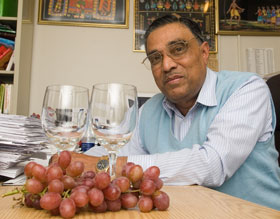
Dipak Das, who until earlier this year ran a high-profile cardiovascular research center at the University of Connecticut, has recorded a slick looking video defense against allegations that he cooked data and manipulated images in scores of published studies, 12 of which have been retracted to date.

Das, who was hit with a 60,000 pages of allegations stemming from a three-year investigation by the university, spends the bulk of the documentary-style interview — which is available on YouTube — talking about the wonders of resveretrol. But he gets into the misconduct charges at about the 15-minute mark.

Continue reading Resveratrol researcher Das in video: Yes, I manipulated images, but only because the journals asked me to

Catching up: Charges against CFS-XMRV researcher Mikovits dropped, ‘gyres’ author Andrulis publishes another paper

A follow-up on two stories we’ve covered here at Retraction Watch:

1. Criminal charges against chronic fatigue syndrome researcher dropped

The state of Nevada has dropped criminal charges against Judy Mikovits, the embattled chronic fatigue syndrome (CFS) researcher whose paper linking the condition to a virus, XMRV, was retracted last year by Science.

As we reported in November, Mikovits was arrested in Ventura County, California on an “out of county warrant” from Washoe County, Nevada, for allegedly taking lab notebooks, a computer, and other material from the Whittemore Peterson Institute in Reno, Nevada, after the WPI fired her in September.

The first report on the dropped charges was apparently by Mikovits’ friend Lilly Meehan on Facebook, news that was picked up by the ProHealth website on June 13 (their post has since been updated). Later that day, ScienceInsider’s Jon Cohen, who has been covering the case closely, reported that Continue reading Catching up: Charges against CFS-XMRV researcher Mikovits dropped, ‘gyres’ author Andrulis publishes another paper

Shikeagi Kato, who resigned post in March, retracts Nature paper

Shikeagi Kato, an endocrinologist formerly of the University of Tokyo who resigned on March 31 amidst an investigation into his work, has retracted another paper, this one in Nature.

Here’s the notice for “DNA demethylation for hormone-induced transcriptional derepression,” which was the subject of a correction last October: Continue reading Shikeagi Kato, who resigned post in March, retracts Nature paper

Chemist Craig Hill, author of JACS and Science papers, explains the retractions

Last week, we reported that Craig Hill, a prominent chemist at Emory University, and his colleagues at six other institutions are retracting three papers they published in the mid-2000s, two in the Journal of the American Chemical Society and one in Science.

We have now spoken with Hill, who walked us through the history of the research. According to Hill, the international team of researchers, after “unusually extensive experiments” felt they had enough evidence to publish their original articles

but all authors (and others) remained skeptical given the unprecedented nature of these compounds.

Hill’s lab continued to conduct experiments and probe the original data after the publications, he said. (Hill wrote a piece for Nature in 2008 explaining the significance of the research, which, among other things, might lead to better ways of harnessing solar energy.) Continue reading Chemist Craig Hill, author of JACS and Science papers, explains the retractions

JACS, Science retracting three papers from leading Emory chemist Craig Hill

The Journal of the American Chemical Society (JACS) and Science are retracting three papers by Craig Hill and colleagues which, we’re told, have been the focus of intense scrutiny within the field since they first appeared in the mid-2000. Hill is an internationally renowned expert in catalysis who has won a slew of awards for his work.

JACS has acted first, issuing two notices recently about the papers it published. The first notice, for 2005’s “A Palladium-Oxo Complex. Stabilization of This Proposed Catalytic Intermediate by an Encapsulating Polytungstate Ligand,” states: Continue reading JACS, Science retracting three papers from leading Emory chemist Craig Hill

Lead author of major breast cancer study announced at ASCO co-authored two corrected papers with Anil Potti

One of the biggest stories so far out of the American Society of Clinical Oncology (ASCO) meeting that just ended in Chicago was that of T-DM1, which, according to Ivan’s Reuters colleagues, “extended the length of time breast cancer patients lived without their disease getting worse.” (The news was even the subject of an embargo break.)

The widely-hailed study of Roche’s drug was led by Duke’s Kimberly Blackwell, who told The New York Times: Continue reading Lead author of major breast cancer study announced at ASCO co-authored two corrected papers with Anil Potti

Retraction count for resveratrol researcher Dipak Das rises to 12

Das, via UConn

Dipak Das, the UConn researcher whom the university earlier ths year found to have fabricated or falsified data more than 100 times, has four more retractions to his name.

The notices appear in the June 1, 2012 issue of the American Journal of Physiology: Heart and Circulatory Physiology, and suggest that Das was not all that cooperative: Continue reading Retraction count for resveratrol researcher Dipak Das rises to 12

Potential retraction record holder Fujii to Anaesthesia: I’m no stats expert, but my studies have “integrity”

As we reported earlier this spring, the UK journal Anaesthesia published a remarkable statistical analysis of the work of Yoshitaka Fujii, the Japanese anesthesiologist who has been accused of fabricating his results for years — and who, we’re led to believe, may soon wind up with the record for retractions, at a number north of 190.

Fujii has responded to the journal with an equally startling (for different reasons, of course) rebuttal. We received permission from Steve Yentis, Anaesthesia‘s editor, to reprint the letter in its entirely. We present it here, and strongly recommend that readers take a look at the journal’s website to read the piece that prompted Fujii’s response: Continue reading Potential retraction record holder Fujii to Anaesthesia: I’m no stats expert, but my studies have “integrity”

Fujii retractions mount

Spring is a time of rebirth and renewal — and, if you are Yoshitaka Fujii, retraction.

We have seen retraction notices in two journals concerning papers by Fujii, the Japanese anesthesiologist who, according to an international group of editors, may ultimately lose some 190 publications to research fraud.

Otoloaryngology — Head and Neck Surgery last month had the following notice for a 2011 article titled “Antiemetic Efficacy of Low-Dose Midazolam in Patients Undergoing Thyroidectomy,” by Fujii and an M. Ikatura (who has not been accused of wrongdoing, as far as we know): Continue reading Fujii retractions mount

Brit psych journal retracts Stapel paper on the paradox of failure

In 2011, Diederik Stapel, a Dutch researcher who at the time was a shining star in the world of social psychology, published an article in the British Journal of Social Psychology with the counter-intuitive claim that failure can sometimes be more emotionally gratifying than success.

We’re guessing this isn’t one of those times. As readers of this blog well know, Stapel has admitted to fabricating loads of data. The BJSP has now retracted the article.

Here’s the notice for the paper, which has yet to be cited, according to Thomson Scientific’s Web of Knowledge: Continue reading Brit psych journal retracts Stapel paper on the paradox of failure