Why has it taken more than a year to correct a COVID-19 paper?

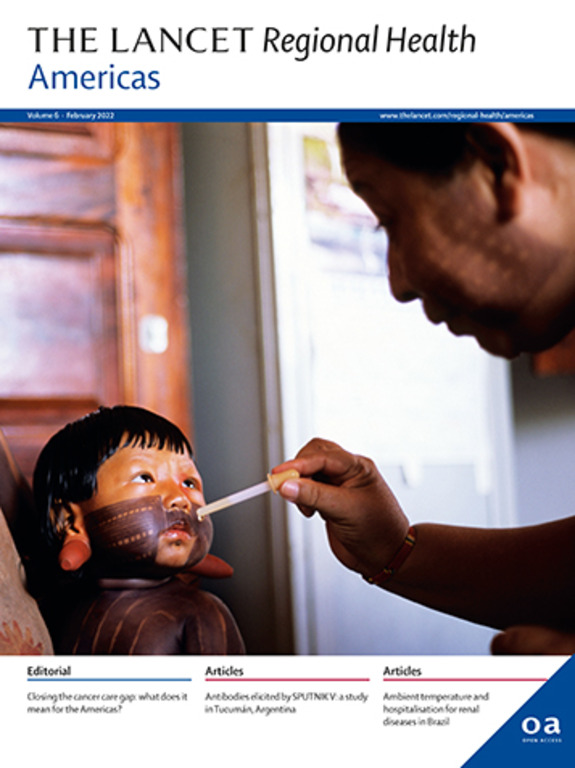
A correction to a clinical trial on a potential treatment for COVID-19 has taken more than a year — and counting — to get published. In the meantime, the article remains marked with an expression of concern that appeared in February 2024. 

The Lancet Regional Health–Americas published the study, a randomized clinical trial of the effect of metformin on hospitalization rates among COVID-19 patients, in December 2021. It has been cited 36 times, according to Clarivate’s Web of Science, 12 of those since the publication of the expression of concern.

In December 2023, the authors “identified small errors in the statistical analysis primary outcome,” corresponding author Edward Mills, a health research methods professor at McMaster University, in Hamilton, Ontario, told Retraction Watch. “We immediately re-ran the analysis and submitted as an erratum,” he said. 

Continue reading Why has it taken more than a year to correct a COVID-19 paper?

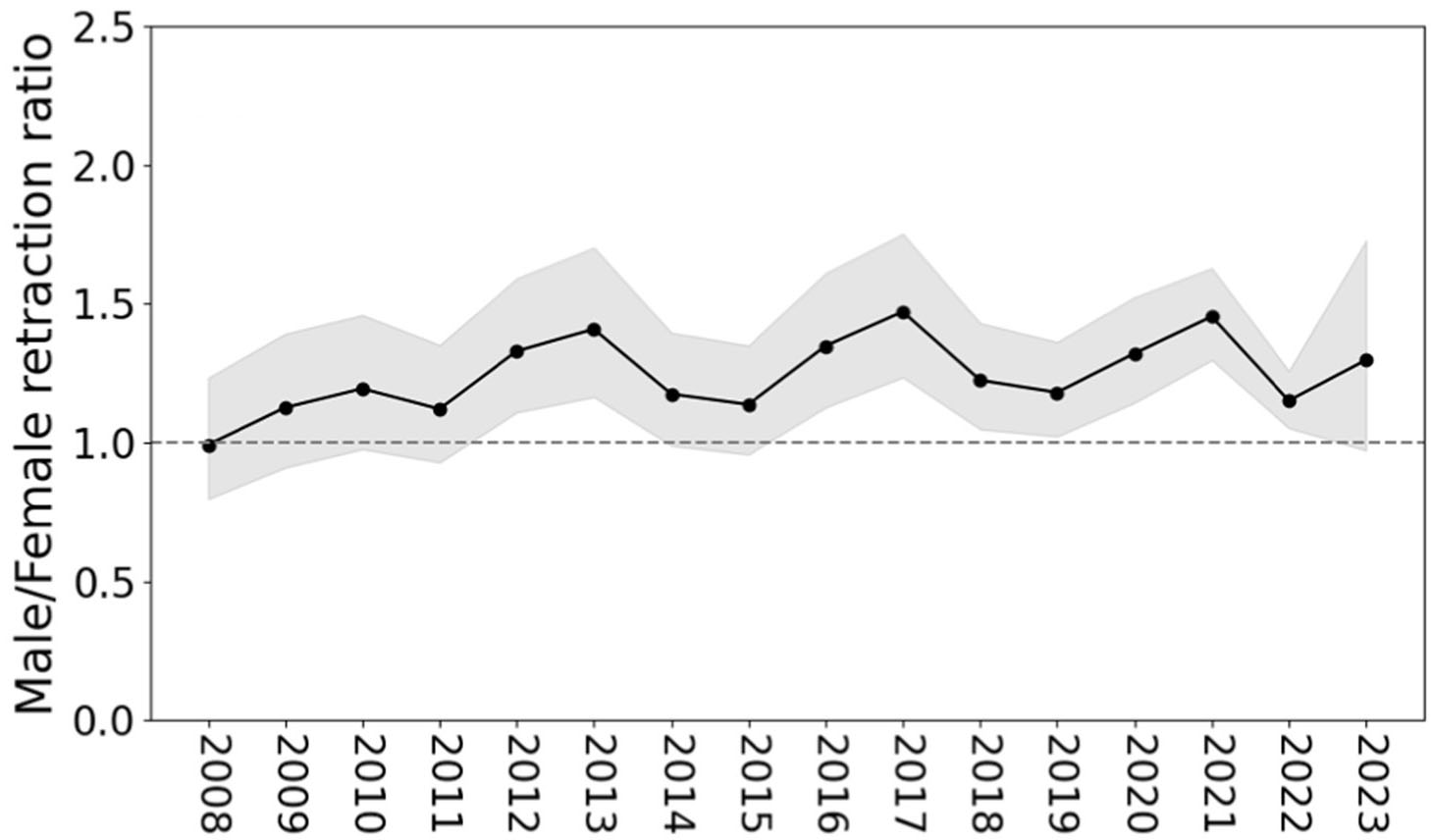
Do men or women retract more? A study found the answer is … complicated 

A new study compares retraction rates between men and women.
Pexels

Longtime Retraction Watch readers know the scientists on our Leaderboard have changed over the years. But one characteristic has remained relatively constant: There are few women on that list – in fact, never rarely more than one at a time.

So when a recent paper dove into whether retraction rates vary by the gender of the authors, we were curious what the authors found.

The team, from Sorbonne Study Group on Methods of Sociological Analysis (GEMASS) in Paris, sampled 1 million articles from the OpenAlex database, then referenced the Retraction Watch database to compare against their sample. 

Continue reading Do men or women retract more? A study found the answer is … complicated 

COVID-19 vaccine myocarditis paper raises questions about what earns post-publication peer review

On March 7, a Sage journal published an expression of concern for an article on cases of myocarditis in people who had received a COVID-19 vaccine. 

“The Editor and the publisher were alerted to potential issues with the research methodology and conclusions and author conflicts of interest” and had undertaken an investigation of the article, the notice stated. According to one of the authors, the investigation involved two new peer reviews of the paper. 

We’ve reported on many cases of authors disagreeing with retractions other publishers issued after conducting post-publication review processes. The papers often involve hot-button issues – pesticide poisoning, the effect of vaping on smoking rates, an estimation of deaths from the use of hydroxychloroquine early in the COVID-19 pandemic, and President Trump’s role in spreading vaccine misinformation on Twitter before the company suspended his account.  

Continue reading COVID-19 vaccine myocarditis paper raises questions about what earns post-publication peer review

Sequence errors are ‘canaries in a coal mine’ in genetics studies, sleuth says 

A genetics researcher came across an interesting paper earlier this year on the gene he studies. The scientist, a doctoral candidate who asked not to be named, decided to take a closer look at which part of the gene, SNHG14, the authors targeted to measure its expression. He ran the sequence of the short strand of DNA, called a primer, given in the paper through a database and found the sequence matched with a completely different gene.

The scientist searched through similar papers and found 19 more across as many journals with the same problem: all their “SNHG14” primers matched with the gene MALAT1/TALAM1. There may be more, but he stopped looking.

Two of the papers he found have been retracted. One appeared in 2023 in Computational and Mathematical Methods in Medicine, a journal Wiley acquired from Hindawi that is no longer publishing. The notice cites inappropriate citations and peer review manipulation. The other article, published in 2022 in the International Journal of Oncology, was retracted for plagiarism. 

Continue reading Sequence errors are ‘canaries in a coal mine’ in genetics studies, sleuth says 

Cureus paper by dean and medical student retracted for mislabeled ECG 

The ECG from the retracted paper, which the journal said was mislabeled.

A paper by a medical student and an associate professor in Florida has been retracted for errors with the central finding of the study, an electrocardiogram whose labeling “does not actually represent any of the characteristics” of the tracing. 

The paper, “Silent Myocardial Infarction: A Case Report,” was published in Cureus in August 2023 and has been cited once, according to Clarivate’s Web of Science.

The retraction notice dated January 28 details issues with the tracing:

Continue reading Cureus paper by dean and medical student retracted for mislabeled ECG 

Editorial board resigns after journal cancels special issue on Palestine

The editorial board of an architecture journal has resigned after its parent association cancelled an upcoming theme issue titled “Palestine.”  

The Journal of Architectural Education planned to publish the issue in fall 2025, according to an archived version of the call for papers, which refers to the “Zionist, militarist, carceral, and capitalist regime of Israeli settler colonialism and apartheid.”

“In the face of the ongoing Israeli genocidal campaign against Palestinians in Gaza, this issue of the Journal of Architectural Education calls for urgent reflections on this historical moment’s implications for design, research, and education in architecture,” the call for papers read. 

Continue reading Editorial board resigns after journal cancels special issue on Palestine

Guest post: Should Zimbardo’s Stanford Prison Experiment be retracted?

A prisoner and guard in the Stanford Prison Experiment. | PrisonExp.org

Philip G. Zimbardo passed away in October 2024 at age 91. He enjoyed an illustrious career at Stanford University, where he taught for 50 years. He accrued a long list of accolades, but his singular and enduring contribution to scholarship was the Stanford Prison Experiment, a simulation carried out in the university’s psychology department in August 1971. The research project became the best-known psychological analysis of institutionalization at the time. 

The study has always been treated with skepticism by penologists and psychologists, and recent scholarship by social scientist Thibault Le Texier has raised fundamental questions about the scientific validity of the investigation, the originality of the research design, the unethical treatment of the subjects, and the credibility of the reported results. 

Many consider Zimbardo’s SPE to be one of the classic studies of experimental psychology in the post-war period. It continues to be reported as a landmark achievement in many psychological textbooks today, despite drawing decades of criticism both in and out of the scientific literature. But considering Le Texier’s findings, should Zimbardo’s work be retracted?

Continue reading Guest post: Should Zimbardo’s Stanford Prison Experiment be retracted?

His manuscript was rejected. Then he saw it published by other authors

A chemist at a university in Pakistan found a surprise when he opened an alert from ResearchGate on a newly published paper on a topic related to his own work. 

When Muhammad Kashif, a chemist at Abdul Wali Khan University Mardan, looked at the paper, he noticed “substantial overlap” with an unpublished review article he had submitted to other journals. On closer inspection, he found it was indeed his paper — published by other authors. 

“I was shocked and deeply concerned,” Kashif told Retraction Watch. “My unpublished work was replicated without attribution, undermining months of effort.” 

Continue reading His manuscript was rejected. Then he saw it published by other authors

Five studies from “Bust Size and Hitchhiking” author retracted 

A journal has retracted five papers about the appearance, sexual behavior and attractiveness of women. 

Nicolas Guéguen, a professor of marketing at the Université de Bretagne-Sud in France, was an author on each of the papers, published in the Sage journal Perceptual and Motor Skills (PMS) at least 15 years ago. All of the articles garnered expressions of concern in 2023, but Guéguen’s history of misconduct long precedes the PMS papers. 

Sleuths have been flagging Guéguen’s work for years for seemingly impossible results. In 2019, he was cleared of wrongdoing by his university, but since then has racked up at least four retractions, according to the Retraction Watch database

Continue reading Five studies from “Bust Size and Hitchhiking” author retracted 

Guest post: If you’re going to critique science, be scientific about it

Loren K. Mell

Editor’s note: This post responds to a Feb. 13 article in The Atlantic, “The Scientific Literature Can’t Save Us Now,” written by Retraction Watch cofounders Adam Marcus and Ivan Oransky.

The contentious issue of what — and more importantly who — to believe, when it comes to medical science, is at a critical moment. Watchdog organizations such as Retraction Watch provide a great service to science and the public, by exposing junk scientists and their products, helping to disinfect the field with their sunlight. I commend Mr. Marcus and Dr. Oransky for their sustained efforts in this meta-discipline. 

However, policing the scientific literature is a tricky business. In particular, one must be careful to apply the same standards one demands of others to one’s own work. Agreeable as many of their points are, Marcus and Oransky’s article discrediting Mawson and Jacob’s study (which Robert F. Kennedy Jr. cited during his confirmation hearings) falls woefully short of meeting even basic scientific editorial standards. This failure imbues their article with the same yellow hue that they decry in others’ journalism.

Continue reading Guest post: If you’re going to critique science, be scientific about it