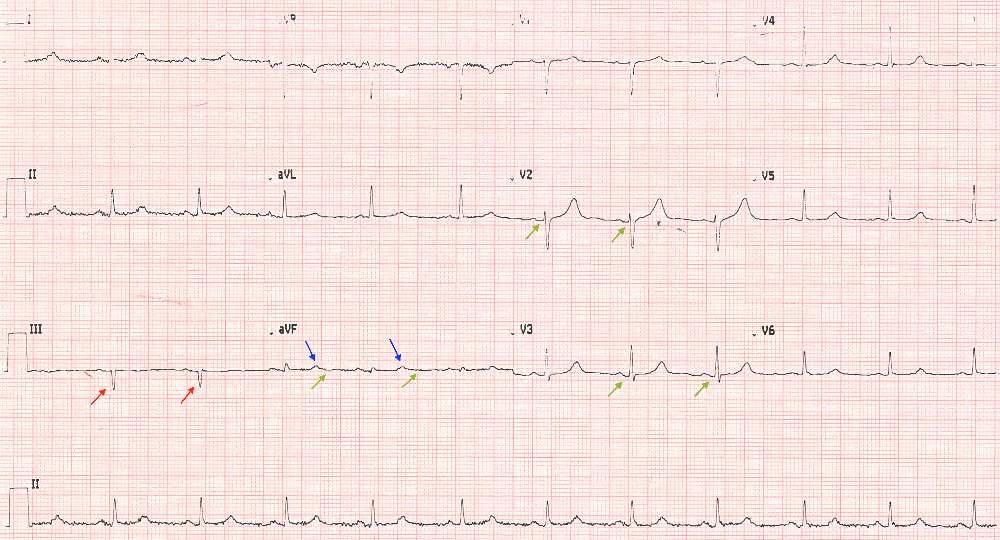
The ECG from the retracted paper, which the journal said was mislabeled.
A paper by a medical student and an associate professor in Florida has been retracted for errors with the central finding of the study, an electrocardiogram whose labeling “does not actually represent any of the characteristics” of the tracing.
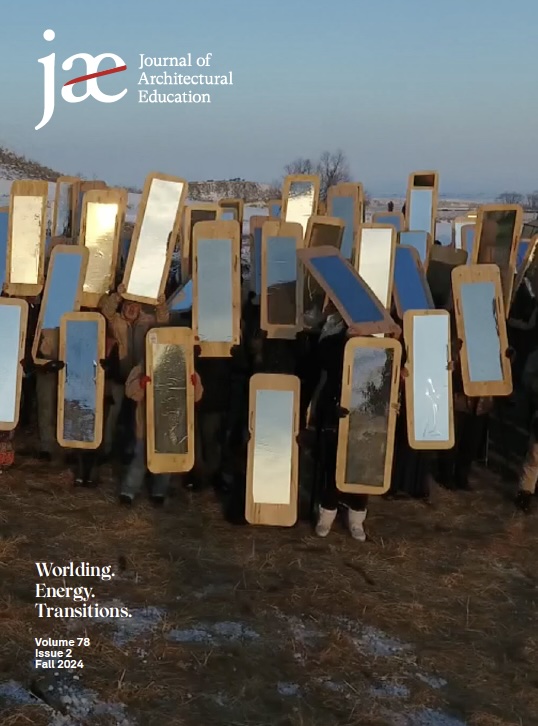
“In the face of the ongoing Israeli genocidal campaign against Palestinians in Gaza, this issue of the Journal of Architectural Education calls for urgent reflections on this historical moment’s implications for design, research, and education in architecture,” the call for papers read.
A prisoner and guard in the Stanford Prison Experiment. | PrisonExp.org
Philip G. Zimbardo passed away in October 2024 at age 91. He enjoyed an illustrious career at Stanford University, where he taught for 50 years. He accrued a long list of accolades, but his singular and enduring contribution to scholarship was the Stanford Prison Experiment, a simulation carried out in the university’s psychology department in August 1971. The research project became the best-known psychological analysis of institutionalization at the time.
The study has always been treated with skepticism by penologists and psychologists, and recent scholarship by social scientist Thibault Le Texier has raised fundamental questions about the scientific validity of the investigation, the originality of the research design, the unethical treatment of the subjects, and the credibility of the reported results.
Many consider Zimbardo’s SPE to be one of the classic studies of experimental psychology in the post-war period. It continues to be reported as a landmark achievement in many psychological textbooks today, despite drawing decades of criticism both in and out of the scientific literature. But considering Le Texier’s findings, should Zimbardo’s work be retracted?
A chemist at a university in Pakistan found a surprise when he opened an alert from ResearchGate on a newly published paper on a topic related to his own work.
When Muhammad Kashif, a chemist at Abdul Wali Khan University Mardan, looked at the paper, he noticed “substantial overlap” with an unpublished review article he had submitted to other journals. On closer inspection, he found it was indeed his paper — published by other authors.
“I was shocked and deeply concerned,” Kashif told Retraction Watch. “My unpublished work was replicated without attribution, undermining months of effort.”
A journal has retracted five papers about the appearance, sexual behavior and attractiveness of women.
Nicolas Guéguen, a professor of marketing at the Université de Bretagne-Sud in France, was an author on each of the papers, published in the Sage journal Perceptual and Motor Skills (PMS) at least 15 years ago. All of the articles garnered expressions of concern in 2023, but Guéguen’s history of misconduct long precedes the PMS papers.
Sleuths have been flagging Guéguen’s work for years for seemingly impossible results. In 2019, he was cleared of wrongdoing by his university, but since then has racked up at least four retractions, according to the Retraction Watch database.
Editor’s note: This post responds to a Feb. 13 article in The Atlantic, “The Scientific Literature Can’t Save Us Now,” written by Retraction Watch cofounders Adam Marcus and Ivan Oransky.
The contentious issue of what — and more importantly who — to believe, when it comes to medical science, is at a critical moment. Watchdog organizations such as Retraction Watch provide a great service to science and the public, by exposing junk scientists and their products, helping to disinfect the field with their sunlight. I commend Mr. Marcus and Dr. Oransky for their sustained efforts in this meta-discipline.
However, policing the scientific literature is a tricky business. In particular, one must be careful to apply the same standards one demands of others to one’s own work. Agreeable as many of their points are, Marcus and Oransky’s article discrediting Mawson and Jacob’s study (which Robert F. Kennedy Jr. cited during his confirmation hearings) falls woefully short of meeting even basic scientific editorial standards. This failure imbues their article with the same yellow hue that they decry in others’ journalism.
While reviewing a manuscript for the Journal of Organic Chemistry, Caroline Kervarc-Genre and her colleague, Thibault Cantat, researchers at the French Alternative Energies and Atomic Energy Commission, noticed something unusual.
The nuclear magnetic resonance (NMR) spectra buried in the supplementary information had striking irregularities: The baseline was interrupted in some parts, and the noise was the same from one spectrum to the next. “Noise being inherently random, repeating noise is only possible if the spectra are altered [or] fake,” Kervarc-Genre told Retraction Watch.
Starting to suspect something was wrong, she and Cantat, examined other papers by the lead author. They discovered data appeared to have been edited in several of the author’s latest publications. “The fraud was not subtle,” Kervarc-Genre said.
She had never come across such blatant fraud, she said, and was unsure about what to do, so turned to PubPeer to report the findings. Others soon joined, uncovering more troubling patterns in the work.
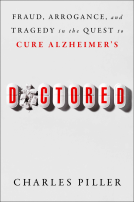
Retraction Watch readers are likely familiar with the work of Charles Piller, an award-winning investigative reporter who has been covering problematic research in neuroscience and other fields for Science. We’re pleased to offer an excerpt of his new book, Doctored: Fraud, Arrogance, and Tragedy in the Quest to Cure Alzheimer’s, which publishes today.
The Journal of Prevention of Alzheimer’s Disease (JPAD) seems authoritative and looks prestigious. Its sponsors are Springer, a division of Springer Nature, one of the largest scientific publishers, and the annual Clinical Trials on Alzheimer’s Disease Congress—a major, global scientific meeting. Many doctors rely on JPAD when deciding whether to prescribe amyloid-reducing drugs such as Leqembi, or others to fight agitation or anxiety that can accompany Alzheimer’s dementia.
Matthew Schrag first raised an eyebrow about the journal in August 2021 while examining possible misconduct in studies behind Cassava Sciences’ simufilam for the citizen petition to the US Food and Drug Administration (FDA). The prior year, JPAD had published a paper by Cassava’s Lindsay Burns and Hoau-Yan Wang that suggested strong potential for the drug. It said simufilam lowered key biomarkers associated with Alzheimer’s—particularly tau proteins—in the spinal fluid of patients who were volunteers for the company’s clinical trial. That paper helped boost confidence in Cassava and simufilam.
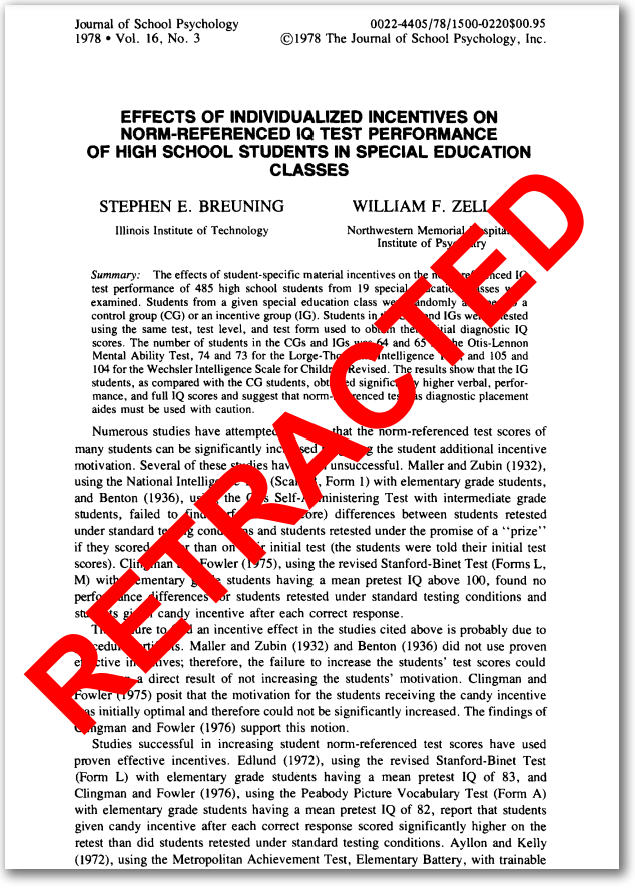
A psychology journal has retracted an article on IQ tests nearly 50 years after publication — and more than 35 years after an investigation found the lead author had fabricated data in several other studies.
Stephen Breuning, a former assistant professor of child psychiatry at the University of Pittsburgh, gained notoriety after a 1987 National Institute of Mental Health report found that he “knowingly, willfully, and repeatedly engaged in misleading and deceptive practices in reporting results of research.” The report concluded Breuning had “engaged in serious scientific misconduct” by fabricating results in 10 articles funded by NIMH grants.
Five of Breuning’s articles published in the 1980s have been retracted; three in the 1980s, one in 2022, and another in 2023. Retraction Watch reported on one of them, “Effects of methylphenidate on the fixed-ratio performance of mentally retarded children,” published in 1983 in Pharmacology Biochemistry and Behavior (now published by Elsevier) and retracted in 2022.
The authors of an influential but controversial 2020 paper on the activity of bat coronaviruses in China which proposed the animals as a “likely origin” for the virus that causes COVID-19 have retracted their work and republished a revised version of the analysis. They say their results and conclusions did not change.
The authors are affiliated with the Wuhan Institute of Virology and the New York City-based nonprofit organization EcoHealth Alliance, which has come under intense scrutiny by members of the U.S. Congress and others. The U.S. government in May suspended funding for EcoHealth amid concerns the COVID-19 pandemic virus may have developed from research on which the nonprofit and Wuhan lab collaborated – a so-called “lab leak.” EcoHealth has denied the pandemic virus could have emerged from its work.