High-profile education researcher has papers retracted and corrected, for plagiarism and misuse of references

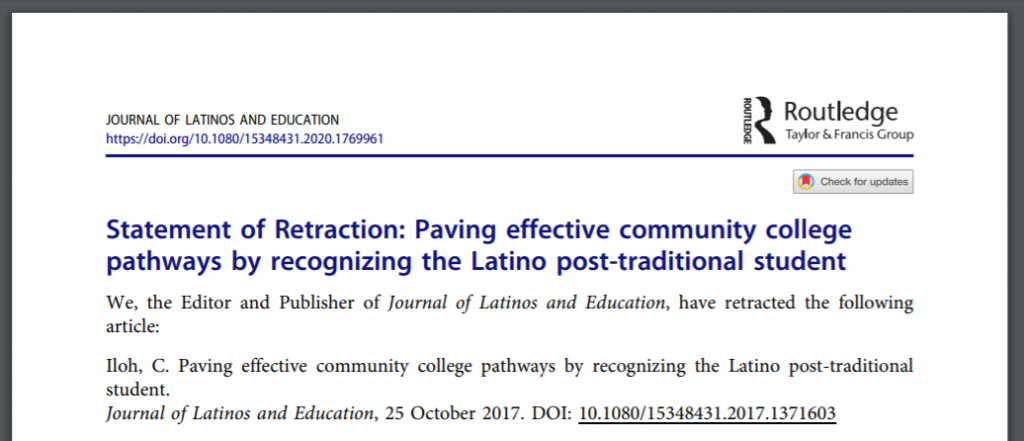
A high-profile education researcher has lost one paper, and corrected two others, for plagiarism and misuse of references. She may also have lost a fourth article, but the journal disappeared the paper without a notice.  

Constance Iloh, of the University of California, Irvine (UCI), is the creator of the “Iloh Model of College-going Decisions and Trajectories,” which she describes as:

a new and innovative three-component ecological model that illuminates contemporary college decisions and educational narratives while also problematizing the notion of college ‘choice.’

In 2016, Forbes magazine named Iloh one of its “30 Under 30” top figures in education. 

Continue reading High-profile education researcher has papers retracted and corrected, for plagiarism and misuse of references

Springer Nature ‘continuing to investigate the concerns raised’ about paper linking obesity and lying

What’s the link between obesity and dishonesty? 

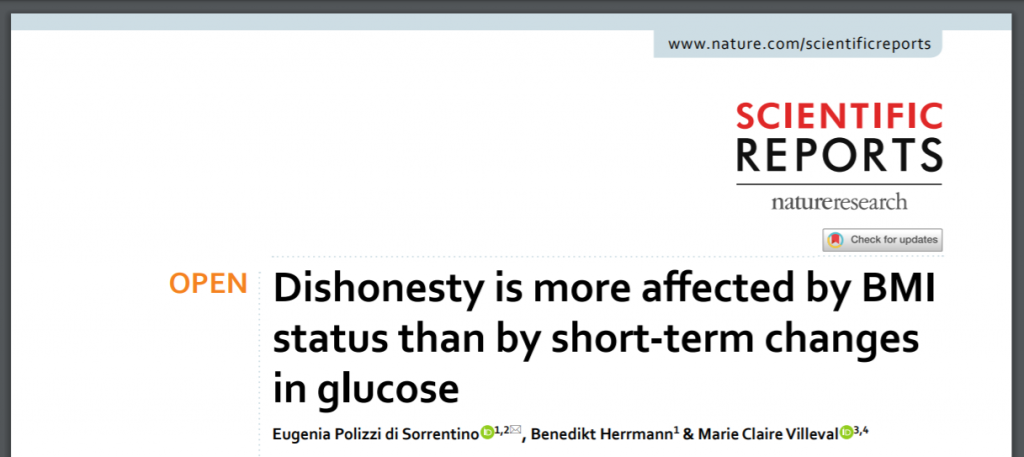
If that question seems preposterous on its face, you’re probably among the critics of a 2020 paper in Scientific Reports which claimed to find that obese people were more deceptive than thinner folk. 

The researchers, led by Eugenia Polizzi di Sorrentino, of the Institute of Cognitive Science and Technologies at the National Research Center in Rome: 

explore[d] the link between energy, obesity and dishonesty by comparing the behaviour of obese and lean subjects when hungry or sated while playing an anonymous die-under-cup task.

They found that: 

Continue reading Springer Nature ‘continuing to investigate the concerns raised’ about paper linking obesity and lying

Top chemistry journal retracts paper for faked data

A leading chemistry journal has retracted a 2019 paper by a pair of researchers in Switzerland after determining that it contained fabricated data. 

The article, “The manganese(I)‐catalyzed asymmetric transfer hydrogenation of ketones: disclosing the macrocylic privilege,” was written by Alessandro Passera and Antonio Mezzetti, of the ETH Zurich in Switzerland. It appeared in Angewandte Chemie International Edition.  

Readers might remember Angewandte Chemie from this post in June about a controversial article it published — and then removed — in the wake of a mass outcry that prompted much of its editorial board to resign and led to the suspension of two of its editors. Fallout from the scandal — in the form of “the journal’s interim Editor-in-Chief Committee” — is evident in the retraction notice, which reads

Continue reading Top chemistry journal retracts paper for faked data

Hydroxychloroquine, push-scooters, and COVID-19: A journal gets stung, and swiftly retracts

This may be the scientific publishing version of “the operation was a success, but the patient died.”

The retraction of a Trojan horse paper on the novel coronavirus has called into question the validity of another article in the same journal which found that hydroxychloroquine is effective against Covid-19. 

The sting article, “SARS-CoV-2 was Unexpectedly Deadlier than Push-scooters: Could Hydroxychloroquine be the Unique Solution?”  — was the brainchild of graduate student Mathieu Rebeaud, aka “Willard Oodendijk” and Florian Cova, of “The Institute for Quick and Dirty Science” (no, not really) in Switzerland. Their goal: to highlight a concerning paper in the Asian Journal of Medicine and Health, which they and others suspect of being a predatory publication — one that is happy to take money to publish anything, while pretending to perform peer review. 

Continue reading Hydroxychloroquine, push-scooters, and COVID-19: A journal gets stung, and swiftly retracts

The ‘Iran Connection’: A ring of four research groups has published hundreds of dodgy papers, says whistleblower

A scheme of far-reaching research misconduct among several groups of Iranian researchers may have created hundreds of low-quality and fraudulent publications, according to a new detailed report by an anonymous whistleblower who has already forced the retraction of dozens of papers by one author in the ring.

The whistleblower, who goes by the pseudonym Artemisia Stricta, says that he or she is an expert in the field of construction engineering — the same as researchers behind the alleged misconduct.

In a new report now being made public by Retraction Watch, Artemisia draws attention to four main groups centered on Ali Nazari, Mostafa Jalal, a postdoc at Texas A&M University, Ehsan Mohseni of the University of Newcastle in Australia, and Alireza Najigivi of Sharif University of Technology in Tehran. The whistleblower lists a total of 287 potentially compromised papers in the 42-page report.

Continue reading The ‘Iran Connection’: A ring of four research groups has published hundreds of dodgy papers, says whistleblower

Consumer researcher leaves Pitt after retractions for data anomalies

A brand researcher has parted ways with the Katz Graduate School of Business at the University of Pittsburgh, Retraction Watch has learned.

The researcher, Nicole Verrochi Coleman, was an associate professor of business administration. Her staff profile disappeared a few weeks after several recent retractions came to light. A Pitt spokesperson confirmed that Coleman was no longer at the university.

Journals pulled several of Coleman’s consumer research articles after learning of “unexplained irregularities” in her data. Coleman’s staff profile at the university now directs to a“page not found” error.

Continue reading Consumer researcher leaves Pitt after retractions for data anomalies

Getting medieval: Society says it is retracting 14 book reviews for plagiarism

More than a dozen book reviews by a history PhD student are under scrutiny for plagiarism concerns. 

The reviews are published in the Al-Masāq Journal of the Medieval Mediterranean, a Society for the Medieval Mediterranean journal published by Taylor & Francis. The majority of the papers appear to be stolen whole works from other authors published in different historical journals.

The society posted a retraction notice today saying that the reviews had been removed, but at the time of this writing, all 14 are still available on publisher Taylor & Francis’s site, without any editor’s notes or other flags.

The society’s notice says:

Continue reading Getting medieval: Society says it is retracting 14 book reviews for plagiarism

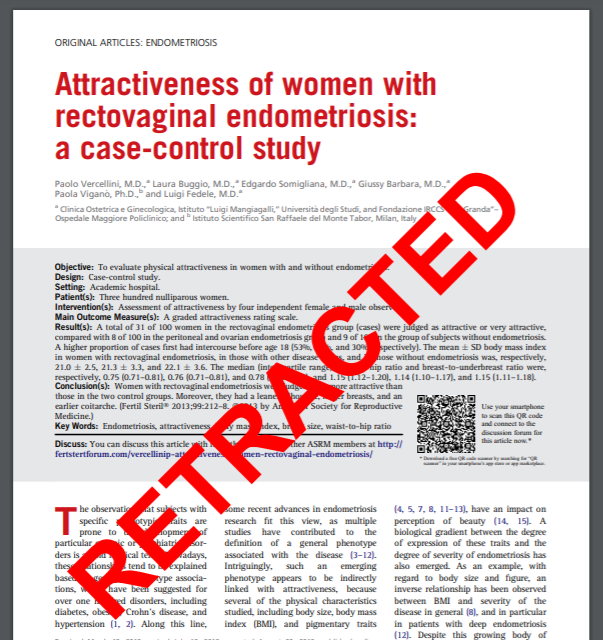
Study rating attractiveness of women with endometriosis is not yet retracted

Despite media reports announcing the retraction of a much-criticized study of whether women with endometriosis were more attractive than other women, the study has yet to be retracted by the journal.

Last week, several news outlets, picking up on a story in The Guardian, said the study, first published in 2012 in Fertility and Sterility, had been retracted. 

The study, called “Attractiveness of women with rectovaginal endometriosis: a case-control study,” claimed to show that:

Continue reading Study rating attractiveness of women with endometriosis is not yet retracted

A retraction and a retraction request as Twitter users call out sexism, fat-shaming, and racism

Overweight people are more dishonest, women with endometriosis are more attractive, and affirmative action needs to stop: Papers with these three conclusions have come under intense scrutiny on social media in recent days, with at least one retracted. 

First up, a study — widely criticized for being sexist — which claimed to find that

Women with rectovaginal endometriosis were judged to be more attractive than those in the two control groups. Moreover, they had a leaner silhouette, larger breasts, and an earlier coitarche.

The study, called “Attractiveness of women with rectovaginal endometriosis: a case-control study” was published in 2013 in Fertility and Sterility, an Elsevier publication. It received sharp criticism on PubPeer beginning a year ago when one commenter, “Ovine Mastadenovirus,” wrote:

Continue reading A retraction and a retraction request as Twitter users call out sexism, fat-shaming, and racism

Cancer surgery group in China may lose second paper

After whistleblowers in China prompted the retraction of a 2018 paper that overstated the number of patients treated in a study, another journal says it’s investigating a second article by the same group.

Last month, as we reported, the Journal of Surgical Oncology retracted “Long‐term outcomes of 530 esophageal squamous cell carcinoma patients with minimally invasive Ivor Lewis esophagectomy.” The move was prompted by whistleblowers who notified the journal that the 530 cases could not have been performed at the authors’ institution, Zhejiang University, in Hangzhou. 

After our post, a Twitter user pointed us to a second article by the group, in BMC Cancer, which claimed to report data on 697 subjects over just one additional year — a highly improbable figure. 

Continue reading Cancer surgery group in China may lose second paper