“This unfortunate situation”: Journal retracts bizarre paper about a black hole at the center of Earth

A black hole, not at the center of the Earth (via Wikimedia)

It was a paper that caught the attention — and bemusement — of Twitter:

And now it is no more, along with four more articles from the Open Access Macedonian Journal of Medical Sciences in what was billed as a special issue on Global Dermatology.

Here’s the whole title: “A black hole at the center of earth plays the role of the biggest system of telecommunication for connecting DNAs, dark DNAs and molecules of water on 4+N- dimensional manifold.” (Be warned that the link takes you to a login.)

You may fairly wonder what a terrestrial black hole and skin diseases have in common. The abstract, which we present for posterity, sheds no, ahem, light on the question:

Continue reading “This unfortunate situation”: Journal retracts bizarre paper about a black hole at the center of Earth

Exclusive: University of Arizona says former researcher committed misconduct by plagiarizing figure

Palash Gangopadhyay

A former researcher in the University of Arizona’s optics school engaged in “a serious case of research misconduct,” Retraction Watch has learned.

Palash Gangopadhyay, who until 2019 was a research scientist at Arizona, used a figure from a 2003 paper by other authors when he co-authored a 2018 paper in Optics Letters titled “High sensitivity magnetometer using nanocomposite polymers with large magneto-optic response,” Wyant College of Optical Sciences dean Thomas Koch wrote to colleagues in an email obtained by Retraction Watch. The 2003 paper appeared in an obstetrics journal.

Figure 4b of 2018 paper
From Figure 3 of 2003 paper

The 2018 paper has been cited nine times, according to Clarivate Analytics’ Web of Science.

Koch wrote:

Continue reading Exclusive: University of Arizona says former researcher committed misconduct by plagiarizing figure

Journal retracts paper claiming smarter people are more likely to use a condom to avoid HIV

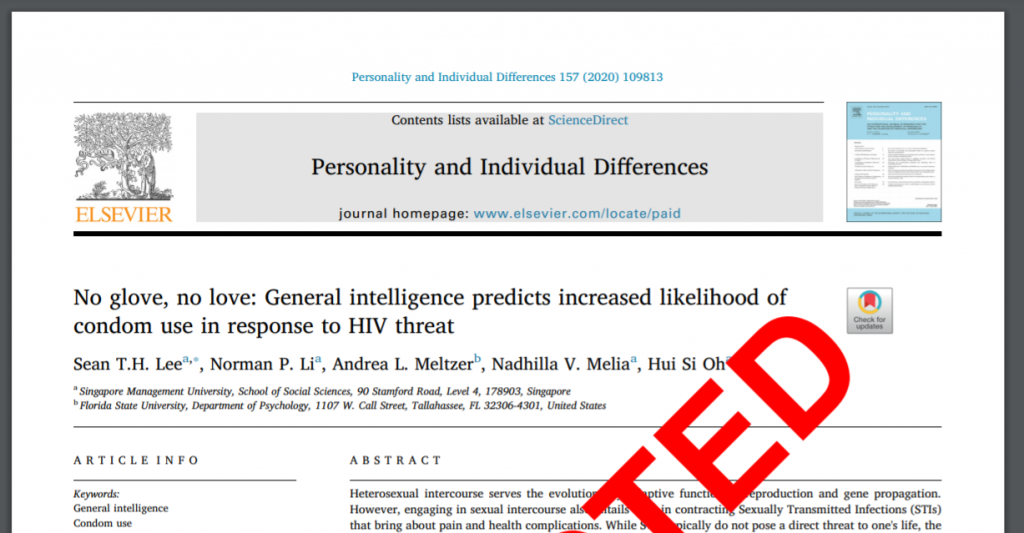
A psychology journal has retracted a 2020 paper purporting to find that smarter people are more likely to use a condom during sex to avoid HIV. 

The new study, by researchers from Singapore and the United States led by Sean Lee of the Singapore Management University School of Social Sciences, appeared in Personality and Individual Differences.

The paper claimed to find that: 

Continue reading Journal retracts paper claiming smarter people are more likely to use a condom to avoid HIV

Publisher retracts nearly two dozen articles, blocks nearly three dozen more, from alias-employing author who plagiarized

IOP Publishing has retracted nearly two dozen conference proceedings which had been cribbed from other articles, translated into English and festooned with citations to the authors’ own work. 

According to the publisher, 12 of the 29 authors on the papers come from the same institution, Universidad de la Costa, in Barranquilla, Colombia. IOP says the institution is investigating. 

The first author on most of the papers is Jesus Silva, who appears to be affiliated with the Universidad Peruana de Ciencias Aplicadas, in Lima, Peru — and has now joined our leaderboard with 23 retractions. For some, the first author is Amelec Viloria, of Universidad de la Costa. 

Except, according to IOP Publishing, Silva and Viloria are the same person, using an alias on some of the articles. 

Continue reading Publisher retracts nearly two dozen articles, blocks nearly three dozen more, from alias-employing author who plagiarized

The list of retracted COVID-19 papers is up to 33

To the list of COVID-19 papers that have been retracted so far, add this: 

The Korean Journal of Anesthesiology has retracted an article it published last month on ventilating COVID patients because it was nearly identical to one that had appeared in a different journal three months earlier. 

The offending article, “Noninvasive versus invasive ventilation: one modality cannot fit all during COVID-19 outbreak,” was written by Abhishek Singh, an anesthesiologist at the All India Institute of Medical Sciences in New Delhi.

Continue reading The list of retracted COVID-19 papers is up to 33

‘Women’s respect is a priority for us’: Journal finally retracts paper claiming women with endometriosis are more attractive

The journal that published a paper claiming that attractive women were more likely to develop endometriosis has finally retracted the article, more than a month after the authors called for the move. 

The article, “Attractiveness of women with rectovaginal endometriosis: a case-control study,” appeared in September 2012 in Fertility and Sterility, an official publication of the American Society for Reproductive Medicine. Over the years, it had been the subject of criticism.

In early August, the authors of the paper, from Italy, called for the retraction of the work. But that didn’t happen until now

Per the retraction notice, which is undated — as has become common for Elsevier journals that overwrite their original HTML pages — but seems to have appeared within the last few days: 

Continue reading ‘Women’s respect is a priority for us’: Journal finally retracts paper claiming women with endometriosis are more attractive

Arizona State investigating data anomalies in work by two former neuroscience faculty members

Arizona State University is investigating two former faculty members suspected of falsifying data in several of their papers.

The inquiry centers on Antonella Caccamo and Salvatore Oddo, who recently lost their 2016 article in Molecular Psychiatry, a Nature journal, titled “p62 improves AD-like pathology by increasing autophagy.”  

Caccamo once held a research appointment in the ASU-Banner Neurodegenerative Disease Research Center. Oddo, also worked in the center, where he was an associate professor. 

While at ASU — including Banner Health — Oddo received more than $11 million in grants from the National Institutes of Health (NIH) and was co-PI on grant from the National Science Foundation worth more than $220,000. Caccamo received one grant from NIH, in 2018, totaling roughly $543,000. 

According to the retraction notice

Continue reading Arizona State investigating data anomalies in work by two former neuroscience faculty members

Going cold turkey: Infectious disease-poultry researcher up to 14 retractions

via Flickr

Nine strikes in a row in bowling is called a “golden turkey.” So what do you call 10 papers on poultry pulled at once for plagiarism? 

We first wrote about Sajid Umar in July 2018, when he’d lost a 2016 article in Scientifica for plagiarism and other sins, and then again earlier this summer when he notched two more retractions from Poultry Science for “grave mistakes.” 

Now, the World’s Poultry Science Journal, a Taylor & Francis title, has pulled 10 more of Umar’s articles — bringing his total to 14, by our count. According to the retraction notice for the 2017 paper “Mycoplasmosis in poultry: update on diagnosis and preventive measures”:

Continue reading Going cold turkey: Infectious disease-poultry researcher up to 14 retractions

University of Kentucky demotes cancer researcher following finding of misconduct by scientist in his lab

A misconduct scandal at the University of Kentucky has led to the demotion of a senior cancer researcher for his lack of oversight of a now-former scientist who fabricated data in at least four papers and two grant applications.  

According to the university, the inquiry began in April 2019, after the institution received complaints about suspect figures in six papers published by UK researchers. The lead on the articles was John D’Orazio, a clinician and researcher with appointments at the Markey Cancer Center and UK Healthcare. 

In November 2019, UK investigators turned their attention to Stuart Jarrett, a co-author on all six papers who had joined D’Orazio’s lab in 2012 but left in September 2019. 

According to the university: 

Continue reading University of Kentucky demotes cancer researcher following finding of misconduct by scientist in his lab

Major indexing service rejects appeals by two suppressed journals

Journals hoping that Clarivate Analytics — the company behind the Impact Factor — would reverse their decision to suppress their titles from the closely watched metric are batting .500.

In July, as we reported, Clarivate suppressed 33 journals from its Journal Citation Reports (JCR), which means they will not have a 2019 Impact Factor, because of what Clarivate said was excessive self-citation. As affected journals have noted, suppression from the list can have a major impact on journals and researchers, many of whom are judged based on where they publish, using Impact Factor as a key metric.

Two journals —  Zootaxa and the International Journal of Systematic and Evolutionary Microbiologysuccessfully appealed the decision, and have been reinstated in the 2019 JCR. But appeals by two others — Body Image and Forensic Science International: Genetics (FSIGEN) — have been denied, Retraction Watch has learned.

Between August 18 and August 26, nearly 500 forensic scientists from 49 countries signed a petition objecting to Clarivate’s move, according to Ulises Toscanini, director of the Laboratory PRICAI-Fundación Favaloro and a professor at Favaloro University in Buenos Aires. Toscanini,  president of the executive committee of the Spanish and Portuguese Speaking Working Group of the International Society for Forensic Genetics, said FSIGEN “is a ‘niche’ journal,” and is “broadly recognized as the top journal of the area.” He continued:

Continue reading Major indexing service rejects appeals by two suppressed journals