Amulets may prevent COVID-19, says a paper in Elsevier journal. (They don’t.)

The paper’s graphical abstract

Sometimes, we just don’t know what to say.

So we’ll let the people of Twitter comment on a paper titled “Can Traditional Chinese Medicine provide insights into controlling the COVID-19 pandemic: Serpentinization-induced lithospheric long-wavelength magnetic anomalies in Proterozoic bedrocks in a weakened geomagnetic field mediate the aberrant transformation of biogenic molecules in COVID-19 via magnetic catalysis,” claiming that

Continue reading Amulets may prevent COVID-19, says a paper in Elsevier journal. (They don’t.)

Widely cited COVID-19-masks paper under scrutiny for inaccurate stat

You probably read a story or heard a news report over the past few days saying that if nearly all Americans wore masks to prevent COVID-19 spread, 130,000 lives could be saved by the end of February. That’s what a paper published on Friday says.

But it turns out that figure sounds twice as good as reality. Here’s the story:

On October 6, a group at the Institute for Health Metrics Evaluation (IHME) — a frequently cited source of COVID-19 data — submitted a manuscript to Nature Medicine. The paper was accepted on October 13, and published on October 23. It concluded:

Continue reading Widely cited COVID-19-masks paper under scrutiny for inaccurate stat

Journal flags — but does not retract — decades-old paper on “correcting” gender identity

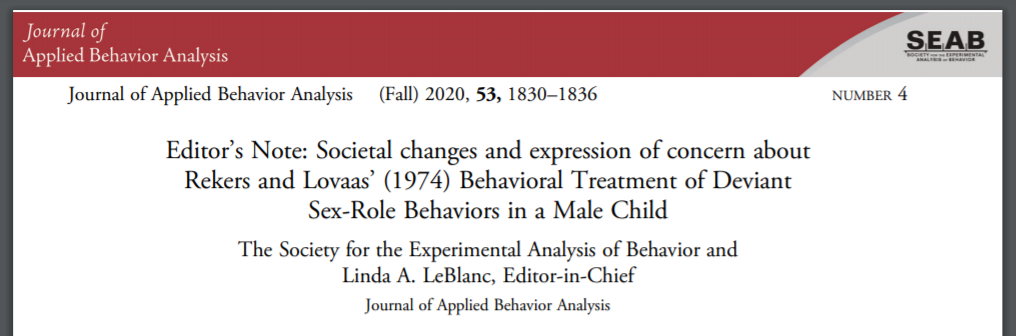
A psychology journal has expressed concern about a 46-year-old paper which described attempts to correct “deviant” gender identity in a 5-year-old boy using physical violence — the latest example of journals purging (or semi-purging) their pages of offensive studies. 

The 1974 article, “Behavioral treatment of deviant sex‐role behaviors in a male child,” appeared in the Journal of Applied Behavior Analysis. Its authors were O. Ivar Lovaas, a controversial psychologist, and George Rekers, who pushed now long-discredited conversion therapy and whose career flamed out spectacularly, as the journal’s editors note in an editorial published alongside the expression of concern:

Continue reading Journal flags — but does not retract — decades-old paper on “correcting” gender identity

Algebra paper retracted because of questions about the “integrity of the mathematics”

A physicist who in 2016 threatened to sue Elsevier after the publisher retracted one of his papers has lost another article over concerns about the “integrity of the mathematics” in the paper. 

The article, “Eight-dimensional octonion-like but associative normed division algebra,” by Joy Christian, of the Einstein Centre for Local-Realistic Physics in Oxford, UK, appeared in Communications in Algebra in July 2020. According to the notice

Continue reading Algebra paper retracted because of questions about the “integrity of the mathematics”

Study finding patients of female surgeons fare better is temporarily removed

An Elsevier journal has, for the moment, removed a paper which found that the patients of female surgeons fare better than those treated by men.

Although the journal didn’t provide an explanation for the move — unfortunately not unusual for Elsevier — a spokesman for the publisher told us that reader complaints about the methodology and statistics in the article prompted the action. 

The paper, which appeared last month in Surgery — the official journal of the Society of University Surgeons, Central Surgical Association, and the American Association of Endocrine Surgeons — was written by a group at the University of South Florida, in Tampa, led by Tara M. Barry, a general surgery resident at the institution. 

“Battle of the sexes: The effect of surgeon gender on postoperative in-hospital mortality,” isn’t available on the journal website. However, a conference abstract by the authors states

Continue reading Study finding patients of female surgeons fare better is temporarily removed

Journal retracts paper claiming that group of Indigenous Americans were Black Africans

A journal has retracted a paper on the origins of a group of Indigenous Americans after readers said the basis of the paper was long discredited.

The paper, “Early pioneers of the americas: the role of the Olmecs in urban education and social studies curriculum,” was written by scholars at the University of North Carolina at Charlotte, including corresponding author Greg Wiggan, and researchers at Towson State University, and published on June 25, 2020, in the Urban Review

In a July 23 post on Medium, Kurly Tlapoyawa and Ruben A. Arellano “ask that the The Urban Review journal retract the article by Wiggan et al and discontinue its promotion of ‘Black Olmecs:’”

Continue reading Journal retracts paper claiming that group of Indigenous Americans were Black Africans

Researchers face disciplinary action as dozens of their studies fall under scrutiny

A group of obstetrics researchers in the Middle East is facing disciplinary action after questions were raised about the validity of the data in dozens of their published studies. 

The tale — involving contaminated clinical trials, potentially fabricated PhDs, findings of misconduct that went ignored, accusations of terrorist sympathies and unresponsive journals — requires some unpacking, so bear with us. 

We begin with a study that appeared in April in the European Journal of Obstetrics & Gynecology and Reproductive Biology (EJOG). Esmée Bordewijk, a PhD student at the Center for Reproductive Medicine at Amsterdam University Medical Center, and her colleagues reported that they stumbled on the problems while conducting a literature review on ovulation induction for the venerable Cochrane Database: 

Continue reading Researchers face disciplinary action as dozens of their studies fall under scrutiny

Heard about the study claiming men who carry guitar cases are more attractive? It’s been retracted.

via PickPik

A controversial psychologist has lost a bizarre paper which claimed that men who carry guitar cases do better with the ladies.

The article, which had appeared in the journal The Psychology of Music in 2014, was one of many papers by Nicholas Guéguen that have raised eyebrows among his peers and some data sleuths — notably James Heathers and Nick Brown — who believe the results don’t withstand scrutiny

Guéguen, of the Université Bretagne-Sud, in France, was the subject of a misconduct investigation that in 2019 cleared him of wrongdoing. That finding came shortly after, as we reported nearly a year ago to the day, he lost a 2014 paper in the Archives of Sexual Behavior on how high heels really do make women sexier:  

Continue reading Heard about the study claiming men who carry guitar cases are more attractive? It’s been retracted.

30 years later, physics journal retracts paper that blamed feminism for many of society’s ills

Gordon Freeman

For those of you who think that critiques of feminism have no place in journals about physics, the Canadian Journal of Physics agrees. But it took them 30 years to get there. 

The journal has retracted a 1990 article by a notorious male chauvinist who claimed, among other things, that feminism was responsible for an increase in cheating in school, psychological damage in young children and an overall decay in society. 

The case has echoes of the controversy over Thomas Hudlicky, another Canadian chemist who recently lost a 30-year-old paper for sexism and anti-diversity views. 

This time, the author was Gordon Freeman, a now-emeritus professor of chemistry at the University of Alberta, in Canada. Its title is one of those science-y-sounding strings of words that say both very little and, on reflection, quite a lot: “Kinetics of nonhomogeneous processes in human society: Unethical behaviour and societal chaos.” 

Continue reading 30 years later, physics journal retracts paper that blamed feminism for many of society’s ills

Almond, no joy: Plant geneticist in Iran up to at least six retractions

A plant geneticist in Iran is up to at least six retractions for misuse of figures and other material from previously published papers. 

The newest retraction involves a 2017 paper in Scientific Reports, a Springer Nature publication, titled “Comparison of traditional and new generation DNA markers declares high genetic diversity and differentiated population structure of wild almond species.” PubPeer commenters have been discussing it for some seven months.

According to the notice

Continue reading Almond, no joy: Plant geneticist in Iran up to at least six retractions