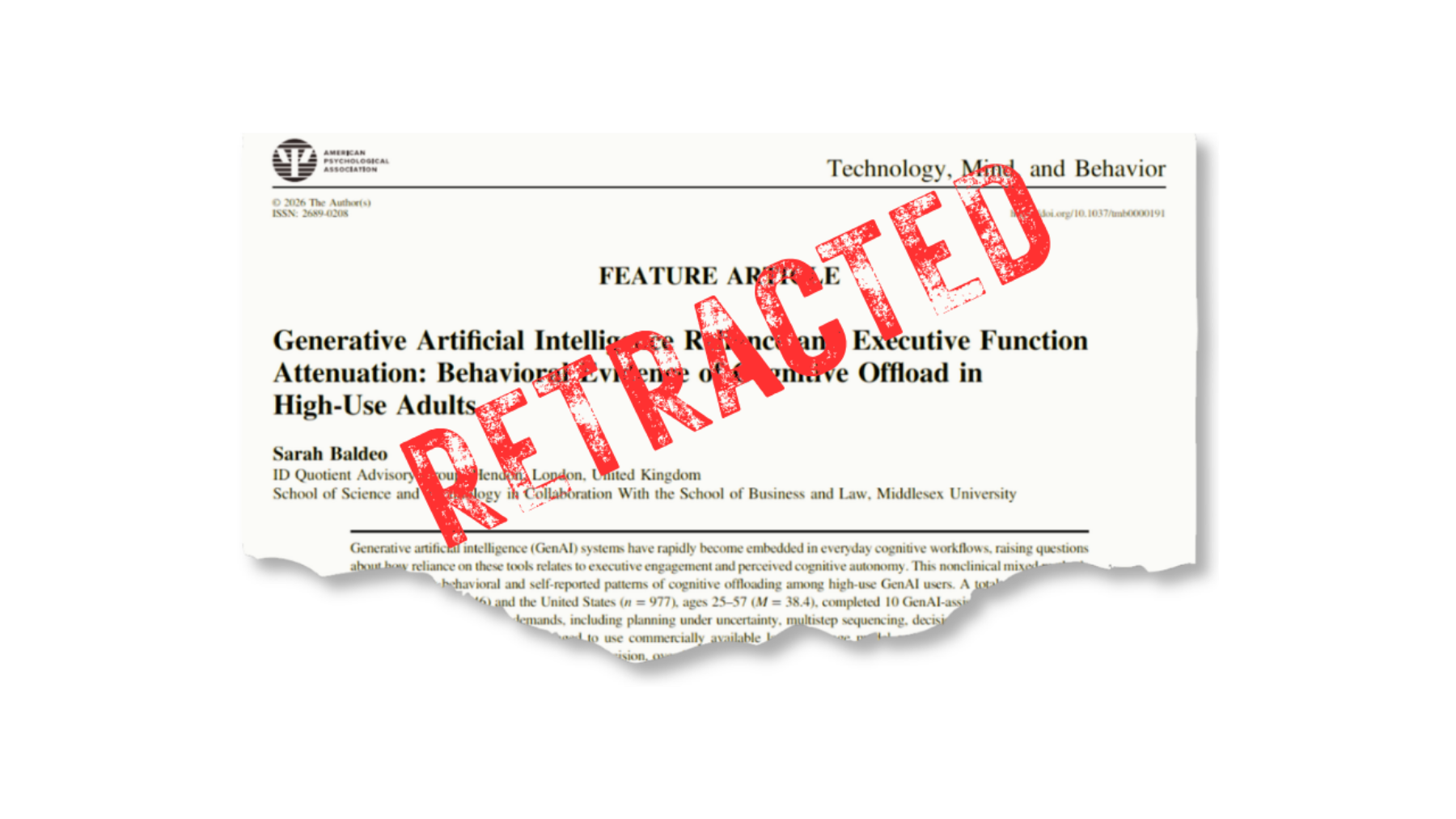
Journal investigating paper on cognitive impact of generative AI
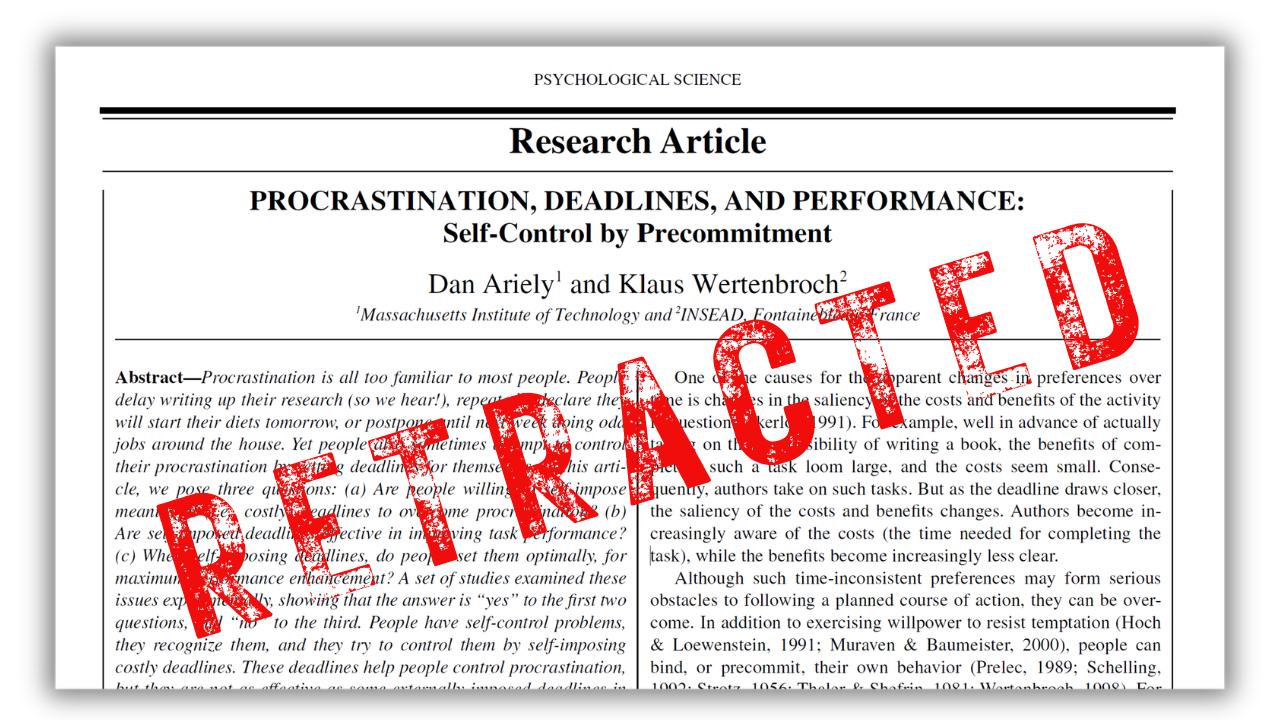
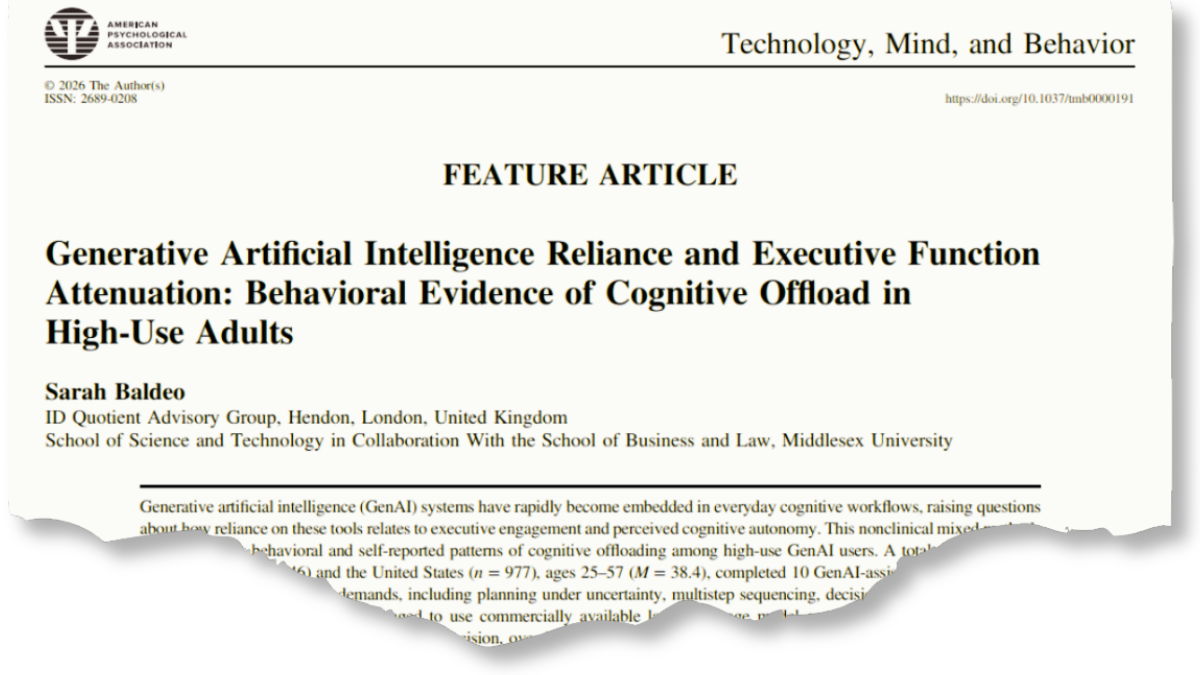
A paper about the effects of generative AI use on confidence in work tasks is under investigation after critics raised questions about the study design, data analysis and ethics approval for the research.

The study, published in April in Technology, Mind, and Behavior, included 1,923 adults recruited online from the United States and Canada to perform a battery of work-like tasks assisted by AI. It garnered a press release from the American Psychological Association, which publishes the journal, and coverage in Time and Futurism.

Sandra Grinschgl of the University of Bern in Switzerland, who studies technology-driven cognitive offloading, got an alert about the study shortly after it came out. She told Retraction Watch she was initially puzzled by the vague descriptions of data collection from online participants in the study. When she looked closer at one of the bar charts, she noticed the lengths of the bars didn’t match the actual value of the labels.

Continue reading Journal investigating paper on cognitive impact of generative AI
Journal retracts depression treatment study with findings called ‘too good to be true’

In the fall of 2024, Matt Williams was grading papers at Massey University in New Zealand when he noticed something off in a study one of his students had cited.

The study, published in 2016, reported overwhelming evidence suggesting that eye movement desensitization and reprocessing, or EMDR, is an effective treatment for depression. But the roughly 85% drop in symptoms of depression linked to the therapy struck Williams as implausible. 

“That’s way too big to have that kind of effect,” Williams recalled thinking as his first impression of the study. “Because I love to procrastinate instead of continuing marking, I then looked up the paper and started reading it.”

Continue reading Journal retracts depression treatment study with findings called ‘too good to be true’

Journal retracts paper criticizing parental alienation theory after group threatens to sue

LittleBee80/iStock

A humanities journal has retracted an article about the controversial theory of parental alienation after receiving legal threats from a group that supports the concept. 

On May 19, the Integrated Journal for Research in Arts and Humanities (IJRAH) removed a review article by Robert Keith Head suggesting the theory of parental alienation is unsupported by research and fails “to meet basic validity requirements for psychological constructs.” 

The move came after the Parental Alienation Study Group (PASG) — which describes itself as an international, nonprofit membership organization dedicated to the study and understanding of parental alienation — accused the journal of publishing “scientific fraud” and demanded the journal retract the paper or face legal action. The journal said the removal was not dictated by “external demands or threats” but followed a “comprehensive secondary evaluation” by its editorial board and independent psychometric experts who identified “critical methodological and structural flaws that undermined the paper’s scientific validity.” 

Continue reading Journal retracts paper criticizing parental alienation theory after group threatens to sue

Guest post: Should Zimbardo’s Stanford Prison Experiment be retracted?

A prisoner and guard in the Stanford Prison Experiment. | PrisonExp.org

Philip G. Zimbardo passed away in October 2024 at age 91. He enjoyed an illustrious career at Stanford University, where he taught for 50 years. He accrued a long list of accolades, but his singular and enduring contribution to scholarship was the Stanford Prison Experiment, a simulation carried out in the university’s psychology department in August 1971. The research project became the best-known psychological analysis of institutionalization at the time. 

The study has always been treated with skepticism by penologists and psychologists, and recent scholarship by social scientist Thibault Le Texier has raised fundamental questions about the scientific validity of the investigation, the originality of the research design, the unethical treatment of the subjects, and the credibility of the reported results. 

Many consider Zimbardo’s SPE to be one of the classic studies of experimental psychology in the post-war period. It continues to be reported as a landmark achievement in many psychological textbooks today, despite drawing decades of criticism both in and out of the scientific literature. But considering Le Texier’s findings, should Zimbardo’s work be retracted?

Continue reading Guest post: Should Zimbardo’s Stanford Prison Experiment be retracted?

Five studies from “Bust Size and Hitchhiking” author retracted 

A journal has retracted five papers about the appearance, sexual behavior and attractiveness of women. 

Nicolas Guéguen, a professor of marketing at the Université de Bretagne-Sud in France, was an author on each of the papers, published in the Sage journal Perceptual and Motor Skills (PMS) at least 15 years ago. All of the articles garnered expressions of concern in 2023, but Guéguen’s history of misconduct long precedes the PMS papers. 

Sleuths have been flagging Guéguen’s work for years for seemingly impossible results. In 2019, he was cleared of wrongdoing by his university, but since then has racked up at least four retractions, according to the Retraction Watch database

Continue reading Five studies from “Bust Size and Hitchhiking” author retracted 

More than three decades after misconduct ruling, researcher’s IQ test paper is retracted

A psychology journal has retracted an article on IQ tests nearly 50 years after publication — and more than 35 years after an investigation found the lead author had fabricated data in several other studies. 

Stephen Breuning, a former assistant professor of child psychiatry at the University of Pittsburgh, gained notoriety after a 1987 National Institute of Mental Health report found that he “knowingly, willfully, and repeatedly engaged in misleading and deceptive practices in reporting results of research.” The report concluded Breuning had “engaged in serious scientific misconduct” by fabricating results in 10 articles funded by NIMH grants. 

Five of Breuning’s articles published in the 1980s have been retracted; three in the 1980s, one in 2022, and another in 2023. Retraction Watch reported on one of them, “Effects of methylphenidate on the fixed-ratio performance of mentally retarded children,” published in 1983 in Pharmacology Biochemistry and Behavior (now published by Elsevier) and retracted in 2022. 

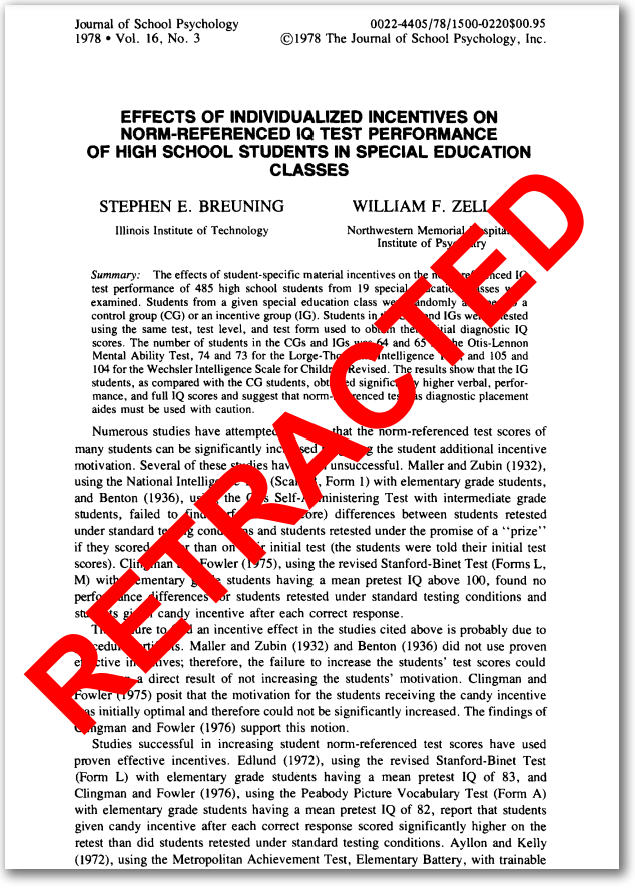
The newly retracted article predates those papers. Published in 1978 in the Journal of School Psychology,  “Effects of individualized incentives on norm-referenced IQ test performance of high school students in special education classes,” found record albums, sporting event tickets, portable radios, and other incentives boosted scores on IQ tests. 

Continue reading More than three decades after misconduct ruling, researcher’s IQ test paper is retracted

Psychology journal apologizes for paper with ‘biased language’ about Tibet

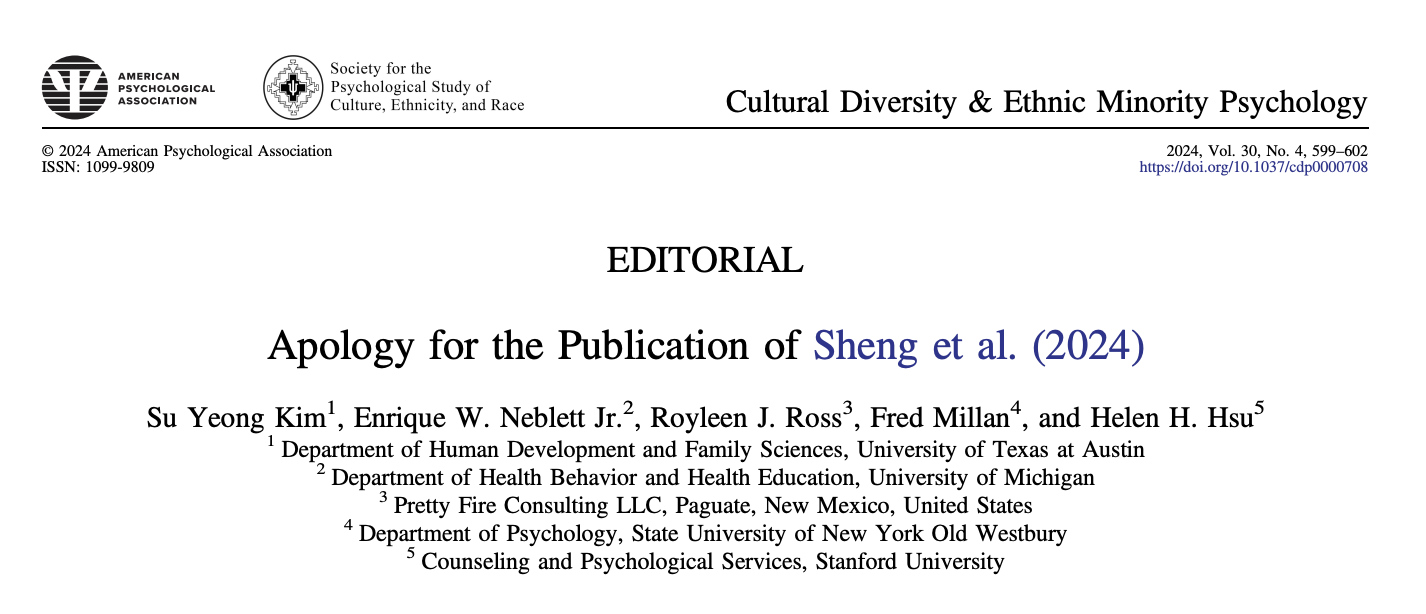
Editors of a psychology journal have published a lengthy apology for failing to identify “biased” language and information in a paper about racial prejudice of Tibetan children against Han Chinese. 

The article, “The development of Tibetan children’s racial bias in empathy: The mediating role of ethnic identity and wrongfulness of ethnic intergroup bias,” appeared in Cultural Diversity & Ethnic Minority Psychology in April. It has yet to be cited, according to Clarivate’s Web of Science. 

The authors listed affiliations with institutions in China, Australia, and Canada. The article describes experiments measuring the empathy – or lack thereof – Tibetan children expressed for characters with Tibetan or Han Chinese names who experienced either social or physical pain. 

Continue reading Psychology journal apologizes for paper with ‘biased language’ about Tibet

Exclusive: Psychology researcher loses PhD after allegedly using husband in study and making up data

Ping Dong

A psychology researcher already under fire for several questionable studies has had her PhD revoked by a university tribunal that found it likely she fabricated data in her thesis. 

Ping Dong, who was a doctoral student at the University of Toronto from 2012 to 2017, had already earned retractions for two papers based on her thesis before the tribunal’s decision to cancel her degree and give the thesis a failing grade. A summary of the case the school has made available online reveals those retractions, which we’ve previously reported on, arose from more serious misconduct than previously publicized and were also subject to an institutional investigation. 

Dong’s research concerned how moral violations and unethical behavior, such as tax evasion or adultery, influence consumer choices.. According to the university’s report, her thesis had an “improbable level of duplication” in the answers research participants gave to open-ended questions. Dong also allegedly confessed to a former supervisor that her husband impersonated participants in her studies and that she had failed to properly randomize the results – although the supervisor contests that Dong ever admitted this to her. 

Continue reading Exclusive: Psychology researcher loses PhD after allegedly using husband in study and making up data

Exclusive: ‘Bust Size and Hitchhiking’ author to earn four more expressions of concern

The journal Social Influence will be issuing expressions of concern for four papers by Nicolas Guéguen, a marketing researcher whose work has long been dogged by allegations, Retraction Watch has learned. 

Guéguen has to date has lost at least three papers to retraction, and has received many more expressions of concern, for his questionable studies. However, his institution, the Université de Bretagne-Sud, cleared him of wrongdoing in 2019.  

Guéguen made a name for himself for his quirky studies – often about human sexuality – like one purporting to find women with bigger breasts were more likely to be successful hitchhikers; and one which claimed to find men with guitar cases are more attractive to women. (The first of those articles has an expression of concern; the second was retracted in 2020.)

Continue reading Exclusive: ‘Bust Size and Hitchhiking’ author to earn four more expressions of concern

Psychology professor earns retractions after publishing with ‘repeat offenders’

Kelly-Ann Allen

A psychologist in Australia has earned a pair of retractions after publishing several papers with international coauthors suspected of authorship fraud, Retraction Watch has learned. 

Kelly-Ann Allen, an associate professor at Monash University, in Clayton, and editor-in-chief of two psychology journals, declined to comment for this article.

The retraction notices, both in Frontiers journals, cite an investigation by the publisher confirming “a serious breach of our authorship policies and of publication ethics.”

Continue reading Psychology professor earns retractions after publishing with ‘repeat offenders’