Same “difference,” as anesthesia paper retracted for plagiarism

Cover, Coverabbild, Titel, TitelbildA group of anesthesiology researchers in China has lost their 2011 paper in Der Anaesthesist because, well, the article wasn’t theirs to begin with.

The paper, “Different anesthesia methods for laparoscopic cholecystectomy,” came from authors at the 309th Hospital of PLA, in Beijing, who purported to report on a randomized trial of 68 patients undergoing laparoscopic colon surgery with either general or spinal (that is, a nerve block) anesthesia. According to the abstract:
Continue reading Same “difference,” as anesthesia paper retracted for plagiarism

Columbia University misconduct retraction highlights what’s wrong with the retraction process

jcacoverThe Journal of Clinical Anesthesia has a retraction of a 2006 paper by a group from Columbia University that, to our minds, is the poster child for how not to handle such things.

The article, “Dexmedetomidine infusion is associated with enhanced renal function after thoracic surgery,” was written by Robert J. Frumento, Helene G. Logginidou, Staffan Wahlander, Gebhard Wagener, Hugh R. Playford and Robert N. Sladen, who now is chief of critical care at the institution. The paper has been cited 30 times, according to Thomson Scientific’s Web of Knowledge.

Why do we bother to name all the authors? Here’s why: According to the retraction notice, one of them — but don’t ask which — is guilty of research misconduct: Continue reading Columbia University misconduct retraction highlights what’s wrong with the retraction process

What happened to Joachim Boldt’s 88 papers that were supposed to be retracted?

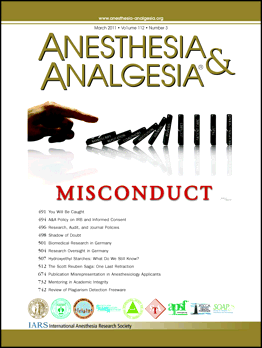
a&amisconductcoverCHICAGO — Almost two years after editors at 18 journals agreed in March 2011 to retract 88 of former retraction record holder Joachim Boldt’s papers, 10% of them hadn’t been retracted.

That’s what Nadia Elia, Liz Wager, and Martin Tramer reported here Sunday in an abstract at the Seventh International Congress on Peer Review and Biomedical Publication. Elia and Tramer are editors at the European Journal of Anaesthesiology, while Wager is former chair of the Committee on Publication Ethics (COPE).

As of January 2013, nine of the papers hadn’t been retracted, Tramer said, while only five — all in one journal — had completely followed COPE guidelines, with adequate retraction notices, made freely available, along with  PDFs properly marked “Retracted.” From the abstract (see page 18): Continue reading What happened to Joachim Boldt’s 88 papers that were supposed to be retracted?

Retraction record broken, again: University report should up Fujii total to 183

a&amisconductcoverKeeping up with the various investigations into the activities of Yoshitaka Fujii — the assumed record holder for retractions by a single author, with 172 likely — can be a challenge. Between the journals pulling his papers and the institutions looking into his misconduct, it’s hard to keep everything straight.

But we have a new report, from a past employer, that makes for interesting reading and helps tie up some loose ends. The document is from Tsukuba University, where Fujii worked more than a decade ago when questions about the propriety of his findings first surfaced. Continue reading Retraction record broken, again: University report should up Fujii total to 183

After retracted study’s cited, editors ask, “time to add scientific integrity to the downside of print on paper?”

JneuranesAs we — and others — have written, retracted articles don’t necessarily creep off to some little island somewhere never to be heard from again. After all, the electronic versions of about a third of retracted papers aren’t marked as retracted. Sometimes, like Napoleon, those papers return from exile to wreak havoc: They get cited as if they had never been retracted.

To wit: The Journal of Neurosurgical Anesthesiology has published a letter to the editor regarding a 2012 article by a group of Italian researchers. The topic of the paper in question was “Perioperative pregabalin for postoperative pain control and quality of life after major spinal surgery.”

That happens to have been an area of interest for one Scott Reuben, a Massachusetts anesthesiologist and pain specialist turned federal inmate who was, Continue reading After retracted study’s cited, editors ask, “time to add scientific integrity to the downside of print on paper?”

Expressions of regret: group retracts sedation paper for stolen words, data

A group of researchers in China have retracted a 2011 article in Acta Pharmacologica Sinica, the official journal of the Chinese Pharmacological Society, acknowledging that they lifted text and results from a previously published paper from other researchers.

The paper was titled “Lipid metabolism disturbances and AMPK activation in prolonged propofol-sedated rabbits under mechanical ventilation.”

According to the notice: Continue reading Expressions of regret: group retracts sedation paper for stolen words, data

Anesthesia journal retracts paper from Estonian researchers in wake of legal inquiry

Acta Anaesthesiologica Scandinavica has retracted a 2008 paper by a group of Estonian researchers who appear to have wound up in legal jeopardy for misrepresenting their work.

Here’s the notice: Continue reading Anesthesia journal retracts paper from Estonian researchers in wake of legal inquiry

Boldt inquiry concludes: False findings in at least 10 studies, but no harm to patients

Ludwigshafen Hospital, via Wikimedia http://bit.ly/Qnt9wS

It has been a while since we heard about Joachim Boldt, the German anesthesiologist whose 90-odd retractions briefly put him at the top of the heap until Yoshitaka Fujii kicked him off earlier this year.

Now, Boldt’s former institution, the Klinikum Ludwigshafen, has released a report on its investigation into the disgraced critical care expert, and the results aren’t pretty. Here’s a press release about the report, in its entirety: Continue reading Boldt inquiry concludes: False findings in at least 10 studies, but no harm to patients

Does anesthesiology have a problem? Final version of report suggests Fujii will take retraction record, with 172

Japanese investigators have concluded that Yoshitaka Fujii, an expert in postoperative nausea and vomiting whose findings drew scrutiny in 2000 but who continued to publish prolifically for a decade after, fabricated his results in at least 172 published studies.

That number nearly doubles that of the current unofficial retraction record holder, Joachim Boldt.

An inquiry by the Japanese Society of Anesthesiologists (JSA) has determined that Fujii, who was fired in February from his post at Toho University, falsified data in 172 of 212 papers published between 1993 and 2011. Investigators said they found no evidence of fraud in three of the papers, but could not determine whether the results reported in the remaining 37 were reliable.

Of the 172 bogus studies, 126 involved randomized controlled trials. Investigators believe this was not a coincidence: Continue reading Does anesthesiology have a problem? Final version of report suggests Fujii will take retraction record, with 172

Report: Fujii faked data in at least 172 papers

A Japanese web site is reporting that Yoshitaka Fujii, a Japanese anesthesiologist suspected of widespread data fabrication, did indeed fake his results in at least 172 published studies.

According to the article, on a site called Jiji Press: Continue reading Report: Fujii faked data in at least 172 papers