Paper with duplicated image “sequentially builds” on neuroscience work, authors argue

A neurochemistry journal has retracted a paper from a group in China over a duplicated image.

According to the notice, the authors used the same image in the two papers to represent different experimental conditions. The only distinguishing feature between the images: “apparent brightness changes.”

The authors defended their actions, explaining that the research published in Journal of Neurochemistry “sequentially builds” on their previous study in Journal of Neuroinflammation, which they mention in the 2015 paper’s discussion. In the notice, the authors were quoted saying:  Continue reading Paper with duplicated image “sequentially builds” on neuroscience work, authors argue

Would-be Johns Hopkins whistleblower loses appeal in case involving Nature retraction

A former researcher at Johns Hopkins who voiced concerns about a now-retracted paper in Nature has lost another bid for whistleblower protection.
Daniel Yuan, a longtime statistician for former Hopkins yeast geneticist Jef Boeke, was dismissed in 2011, after he’d spent years raising concerns about research coming out of the lab. Yuan’s criticisms, which continued after he stopped working for Boeke, peaked in 2012 after Boeke and former labmate Yu-li Lin published paper in Nature. Later that year, Lin was found dead in his lab, a suspected suicide. In 2013, the paper was retracted, citing an inability to reproduce the main conclusions. 

Since 2013, Yuan has pursued a wrongful termination lawsuit, claiming that federal regulations surrounding scientific misconduct afforded him protection from retaliation.

In late March, Maryland’s highest court ruled against Yuan, saying that those misconduct regulations are “too vague” to offer cover to employees claiming whistleblower protection. According to lawyers we consulted, the decision could make it harder for would-be whistleblowers to fight retaliation, while also giving institutions more leeway to handle these issues on their own.

Continue reading Would-be Johns Hopkins whistleblower loses appeal in case involving Nature retraction

Journal retracts paper eight months after U.S. Feds announce findings of misconduct

In August, the U.S. Office of Research Integrity announced that a former postdoctoral fellow at the National Human Genome Research Institute (NHGRI) doctored data in two published papers.
It took one journal a little longer than five months to remove the researcher’s name from the co-author list, and replace one figure.

It took the second journal more than eight months to retract the paper.

Here’s the notice for “A BLOC-1 Mutation Screen Reveals that PLDN Is Mutated in Hermansky-Pudlak Syndrome Type 9,” published by the American Journal of Human Genetics (AJHG):

Continue reading Journal retracts paper eight months after U.S. Feds announce findings of misconduct

Paper by Harvard cancer biologist flagged over “credible concerns”

A cancer biologist at Harvard who’s issued multiple editorial notices in recent years has received an expression of concern about a 2011 paper, citing “credible concerns” with the data and conclusions.

The publisher does not detail the nature of the issues in the notice.

In the past few years, last author Sam W. Lee lost a Molecular Cell paper in 2013 due to figure duplication and a Journal of Biological Chemistry paper in 2015, citing “manipulated” data in a figure.

Lee also issued two mega-corrections in 2011 in Nature and Current Biology, which also cited figure duplication. Interestingly, both papers were corrected for a second time — the 2006 Current Biology paper in 2016, over figure-related errors, and the 2011 Nature paper in 2015, over concerns the animals used may have experienced excess suffering (prompting an editorial from the journal).

The latest notice, issued by the Journal of Biological Chemistry, doesn’t provide much information for the basis of its expression of concern over Lee’s 2011 paper: Continue reading Paper by Harvard cancer biologist flagged over “credible concerns”

Former UCLA vice-chancellor loses cancer paper for image manipulation

The former vice chancellor for research at the University of California, Los Angeles, has retracted a 2012 paper after an internal investigation found evidence of image manipulation.

The journal Molecular Cancer Therapeutics received a letter about the problems with the paper from the UCLA Research Integrity Officer, and a retraction request from last author James Economou, also the chief of surgical oncology.

According to the notice, the paper duplicated images from a 2011 paper also by first author Ali Jazirehi, based at UCLA. This is Jazirehi’s second retraction.

Here’s more from the notice:

Continue reading Former UCLA vice-chancellor loses cancer paper for image manipulation

Updated: Vaccine-autism study retracted — again

For the second time, a journal has quickly retracted a study that suggested vaccines raise the risk of autism and other neurodevelopmental disorders.
The study first raised a furor last year, prompting a Frontiers journal to quickly retract it. After it was republished in the Journal of Translational Science this month, that journal has also retracted it.

Although the titles of the two papers changed, the abstracts were nearly identical. Both studies surveyed the parents of 666 home-schooled children, 39% of whom where not vaccinated, and concluded that vaccination increased the risk of neurodevelopmental problems, particularly if children were born prematurely.

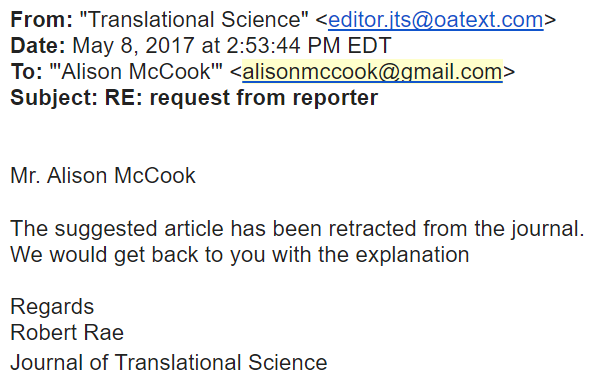
A representative of the Journal of Translational Science told usPilot comparative study on the health of vaccinated and unvaccinated 6- to 12-year-old U.S. children” has been retracted, and it will update us with an explanation.

Here’s more from the (now-retracted) abstract:

Continue reading Updated: Vaccine-autism study retracted — again

Can we do math unconsciously? Replicators of a prominent 2012 study have some doubts

In 2012, news media were abuzz with a new finding from PNAS: Authors based in Israel had found evidence that our brains can unconsciously process more than we thought — including basic math and reading.  In other words, the authors claimed people could read and do math without even knowing what they were doing.

With such a major development in the field of consciousness research, other groups quickly got to work trying to replicate the findings. Those efforts have taken some twists and turns — including a recent retraction of a replication paper that was, itself, not reproducible (which is not something we see every day). But overall, five years after the initial, remarkable result, the replication efforts are calling it into question.

According to Pieter Moors at KU Leuven, a researcher in this field:

Continue reading Can we do math unconsciously? Replicators of a prominent 2012 study have some doubts

Researcher who sued to prevent retractions now has 12

A diabetes researcher who once sued a publisher to prevent several retractions has just issued his 12th.
The latest retraction, like several others for Mario Saad, appears in the journal Diabetes. Although in the past Saad expended considerable effort to protect four other Diabetes papers from this same fate, the latest retraction was initiated by the authors, citing several duplicated images. The American Diabetes Association had flagged the 2009 paper with an expression of concern earlier this year.

In 2015, Saad brought a lawsuit against the ADA, claiming that it “wrongfully published” four expressions of concerns in its flagship journal Diabetes, in an attempt to prevent the papers from being retracted. He lost, and the papers were retracted in 2016.

The lawsuit also did nothing to deter the ADA from flagging other potentially problematic papers with expressions of concerns, including the latest 2009 Diabetes paper, on which Saad is last and corresponding author.  Continue reading Researcher who sued to prevent retractions now has 12

Author objects to retraction after he says journal ignored his queries for three years

In 2014, a journal contacted researcher Denis Rousseau about one of his papers that had just been published online ahead of print, raising some concerns. According to Rousseau, he sent the journal a corrected figure “almost immediately,” which he believed addressed the issue.

Rousseau, a cell biologist at the University Joseph Fourier in Grenoble, France, said he then contacted the journal many times over the next three years to ask about the status of the paper — which never ended up in print — but heard nothing back.

Three years passed.

In March, the publisher finally contacted Rousseau, this time to ask him to issue a formal retraction for the paper. And despite his objections, Molecular and Cellular Biology published a sparse retraction notice, which provides little information about what went wrong:

Continue reading Author objects to retraction after he says journal ignored his queries for three years

Harvard teaching hospital to pay $10 million to settle research misconduct allegations

Piero Anversa

Brigham and Women’s Hospital and its parent healthcare network have agreed to pay $10 million to the U.S. government to resolve allegations it fraudulently obtained federal funding.

The case, which involves three former Harvard stem cell researchers, dates back several years. In 2014, Circulation retracted a paper by Piero Anversa, Annarosa Leri, and Jan Kajstura, among others, amidst a university investigation into misconduct allegations. Anversa and Leri — whose lab was described as filled with “fear” by one former research fellow — later sued the hospital for notifying journals of that investigation. They lost.

In the agreement announced today by the Department of Justice (DOJ), Partners Healthcare and Brigham and Women’s Hospital have agreed to pay the government $10 million to settle allegations that the researchers fraudulently obtained funding from the National Institutes of Health:

Continue reading Harvard teaching hospital to pay $10 million to settle research misconduct allegations