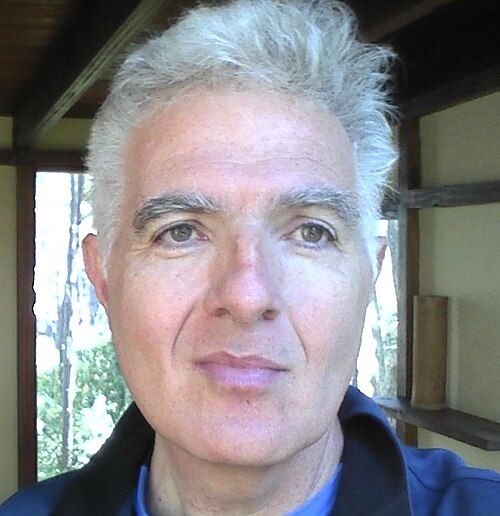
The U.S Office of Research Integrity has formally announced a 15-year funding debarment against a former Rice University scientist for research misconduct, resolving allegations that arose 17 years ago.
Chemist Ariel Fernández intentionally fabricated data in 12 grant-supported papers, four unpublished manuscripts, one presentation and three grant applications while a professor at Rice University in Houston, according to a notice posted May 1 on ORI’s website and to be published in the Federal Register on May 5. As part of the sanctions, Fernández is barred from receiving federal research funds for 15 years. The announcement is the third finding this year from ORI.
The notice follows a decision nearly a year ago by administrative law judge (ALJ) Margaret G. Brakebusch upholding ORI’s findings and recommended debarment, issued in 2022, after an appeal by Fernández. We reported on that ALJ decision after it was made public in February of this year. An exclusion record posted the same day our story ran shows Fernández’s debarment started on March 25. (We reached out to ORI about the case on March 5.)
Fernández had only a brief comment about the posting.
“Who gives a shit?” he wrote in an email to Retraction Watch. “Everybody in academia knows I only did theoretical work at Rice.” Fernández, who threatened to sue us in 2013, said after those involved in the “ORI attack” against him are “arrested for conspiracy against the United States,” he will then “think about suing everybody that did wrong to me.”
Fernández has denied the allegations and told us previously he resolved the misconduct case years ago through a settlement with Rice. According to a copy of the settlement, the university paid him $240,000 and released him from any liability, and he agreed to leave the university in 2011.
A spokesperson for Rice University said the institution had no comment.
A Rice University panel started investigating Fernández in 2009 after a graduate student reported possible manipulated images in a manuscript he and Fernández were working on. At the time, Fernández held the post of Karl F. Hasselmann Chaired Professor of Engineering. The panel found Fernández acted intentionally to “fabricate, falsify and/or plagiarize research that he submitted for publication,” according to the ALJ’s summary. ORI received Rice’s report on June 30, 2010.
The office determined Fernández “intentionally, knowingly, or recklessly fabricated and/or falsified the synthesis of six novel chemical compounds, figures of Western blots, and confocal microscopy images” by copying, manipulating, and relabeling images in the affected publications, according to the May 1 notice.
On Nov. 9, 2022, Fernández received a charge letter from ORI notifying him of the office’s research misconduct findings. He contested the findings and requested a hearing. On May 22, 2025, Brakebusch issued a decision in favor of HHS.
As part of its administrative actions, ORI plans to send a notice to the journals of the 11 papers that require a retraction and/or correction.
Fernández has claimed ORI revived his research misconduct case after a 2021 paper he wrote supporting a lab origin of SARS-CoV-2. He said critics of his work at the National Institutes of Health are “weaponizing ORI” by “using research misconduct allegations to discredit individuals such as myself who hold views opposed to the official narrative that upheld the ‘natural’ origin of SARS-CoV-2.”
As part of his argument, Fernández showed us an email purportedly from an NIH researcher sent in June 2021 threatening to resurrect his ORI case if Fernández didn’t remove his paper. Earlier this month, an NIH spokesperson told us that, “following a thorough review,” the agency has no record of the emails believes “the email in question is not authentic.”
Like Retraction Watch? You can make a tax-deductible contribution to support our work, follow us on X or Bluesky, like us on Facebook, follow us on LinkedIn, add us to your RSS reader, or subscribe to our daily digest. If you find a retraction that’s not in our database, you can let us know here. For comments or feedback, email us at [email protected].
Sooooo…… he gets a debarment and Rice pays him $240K? Accountability…
Wow, that is truly remarkable—it took the NIH ORI such a long time to reach a decision.
ORI went through a prolonged period where it was hardly issuing any decisions at all. I suspect this was one of the many cases that did not get attention during that period.
They are not the NIH ORI; they are under the Division of Health and Human Services.
Is anyone aware of the current address of Dr. Ariel Fernandez?
only did theoretical work or only theoretically did work?
Is anyone aware of the current address of Dr. Ariel Fernandez?
He stole millions, did various publishing false actions. Why is he still in the US, benefitting from the US research environment? Why has he not been deported to Argentina?
Does anyone know why the PHS Administrative Action Report (https://ori.hhs.gov/ORI_PHS_alert.html) shows his debarment as “For life”?