Benjamin Wilson self-portrait, via Wikimedia http://bit.ly/zkWs5C
We tend to focus on new retractions here at Retraction Watch, and find it difficult enough to even keep up with the hundreds per year. But sometimes it’s illuminating to take a dip into history, so when Richard van Noorden alerted us to what may be the earliest-ever English language retraction, we thought we’d take a look.
Is self-plagiarism — perhaps best referred to as duplication of your own work — a big problem in nanotechnology research?
The American Chemical Society (ACS) Nano journal retracted a study, “Retraction of Nanoembossing Induced Ferroelectric Lithography on PZT Films for Silver Particle Patterning,” late last month because of such duplication:
This article was withdrawn at the request of the Editor-in-Chief, with agreement by the authors, due to unacceptable redundant text and figures with a previously published article by the same authors (Langmuir 2011, 27, 5167-5170. DOI: 10.1021/la200377b).
Late last year, we published an invited commentary in Nature calling for science to more formally embrace post-publication peer review, and stop fetishizing the published paper. One of the models we cited was Faculty of 1000 (F1000), “in which experts flag important papers in their field.”
So it’s not surprising that F1000 is announcing today that they’re launching a new journal, F1000 Research,
intended to address three major issues afflicting scientific publishing today: timely dissemination of research, peer review and sharing of data.
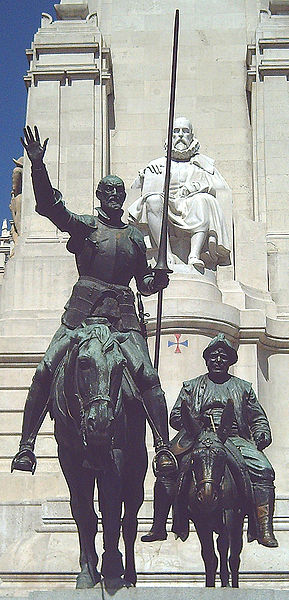
Don Quixote and Sancho Panza, Madrid. Photo by Zaqarbal via Wikimedia
If Retraction Watch was actually a business, as opposed — for the moment, anyway — to a labor of love for two guys with day jobs, 2011 would have been a very good year for business.
It was a year that will probably see close to 400 retractions, including a number of high-profile ones, once the dust settles. Those high numbers caught the attention of a lot of major media outlets, from Nature to NPR to the Wall Street Journal. Science publications, including LiveScience and The Scientist, have done their own end-of-year retraction lists.
If there’s one consistent lesson of covering retractions, it’s that science doesn’t stop when researchers publish a paper. But what also seems true is that once a paper is published, lots of people — authors and editors, in particular — are often reluctant to say just what’s happened next, particularly if it casts the study or the journal in a negative light.
Some of this is understandable, given the weight given papers by tenure committees and granting agencies. Still, Retraction Watch readers will not be surprised to know we’d like that to change, so when Nature asked us to contribute an end-of-the-year commentary, we decided to focus on post-publication peer review. In our piece, which appears this week, titled “The paper is not sacred,” we argue: Continue reading Stop fetishizing the scientific paper: Our invited Comment in Nature
photo by Cea via Flickr http://www.flickr.com/photos/centralasian/
Recently, Ivan has been invited to speak to two groups — the Danforth Center, in St. Louis, and CrossRef members, at their annual meeting in Cambridge, Mass. — about retractions and Retraction Watch. He gave variations on the talk below, “The Good, the Bad, and the Ugly: What Retractions Tell Us About Scientific Transparency.” In it, he discusses a number of cases we’ve uncovered at Retraction Watch, and offers some solutions for improving transparency. Use the arrows at the bottom of the slides to click through the presentation. Continue reading The Good, the Bad and the Ugly: What retractions say about scientific transparency
Ivan will be joining Richard van Noorden, author of Nature‘s feature last week on retractions, for a live Q&A today at 11 a.m. Eastern (4 p.m. BST). Join us and ask questions here.
And while you have your calendars out, Ivan is part of a SONYC panel next week in New York on retractions. Get a free ticket here.
One of the themes we’ve hit hard here at Retraction Watch is that there is tremendous variation in how journals deal with retractions. Some make notices crystal clear, while others seem to want to make them as opaque as possible. Some editors go out of their way to publicize withdrawals, while others bury them and won’t talk about them when they appear.
In a Nature feature out today on retractions, Richard van Noorden highlights those disparities. He also highlights the fact that there are more retractions to talk about: As a graphic accompanying the piece makes clear, retractions have risen 10-fold in the last decade, even as the number of papers published has grown by less than fifty percent.
But even with that growth, the number of retractions — we’re on track for 400 this year, according to Thomson Reuters — is a vanishingly small percentage of the 700,000 papers published annually. Still, science prides itself on transparency — or should, anyway. van Noorden gives Ivan the chance to offer some advice to those scientists and editors who are reluctant to acknowledge there’s ever any dirty laundry in science: Continue reading Do editors like talking about journals’ mistakes? Nature takes on retractions
Careful Retraction Watch readers may have noticed that one of the categories in our right-hand column under “by reason for retraction” is “lack of IRB approval.” That’s because in just over a year, we’ve written a number of posts about two cases of retractions for that reason.
Journals with high impact factors retract more papers, and low-impact journals are more likely not to retract them, the study finds. It also suggests that high- and low-impact journals differ little in detecting flawed articles before they are published.
One thing you notice when you look at Cokol et al’s plots is that although their models seem to take retractions “per capita” — in other words per study published — into account, they don’t report those figures.