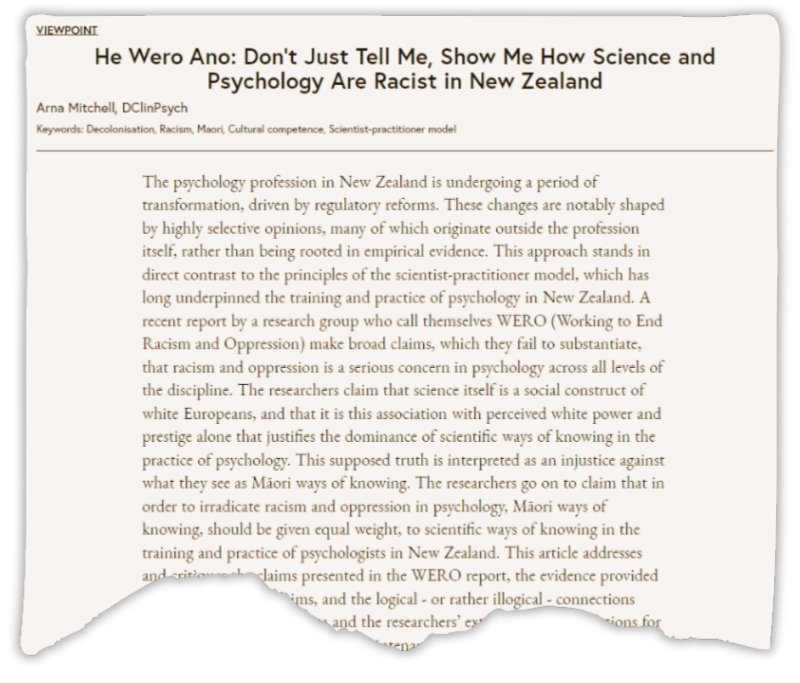
When Arna Mitchell submitted her article critiquing a proposal for different standards of practice for Māori and non-Māori clients in clinical psychology, she thought it would be too controversial to publish because it challenged views becoming influential among professional and academic circles.
But the Journal of the New Zealand College of Clinical Psychologists (JNZCCP) had the paper peer-reviewed and published it in August 2025. And then, 10 months later, they deleted the article, after deciding the work could perpetuate harm to Māori, the indigenous people of New Zealand, and that it conflicted with the college’s values.
The college defended the deletion by arguing the journal is not an independent, indexed academic journal. But the decision has caused members to quit the college and has drawn criticism from the field, including from a former editor of the journal.
“I have not been shown how my ideas are wrong or inaccurate. I have not been shown how my ideas are not aligned with my professional ethics,” Mitchell told Retraction Watch. “The ideas in my article challenged the dominant narrative in our psychology institutions and were politically and ideologically inconvenient for some of our professional leaders. In my opinion, those are reasons for more robust discussions, not censorship.”
In her article, Mitchell, a clinical psychologist in New Zealand of Māori descent, argued the draft codes of the New Zealand Psychologists Board would set different standards of care for Māori clients, including weakened protections in confidentiality, informed consent and autonomous decision-making. She believed the codes were shaped by a report from the Working to End Racism and Oppression (WERO) research program — which she said used a methodology that couldn’t support its conclusions and recommendations addressing systemic racism in the field.
According to Mitchell, the report’s recommendations could result in Māori clients treated using cultural approaches rather than individual, evidence-based assessment, and assume the group is homogeneous rather than diverse.
“My argument was not against culturally responsive practice or the inclusion of Māori knowledge and practices where they are appropriate and supported,” Mitchell said, adding that she questioned whether an approach is necessarily better for Māori simply because it is culturally derived. “We need evidence to establish whether interventions, regardless of how they are derived, are effective.”
Mitchell said she and the editors had open conversations before its publication about how the article “would be challenging for some people to read.” In one exchange before publication, editor-in-chief Liesje Donkin told Mitchell “I personally don’t think we should shy away” from controversy.
The journal published it in August 2025 as a viewpoint — a label Mitchell believes was later used to undermine the article and dismiss her opinions. In a letter published in the same issue as the article, Donkin and two associate editors, Paul Skirrow and Zara Mansoor, defended open debate. It began with a Māori proverb: “What is the food of chiefs? It is discussion, discussion, discussion.” They wrote: “academic freedom and professional critique are not threats to our cohesion,” and that “if an article challenges your perspective, we encourage you to sit with that discomfort.”
The president of the NZCCP said they would not be commenting on our questions, the editors of the journal have not responded to our emails.
After publication, several members of the college circulated a petition calling out “serious concerns” about Mitchell’s views, and pushing for a vote of no confidence in a meeting at which Mitchell and several others were running for the college’s executive. Mitchell said her critics believed her to be against mātauranga Māori — a term to describe the traditional knowledge system of the Māori people — “which I actually support,” Mitchell said. “[They] mischaracterized what I had written.”
Two responses to Mitchell’s article also appeared in December in Psychology Aotearoa, a journal published by the New Zealand Psychological Society. Both mentioned the article but did not cite it directly, with one describing Mitchell’s viewpoint as work that “fundamentally seeks to uphold the racist hierarchy within psychology.” A representative of the society declined to comment on the responses or the group’s involvement in the removal of the article.
“Psychologists on social media were telling psychologists to de-platform me,” Mitchell said. “So I am guessing they didn’t cite my article as a way of de-platforming it.” But regarding the critiques themselves: “I kind of saw that as a normal process,” she said. “Everyone is entitled to their perspective,” though she said the ad hominem attacks and mischaracterizations of her arguments were inappropriate.
A few weeks later, Mitchell received an email from Donkin informing her of corrections needed to the article. After a back and forth, Donkin and Skirrow issued a correction in September addressing definitions and facts about the report that Mitchell was criticizing.
In an email to members announcing the corrections, the editors said they wanted to “personally apologise for some significant errors” included in the article, and published the correction after “a thorough internal review, as well as significant consultation with a number of legal and professional experts.” The editors also apologized to the team behind the WERO report and said they would take “further steps to address [the article’s] impact.” The editors cited their adherence to the COPE guidelines in the correction.
Donkin and Skirrow have not responded to requests for comment.
Mitchell sensed the correction wasn’t the end of the story. The wording implied the NZCCP was “still trying to make up for what [they’d] done,” she said. “So that indicated they were still doing something in the background.”
Eight months later, on the morning of June 18, Donkin emailed Mitchell to say NZCCP’s council had decided to take the article down “after ongoing discussion and careful consideration,” saying that retaining the article “could perpetuate harm to Māori.” Donkin wrote that the NZCCP remains “committed to open and rigorous dialogue within psychological science and practice,” but that “such dialogue must occur in ways consistent with our values.”
“A notice to our readership regarding the removal will be circulated later today, and I wanted to ensure you were aware before that goes out,” she wrote to Mitchell.
About three hours later, the organization’s membership was informed about the removal via email from the editors. “We apologise for harm that this article has caused and are working to remedy this,” the editors wrote.
Mitchell asked for minutes from the council meeting where she believes the decision was made, to understand why her article was removed, but has not received them.
“They could have communicated with me when the decision was made, given me an opportunity to kind of explain why I don’t think what I’ve written is actually against their values,” Mitchell said. “But I only wrote it because I want Māori to receive high quality care.”
“No one has communicated with me about why my ideas are not allowable,” Mitchell said.
This isn’t the first time we’ve reported on journals removing articles out of concern of harm. In 2023, researchers at the University of Minnesota requested their commentary on structural racism be retracted over misleading information. A few years earlier, Brown University pulled a press release about a study on transgender teens after public backlash. The journal also published a revised version of the article and a lengthy explanation of the changes, emphasizing the study was hypothesis generating rather than proof of rapid onset gender dysphoria.
COPE guidelines state a retraction notice should be freely accessible to all readers and should link to the retracted article. Retraction with removal of an article is a “rare” case when an article “violates personal privacy, is the subject of a court order, or could have a serious health risk to the general public or the environment,” the guidelines state. In these circumstances, the notice “should clearly state why the content of the article has been removed.” There is no retraction notice on the journal’s website, and the article is no longer accessible. It was also removed from third-party platform Zenodo in late July, where it had accumulated more than 9,000 views.
In a statement to media at the time, the NZCCP executive said the journal “is not an independent, indexed academic journal, and editorial decisions must be considered within the context of the College’s governance, values, and constitutional commitments.”
The journal had always been presented as a scientific journal, said Helen Buckland-Wright, a clinical psychologist and former member of the NZCCP who also ran for an executive position alongside Mitchell. If it was a magazine, she said, “why have a peer review? Why have editors who are academics and go through an academic process?”
“To my mind, I think that is a rebranding of what the journal has been traditionally understood to be.”
Buckland-Wright said she quit the college last August. She also said many other members, including other distinguished psychologists and some founding members, quit in protest of the article’s removal. Others expressed their opinion about the removal online—including Richard Dawkins on X, calling the removal “utterly contemptible.” Kumari Valentine, a former editor of the journal for 11 years, wrote on Substack that professional journals are “not merely vehicles for organisational messaging,” but exist to “facilitate dialogue, debate, scholarship, and critical reflection,” she wrote, in her article titled ‘NZCCP Sets a Precedent of Censorship.’
“I worry that when a Māori author’s contribution is removed from the scholarly record because it is considered inconsistent with organisational values, we risk sending a message that some Māori voices are welcome while others are not,” Valentine wrote on Substack.
“If it was so egregious, I think they should have followed the COPE guidelines,” Buckland-Wright said. “People should be permitted to make their own minds up, I think it’s robbing people of the opportunity to do their own thinking about it, whether they agree with it or not.”
Mitchell said she’s received a huge amount of support from Māori individuals, as well as Pākehā — non-Māori New Zealanders. “I was worried that I would be alienating people, but it seems like the group I’m alienating is a very select group working in particular areas, who have a lot of institutional power and sway.”
Mitchell is now seeking to publish her article elsewhere.
Like Retraction Watch? You can make a tax-deductible contribution to support our work, follow us on X or Bluesky, like us on Facebook, follow us on LinkedIn, add us to your RSS reader, or subscribe to our daily digest. If you find a retraction that’s not in our database, you can let us know here. For comments or feedback, email us at [email protected].
The left continues to eat itself.
How is the left eating itself here
Some typos: “homogenous”, “of corrections needed to the article”
Some additional details on what exactly the college is objecting to in Mitchell’s article would be helpful… Like, what does it mean that Maori clients wouldn’t have to receive the same level of confidentiality?? Are meddling family members allowed to get info from the psychologist against the client’s wishes or something?
The retracted paper’s quote from the draft is alarming:
“In the case of Māori and other collectivist cultures, concepts of privacy and confidentiality may be somewhat altered when the sharing of information leads to additional support and culturally appropriate processes between members of the community. Determining the appropriate balance between this and the
individual’s right to privacy will need to be determined on a case-by-case basis.”
If you come from a “collectivist culture” (say a literal patriarchal society) and your therapist decides that “sharing of information” (say with your patriarch) leads to “additional support and culturally appropriate processes” (say being closely supervised by and physically punished by your patriarch for expressing criticism of him), that’s ethically acceptable. Great way to make sure no person trusts a therapist ever again, not just if they come from a culture that’s obviously collectivist, because who’s to say a therapist doesn’t decide that, whatever part of society you come from, your family unit is a collectivist culture, so they’re allowed to repeat everything you said to your parents, or siblings, or children?
Where is the line between clients where these “collectivist” concessions are permitted and clients where the standard confidentiality agreement is legality enforced? Could (non-collectivist) pakeha clients request this treatment modality, and if yes, then wouldn’t that suggest the proposed modifications are already within the legal framework? Do the modifications still expect the practitioner to exclude the possibility of coercive control for all clients who waive confidentiality, or just the ones who don’t look like they’re Maori?
Reminiscent of the response to the response to the letter “in defence of science” see https://en.wikipedia.org/wiki/Listener_letter_on_science
Thanks to Retraction watch for a fascinating discussion of an unfortunate situation.
Science, human rights, and medical ethics must never be abandoned in the name of “cultural norms.” I would really like to know if those behind the petition against Dr Miller were Maori themselves.
Dr. Mitchell
Dr. Mitchell is right. Perhaps the Maoris just wanted to protect their own culturally-derived values, against (any) individualistic nature of modern or non-traditional Maori values. At least each Maori should have the freedom of choice to decide for themselves, even though this may not be in line with their cultural values of collective decision. Perhaps the Maoris fear the promotions of Dr Mitchell’s views may plant the seed that could completely destroy their cultural heritage, and thus the (Maori-bond) between them in the near future. Understanding the Maoris views on this issue should never be sidestepped.
This is a deeply infantilizing and patronizing statement. I highly doubt Maori tradition and culture is at risk from professional psychological guidelines.
Wrong
Thanks RW for providing a copy of the paper.
Interesting that Dr Arna Mitchell is herself part-Maori https://nzissues.com/Community/threads/maori-psychologist-silenced-for-saying-there-is-no-evidence-of-systemic-racism-in-maori-health.80953/
That discussion seems pretty repulsive, and doesn’t introduce anything that goes beyond what’s already discussed in the story.