Journal flags — but does not retract — decades-old paper on “correcting” gender identity

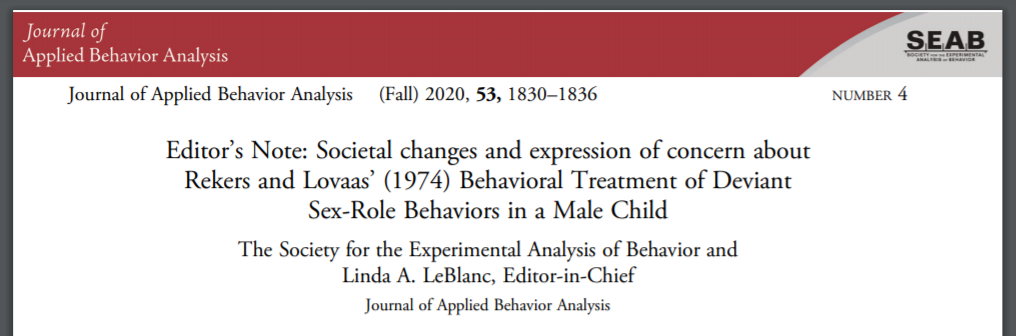
A psychology journal has expressed concern about a 46-year-old paper which described attempts to correct “deviant” gender identity in a 5-year-old boy using physical violence — the latest example of journals purging (or semi-purging) their pages of offensive studies. 

The 1974 article, “Behavioral treatment of deviant sex‐role behaviors in a male child,” appeared in the Journal of Applied Behavior Analysis. Its authors were O. Ivar Lovaas, a controversial psychologist, and George Rekers, who pushed now long-discredited conversion therapy and whose career flamed out spectacularly, as the journal’s editors note in an editorial published alongside the expression of concern:

Continue reading Journal flags — but does not retract — decades-old paper on “correcting” gender identity

Retraction of paper on romantic crushes marks second for psychology researcher

via Wikimedia

A psychology researcher who left her tenure track position at Northwestern University in 2018 amid concerns about the integrity of her data has lost a second paper.

Here’s the abstract of the 2018 paper, titled “Romantic crushes increase consumers’ preferences for strong sensory stimuli:” 

Continue reading Retraction of paper on romantic crushes marks second for psychology researcher

Retraction of paper on police killings and race not due to “‘mob’ pressure” or “distaste for the political views of people citing the work approvingly,” say authors

via Tony Webster/Flickr

The researchers who earlier this week called for the retraction of their hotly debated paper on police shootings and race say the reasons for their decision to pull the article have been misinterpreted. 

Crime researchers David Johnson, of the University of Maryland, and Joe Cesario, of Michigan State University, initially referred in a retraction statement to citations to the work of Heather Mac Donald, of the right-leaning Manhattan Institute, who wrote about the PNAS article for the City Journal and the Wall Street Journal.

Those pieces, Cesario and Johnson said, had unfairly co-opted the paper, ““Officer characteristics and racial disparities in fatal officer-involved shootings,” to argue against the existence of racial bias in police shootings. 

In an amended statement, the authors noticeably omit references to Mac Donald. On Wednesday, Cesario told Retraction Watch: 

Continue reading Retraction of paper on police killings and race not due to “‘mob’ pressure” or “distaste for the political views of people citing the work approvingly,” say authors

77-year-old paper by controversial psychologist Hans Eysenck earns an expression of concern

Hans Eysenck

Journals have issued expressions of concern for seven more papers by Hans Eysenck, including one for a paper the now-deceased psychologist published in the middle of World War II. 

Suspicions about Eysenck, who died in 1997, surfaced in the early 1990s, if not before. At least 14 of his papers have been retracted so far — a total his biographer has said could well eclipse 60. And 71 have now been hit with expressions of concern.

The latest such moves come from the Journal of the Royal Society of Medicine, which issued the following notice

Continue reading 77-year-old paper by controversial psychologist Hans Eysenck earns an expression of concern

Journal calls 2012 paper “deeply offensive to particular minorities”

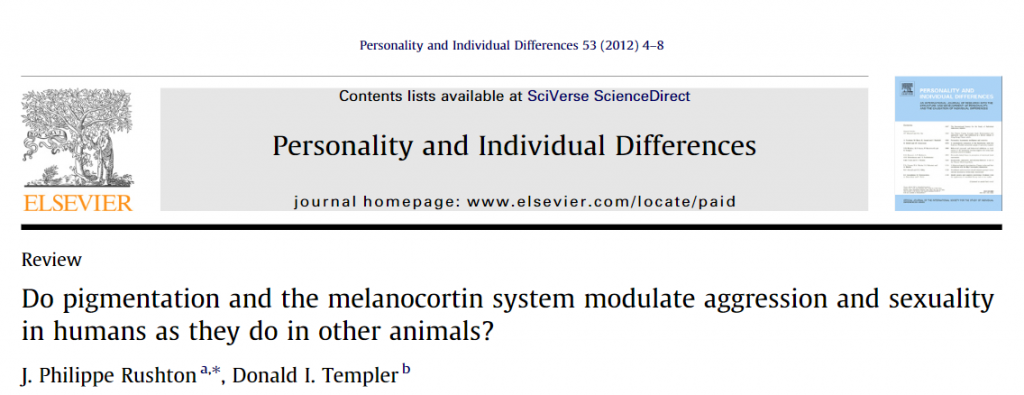
An Elsevier journal plans to issue a retraction notice this week about a widely criticized 2012 paper claiming to find links between skin color, aggression, and sexuality.

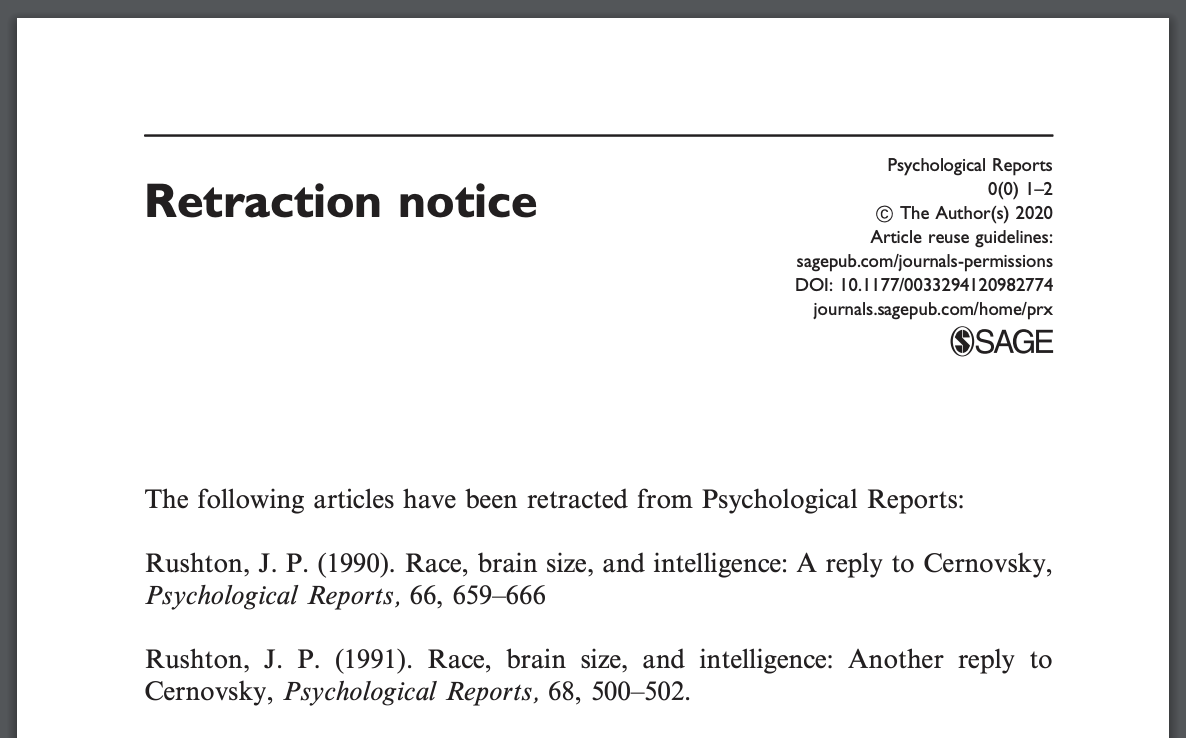
Earlier this month, we reported that the journal, Personality and Individual Differences (PAID), would retract the study “Do pigmentation and the melanocortin system modulate aggression and sexuality in humans as they do in other animals?” by the late authors Philippe Rushton and Donald Templer, published in 2012.

The paper was the subject of a highly critical Medium post in November 2019, and of a petition with more than 1,000 signatures sent to Elsevier earlier this month.

The four-page retraction notice, provided to Retraction Watch by Elsevier, begins with a description of the history, policies and procedures at the journal, then launches into a litany of issues with the paper:

Continue reading Journal calls 2012 paper “deeply offensive to particular minorities”

Editors in chief past and present apologize for publishing article that “feed[s] into racist narratives”

The previous and current editors in chief of a psychology journal have apologized for publishing an article about which one of them writes, “in retrospect I can certainly see that their article does feed into racist narratives.”

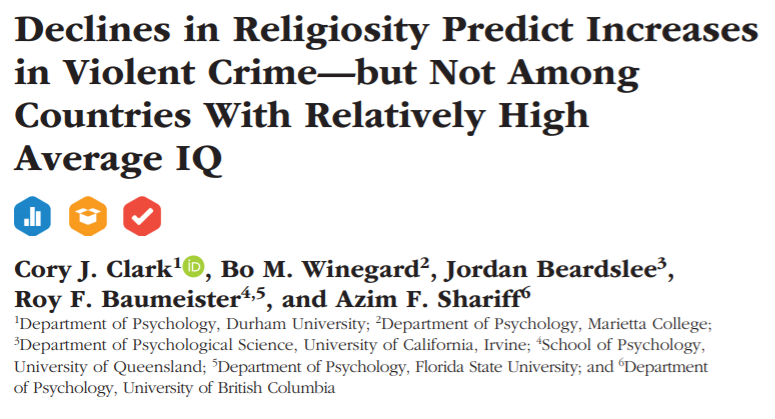
Earlier this month, we reported that the authors of “Declines in Religiosity Predict Increases in Violent Crime—but Not Among Countries With Relatively High Average IQ,” first published in January in Psychological Science, had requested its retraction because they realized they had not vetted the research behind the paper well enough before submitting.

In a retraction notice dated yesterday, the journal’s current editor in chief, Patricia Bauer, writes that the article “has been retracted at the request of the authors:”

Continue reading Editors in chief past and present apologize for publishing article that “feed[s] into racist narratives”

Authors of article on IQ, religiosity and crime retract it to do “a level of vetting we should have done before submitting”

The authors of a paper that some critics have labeled white supremacy in academic robes say they will be retracting the article because some of the data they’d used for their analysis were “highly questionable.” 

The January 2020 article, from a group led by Cory Clark, of Heterodox Academy and New York University, was titled “Declines in religiosity predict increases in violent crime—but not among countries with relatively high average IQ.”  

Appearing in Psychological Science, the flagship publication of the Association for Psychological Science, the paper argued that:

Continue reading Authors of article on IQ, religiosity and crime retract it to do “a level of vetting we should have done before submitting”

“I was shocked. I felt physically ill.” And still, she corrected the record.

Julia Strand

Two years ago, Julia Strand, an assistant professor of psychology at Carleton College, published a paper in Psychonomic Bulletin & Review about how people strain to listen in crowded spaces (think: when they’re doing the opposite of social distancing).

The article, titled “Talking points: A modulating circle reduces listening effort without improving speech recognition,” was a young scientist’s fantasy — splashy, fascinating findings in a well-known journal — and, according to Strand, it gave her fledgling career a jolt. 

The data were “gorgeous,” she said, initially replicable and well-received: 

Continue reading “I was shocked. I felt physically ill.” And still, she corrected the record.

Journal founded by Hans Eysenck issues expressions of concern for his papers, despite calls by university to retract

Hans Eysenck

Bucking the advice of university investigators, a journal founded by Hans Eysenck has issued expressions of concern — not retractions — for three articles by the deceased psychologist whose work has been dogged by controversy since the 1980s. 

The move comes barely a week after other journals opted to retract 13 papers by Eysenck, who died in 1997. Those retractions were prompted by the findings of a 2019 investigation by King’s College London, where Eysenck worked until 1983. That inquiry concluded that: 

Continue reading Journal founded by Hans Eysenck issues expressions of concern for his papers, despite calls by university to retract

Journals retract 13 papers by Hans Eysenck, flag 61, some 60 years old

Hans Eysenck

Two journals have retracted 13 papers co-authored by the late — and controversial — psychologist Hans Eysenck, following a university investigation that found dozens of his papers to be “unsafe.”

One of the journals, Perceptual and Motor Skills, subjected 36 of Eysenck’s papers to expressions of concern, while another — Psychological Reports — subjected 25 of them to the same flag. Both journals are published by SAGE.

A May 2019 report by King’s College London into the work of Eysenck and Ronald Grossarth-Maticek, apparently of the University Heidelberg, that more than two dozen papers be retracted. Among other issues, the report cited

Continue reading Journals retract 13 papers by Hans Eysenck, flag 61, some 60 years old