The publishing firm Wiley says it is investigating a pivotal paper about a controversial public health tool after Retraction Watch reported on a robust critique of the article which highlighted a number of potentially serious flaws with the research.
We’re talking about the Morisky Medication Adherence Scale (MMAS), whose developer, Donald Morisky, has been hitting researchers with hefty licensing fees — or demands to retract — for nearly two decades.
One of the key papers supporting the validity of the MMAS-8 (the second iteration of the MMAS) was a 2008 article by Morisky and colleagues in the Journal of Clinical Hypertension.
As long-time readers of this blog know, we’ve spilled more than a few pixels on the work of Donald Morisky. His Morisky Medication Adherence Scale (MMAS) has been a financial boon to himself — and the bane of many researchers who have been forced to either retract papers or pay Morisky what they consider to be exorbitant fees to retroactively license the instrument.
But lately things have been a bit rocky for Morisky. Last year, he and his former business associate (read, legal enforcer) found themselves embroiled in a lawsuit which claims, as we reported, that Morisky used:
their company as a personal piggy bank and taking steps to starve the business of clients and funnel money to his family.
And now, a researcher has questioned the validity of the MMAS, arguing that his review of a foundational paper underpinning the instrument shows serious flaws.
Contemporary social psychology has been seized over the past years by a loss of credibility and self-confidence associated with scientific fraud and unsuccessful attempts to replicate the modern corpus of knowledge. The most notorious case was that of Dietrick Stapel. Fifty-eight papers published over a decade and a half were retracted due to fraud and suspicious research practices.
One of the most poignant questions raised by the review committees in three universities where he worked was how it was possible for such dubious scientific practices to escape the notice of all the academic reviewers in the high-profile journals, the funding agencies and at the scientific conferences. Many statistical anomalies were identified readily by statisticians who assisted in the review of Stapel’s papers. The committees were forced to conclude that “there is a general culture of careless, selective and uncritical handling of research and data. The observed flaws were not minor ‘normal’ imperfections in statistical processing, or experimental design and execution, but violations of fundamental rules of proper scientific research.” The culture contributed to the absence of skepticism about Stapel’s extraordinary findings.
But while trying to replicate the findings, Slagter and a then-PhD student of hers, Leon Reteig, found a critical mistake in a statistical method first proposed in a 1986 paper. Slagter told us:
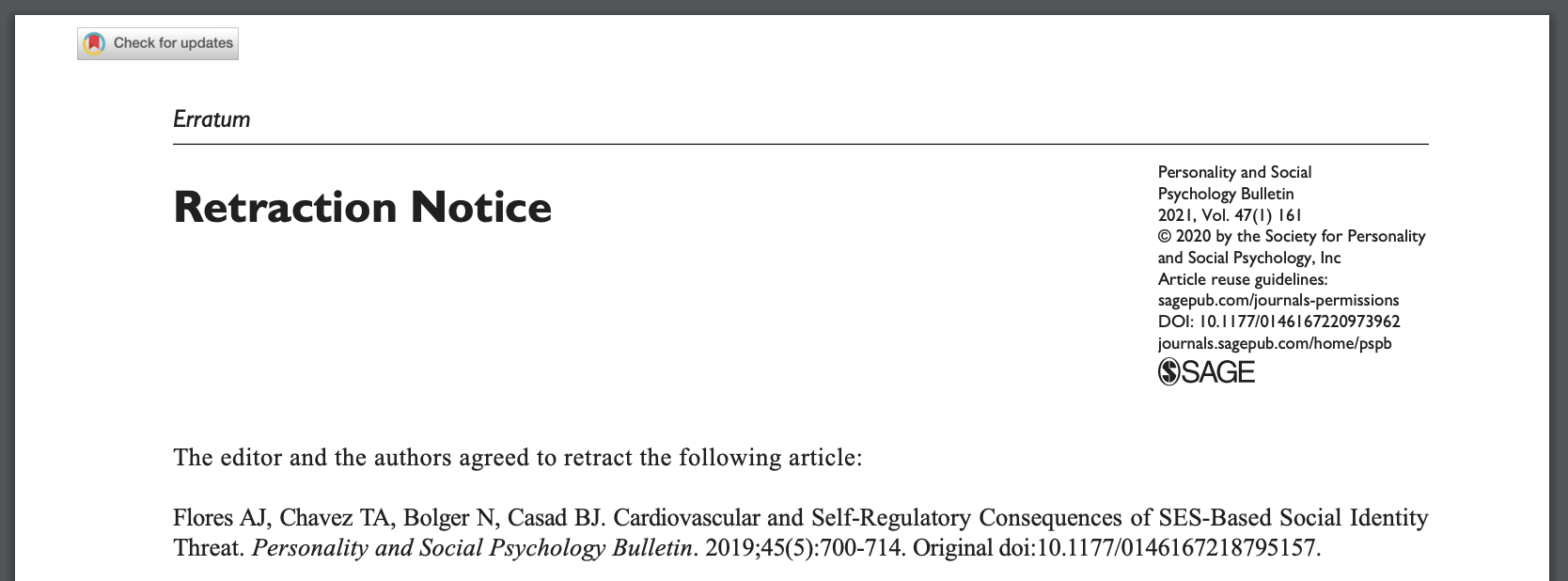
Personality and Social Psychology Bulletin has retracted a 2018 paper because, according to a retraction notice, the first author changed data in a way that “resulted in incorrect and misleading results.”
The article, “Cardiovascular and self-regulatory consequences of SES-based social identity threat,” claims to show that socioeconomic status-based “social identity threat can go from ‘in the air’ to ‘under the skin’ to influence physiological and self-regulatory processes.” It has been cited twice in addition to the retraction notice, according to Clarivate Analytics’ Web of Science.
A psychology journal has retracted a pair of decades-old articles by a now-deceased psychologist with noxious views about race and intelligence after the editors concluded that his work was “unethical, scientifically flawed, and based on racist ideas and agenda.”
The author, J. Philippe Rushton, was affiliated with the University of Western Ontario, where he was notorious for publishing highly questionable studies that promoted tropes of white supremacy, including that Blacks are less intelligent than whites and that
A researcher in Ecuador has lost a 2019 paper on the application of a widely-used psychological research instrument after the owner of the tool flexed their copyright muscle.
The episode — like another one, recently — echoes the case of Donald Morisky, a UCLA researcher who developed an instrument for assessing medication adherence — and then began charging other scientists small fortunes (and, in some cases, large ones) for use of the tool, or forcing retractions when they failed to comply. (For more on the Morisky case, see our 2017 piece in Science and this recent warning by journal editors.)
Written by Paúl Arias-Medina, of the University of Cuenca, the article, “Psychometric properties of the self-report version of the strengths and difficulties questionnaire in the Ecuadorian context: an evaluation of four models,” appeared in BMC Psychology.
We wrote in September in WIRED about a trend among journals of purging racist and sexist work from their archives. To that trend we can now add papers that are homophobic and racist.
The Journal of Nervous and Mental Disease has retracted a 1951 article by one Benjamin H. Glover, at the time a professor of psychology at the University of Wisconsin–Madison. The article, “Observations on Homosexuality Among University Students,” claimed that:
A psychology journal has expressed concern about a 46-year-old paper which described attempts to correct “deviant” gender identity in a 5-year-old boy using physical violence — the latest example of journals purging (or semi-purging) their pages of offensive studies.
A psychology researcher who left her tenure track position at Northwestern University in 2018 amid concerns about the integrity of her data has lost a second paper.