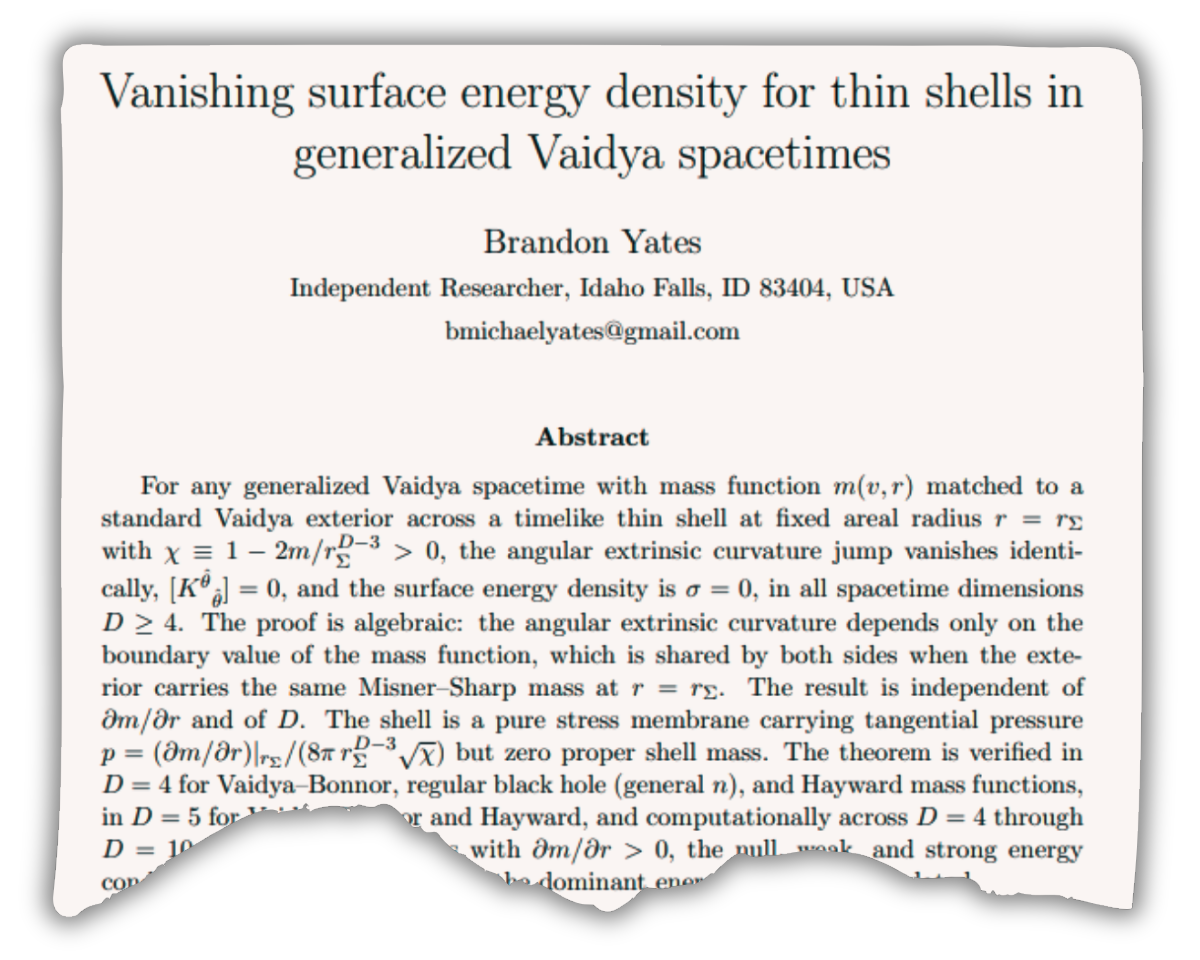
Some people compose music or make YouTube videos for a hobby. That’s Brandon Yates’ job — so in his spare time, he tries his hand at theoretical physics. But his only published paper was questioned because of his lack of professional training in the field — despite the physicist who inspired his work saying the work looks legitimate.
Based in Las Vegas, Yates earns a living as a composer for the animated series called “Death Battle.” He also has had an “intuitive understanding of, and love for, General Relativity for as long as I can remember,” he told Retraction Watch. But he has no formal training in physics and is self-taught, he said.
After watching a video lecture series online by Canadian physicist Eric Poisson, in January, Yates built a computer algebra program to look into rules in general relativity used to fuse two spacetimes across a thin shell, Yates said. By March, he had come across a conditional result he believed to be novel.
He spent a few weeks trying to understand his finding, “and then sat on it a couple more weeks for a literature search and to decide whether to submit a paper despite my station,” Yates told us. He submitted his findings to the International Journal of Geometric Methods in Modern Physics and said the peer reviewers asked only for a few “presentational” fixes, including that he hadn’t used his key words enough.
While the paper was under review, Yates posted on X in March asking for an endorsement for a different paper he hoped to post on arXiv, which requires such backing for new authors.
General relativity is a popular topic for amateur physicists or people working outside their expertise. Regardless of his lack of formal training, Yates’ paper on vanishing surface density in generalized Vaidya spacetimes was published on June 20, listing him as an independent researcher.
“It’s probably worth making explicit that I have no incentive to fudge anything. I’m successful in another field and already have a thriving career,” Yates told us.
The day after it was published, a physicist who declined to give us his full name because he “would like to focus quietly on my academic research without troubles,” emailed the journal to express concern that Yates “appears to have no formal education in any STEM-related field.”
“This lack of background, coupled with the highly technical nature of the work, strongly indicates that the manuscript was likely generated using an aggressive, AI-assisted workflow by someone outside the scientific community (specifically, a professional musician),” the physicist wrote.
Yates told us he used a generative AI tool, but within the confines of what is acceptable at the journal. The AI “was limited to assistance with phrasing in academic register, LaTeX formatting/typesetting, and assistance preparing the Python verification script,” he said. “The mathematical claims are supported by the exact symbolic verification materials and do not depend on AI output.”
Francesco Bajardi, co-executive editor at the International Journal of Geometric Methods in Modern Physics, told us the journal’s review of the article “has not identified evidence suggesting improper use of AI, though we cannot state this with certainty.”
“However, the lack of affiliation and background are clearly suspicious,” Bajardi said. He told us the journal was no longer investigating the article because “there is no certain proof that the manuscript has been entirely written by AI.”
Poisson, whose work inspired Yates, told us the paper “doesn’t reveal any red flag that suggests to me a major AI involvement.” He noted the work “describes a rather straightforward exercise in applying junction conditions in general relativity, with no particular interest nor novelty, but I see nothing objectionable about it,” he said.
Yates told us “there was never a grand plan here. I found a result I thought might be novel, did my best to turn it into a proper paper, and submitted it through the normal process.” He is now taking online courses so he “can pursue proper accreditation,” Yates said. “A BA, and later if I’m lucky, a PhD in mathematical or computational physics. I’m also actively seeking out a mentor, though I’ve had no luck so far.”
“I didn’t expect that working without a degree would turn a refereed paper into news,” he said. “I’m pursuing physics because it brings me joy, and submitted the paper when I’d found something.”
Update, August 6, 2026, 7:00 pm ET: This story was updated to clarify that Yates’ request for an endorsement posted on X was for a different paper, not the one eventually published in June.
Like Retraction Watch? You can make a tax-deductible contribution to support our work, follow us on X or Bluesky, like us on Facebook, follow us on LinkedIn, add us to your RSS reader, or subscribe to our daily digest. If you find a retraction that’s not in our database, you can let us know here. For comments or feedback, email us at [email protected].
If Wikipedia is to be believed, Albert Einstein published ground-breaking papers on the photoelectric effect, Brownian motion, the special theory of relativity and the equivalence of mass and energy in 1905, before being formally awarded a PhD in 1906. It’s not that the gentleman described in the article is a new Einstein – it sounds as though his research is rather routine, not ground-breaking at all. However, objecting that his paper shouldn’t have been published because he lacks the proper academic credentials is absurd, and snobbish. Talented amateurs have made major credentials in many fields. Charles Darwin, arguably the greatest biologist of all time, didn’t have a PhD, and studied theology rather than biology at university … Papers should be judged on their own merits, not on the basis of the letters (if any) after the names of their authors. That objection to the current paper is credentialism at its worst.
He could easily dispel the skepticism by giving an in-person presentation (slides plus blackboard) with an extensive Q&A to experts in the field. He already is comfortable with some degree of public speaking through YouTube, and could use AI to help him format slides in Beamer, so the only challenge would be finding a group of physicists to present to. If three months of amateur GR studying in one’s free time is sufficient to get a deep enough understanding of the topic *and* generate novel enough results to publish a paper, then surely 8 months in he’d be expert enough to answer any specific follow-up questions.
I’m an academic in a similar field. No one is going to invite this man for a talk, we don’t have time for that, and no one cares.
You don’t NEED to be able to defend your work in person: many can’t. The peer review process is the process for determining what is appropriate to publish, and this man passed it.
It doesn’t not matter how his paper was written as long as it was not plagiarized, and that’s a really high bar considering we ARE allowed to re-use other peoples’ results with appropriate attribution.
The person who reported him is a petty Karen who is mad about the rise of AI. Look at our math unions statements on AI: we are allowing it. Everyone is obviously going to use it considering how powerful of a tool it is. This whiny man acting like a paper “shouldn’t count” because AI was used is going to be left behind. The paper is either correct or it’s not. It either passed peer review, or it didn’t. We are not going down this road of arguing about what was “human written” or not, because frankly, we don’t care. We just want the truth, and this tool helps us get it. That’s what the community consensus is rapidly becoming.
Well, it’s definitely not true that the community consensus is becoming more tolerant of AI academic contributions; quite the opposite, if you are to read other RW articles. There are already plenty of studies demonstrating that LLM papers are overwhelming academic publishing with content that is, at best, non-novel, uninsightful, or uninteresting, if not incorrect.
If receiving “the truth” is the only objective you “academics in a similar field” have for your research, and if this can now be achieved with AI, then what is the point in any human trying to gain expertise in that field now? Why even teach it to undergrads if there is nothing for either them or science to gain from their learning your field?
Finally, if the hypotheses, experimental design, data, etc were formulated by an LLM then the LLM should be credited as the author and the human prompt engineer relegated to the acknowledgements or Materials and Methods section. I’m not saying this is relevant to this case,
What is, in this context, the fundamental difference between using AI as an aid and using a calculator as an aid? I can’t wait until someone with access to a sufficiently clever AI combs through all the scientific output of the past few decades.
Given that many papers (even currently as we speak) have been retracted for peer review manipulation and peer reviewers use more and more ai to do their work I doubt peer review undoubtedly prevents junk being published. With this I am not stating this paper is bad or the peer review was bad but you can’t use the ‘it passed peer review’ argument.
Of course does not mean the paper is bad.
Respectfully, I don’t think you understand academia. Einstein was working on his PhD dissertation and actively doing research. It is typical for people seeking their PhD to publish as they’re writing their dissertation. And he had an education in physics and mathematics already.
Papers should be judged on their merits, but it’s also more difficult to have faith in the quality of research or just simply that something actually truly novel will be published from someone without extensive knowledge of the field. As Yates pointed out in the article, the paper lacked novelty and interest.
There is import in having a background in the field that you are publishing in, as it actually gives you a better understanding of gaps in research to explore to make a meaningful contribution to the field.
Shame on this guy “a physicist who declined to give us his full name”. What kind of world are we living in now, some really cares more about credentials than contents.
Well said!
Calling this “academic snobbery” really misses the bigger picture. This isn’t about protecting an exclusive club with fancy degrees; it’s about common sense, the ethical use of AI, and keeping science trustworthy.
The whole “talented amateur” argument, especially the comparison to Einstein, just doesn’t hold up here. Einstein wasn’t just some guy off the street; he was trained at ETH Zurich, one of the top STEM universities in the world. On top of that, physics has changed a lot since 1905. Today, you need years of intense, highly specialized math just to read a theoretical physics paper, let alone write one from scratch.
Because modern physics is so insanely complex, common sense tells you a harsh truth: someone without a background in the field simply cannot produce a theoretical physics paper. Full stop. If a beginner suddenly hands in a highly technical paper, the only logical conclusion is that they didn’t actually write it. These days, that usually means they are trying to pass off AI-generated work as their own.
Ultimately, science only works if we can trust it. If you publish a paper, you have to actually understand the math, defend your methods, and answer tough questions from other scientists. Taking credit for something a chatbot spat out isn’t a victory for the underdog – it’s fraud. It totally undermines the basic trust that science is built on, and no responsible physicist is going to just let that slide.
Ironically, your argument about the math is exactly why his paper cannot have been written by AI. AI sucks at math. It hallucinates when trying to copy simple arithmetic into documents, much less high-level math. There’s no way that a paper written by AI would pass peer review because all of the technical parts would be gibberish.
Reminds me a bit of the career path of this fellow, who came to science from music by way of bike racing:
https://www.relationrx.com/about/lindsay-edwards
What matters is whether the results and conclusions hold up. Credentials are no guarantee of quality. Plenty of poorly designed and/or badly reasoned work comes from people with advanced degrees. Charles Darwin had no degrees.
The appeal to authority that permeates academia is a sure sign academia is not about discovery, but protection of interests. A finding should only be judged on its own merit, not the background of the author(s).
As someone who’s been told to my face “who are you to work on this topic” by a fellow academic from a “fancier” institution, I am sadly not surprised that someone thinks “who is this guy to have discovered something without going through the rite of passage”. Remember, scientists and science exist long before PhDs did
If a gold fish somehow were able to communicate a new scientific discovery it should be the evidence of the claim not the gold fish which is judged on the merits. I also rather suspect very soon Ai will by hallucinations or legitimate “mental exercise” give real scientific discoveries abscent a human mind asking a question. Judging by the quality of the research even the questions being asked these days, I bet a lot of people in acedemia feel threatened by outsiders.
Are we returning to the 14th century?
Try doing the same in neuroscience. No credentials = no publish.
We probably count the number of amature neuroscientists on zero hands lol
Dear Dr Adam Marcus and Dr Ivan Oransky as well as All and Sundry,
As a multidisciplinary researcher, writer and independent scholar with multiple degrees as well as being a composer, I can certainly understand the predicaments of someone like Brandon Yates, who has tried to publish a paper on a narrowly defined topic or niche subject.
Unfortunately, there are far too many extant issues that remain to be addressed by scholarly publications. Academic papers published in most if not all conventional journals tend to be highly limited in scope, format and feature, mostly presented in monochrome or greyscale and rarely in colour; cannot include large or complicated illustrations, maps, charts, schematics and/or statistics; unable to incorporate audiovisual contents, videos, animations, pop-ups, hyperlinks, comments, revisions, extensions, user interfaces and other real-time, dynamic or interactive components, let alone social media integration; and ill-suited or ill-prepared to deal with highly innovative, interdisciplinary and/or multidisciplinary works, not to mention that there continue to be few or no referees and reviewers qualified or knowledgeable enough to evaluate them properly and cogently without intellectual oversight and bias.
Circumventing the many restrictions and conventions imposed by academic journals whose contents are often hidden behind paywalls, self-publishing certainly presents numerous advantages, which, when combined with the dynamic nature of a blog post offering contents that can be freely viewed and shared by visitors and commenters, are attractive to the likes of us who have been inveterate teachers and communicators.
Yours sincerely,
SoundEagle🦅
The theoryofeverything.ai is a service/website that can review the paper on merit so the independent researchers getting reviews and feedback from a panel of ai can find and prepare the work for more formal review. Science should not be based on institution bias but on the science.
That AI slopsite is more biased than any institution or set of institutions in its field.
Credentialism is rampant, even when one has a relevant graduate degree but not a Ph.D. Someone I know asked me to contribute my knowledge of statistics and clinical trials to work he was trying to get accepted by the Cochrane Review. They said he couldn’t use me because I only had a masters degree and decades of professional experience in the field (including 50 articles in peer-reviewed journals) but no doctorate.
If you’re part of “the world system” it’s easier, you get a little extra “help” if you know what I mean.
A composer….that sounds like he had some musical education…. possibly elite schools….the very notion of wanting to be a composer is upper crust….so he may have a background in physics, mathematics,…hence the paper.
It’s easier when you’re part of “the world system” you get “help”
I have known Brandon for years. He self-learned, self-taught, and played/sang in local bands for years when he was young. Not sure what part of the world system you are, but he always does his best for the things he loves when there is no resource helps him.
People with a strong belief in credentials should consider the strange case of Cambridge (UK) Professor Jason Arday.
I think it’s great that keen amateurs can publish in theoretical physics, and the competition should motivate professional academics to increase their quality and focus on more innovative research!
It is common problem with people from Academia, even after being in Industry for almost 20 years, I faced so much trouble getting accepted or endorsed for being independent researcher.
My take would be: there is nothing wrong with being an independent researcher per se, but the issue is that so much fraud (including paper mill products) come from addresses such as @gmail.com or @163.com. In my opinion, ORCID should be mandatory by now, and the trust markers they try to promote could apply also for independent researchers with some suitable modifications.
this is the world we are living in, everybody thinks they are smart and they should be acknowledged. yet they need a small push from mama nature to realize they are not special.
What are you talking about?
As a PhD in chemistry with 20 years of experience, both in academia and in the industry, frankly speaking, I do not see any issue here. Why must one hold a PhD in whatever matter to be allowed to publish anything on a particular subject? We had highly respected polymaths in the past that are still considered with high regard, and they did not have a formal education. If this author have provided a meaningful contribution to the field, it shall be welcomed, not criticised. Conversely, there are a lot of scientists, many renowned ones, who publish crap increasing the noise in several fields. The science today is so twisted…
It doesn’t even have to be a particularly meaningful contribution in global terms, just adequate for the particular journal.
The non- negotiable part is proper attribution and content that passes peer review, which this apparently meets.
Demarcation disputes are very unseemly.
I am in medicine. I left high-powered academia in the ’80s and moved to Maine. We are resource-poor, and many of the people who grew up here were not given the opportunity to get higher education and advanced degrees. As a doc, I often needed to work outside my specialty because there was no one else. Period.
I can state with considerable assurance that credentials do not guarantee competence, and that uncredentialed individuals can be highly competent.
I will grant you that credentials increase the likelihood of subject matter expertise and likely improve judgment. By no means is it a foregone conclusion. Similarly, uncredentialed individuals can be highly competent and exercise excellent judgment, but I think the burden of proving that lies on the individual and it cannot be the initial assumption. In several instances, I worked with subordinates who, had they been born in a different place and at a different time, would have been my colleague or my boss.
Perhaps the most interesting thing about this whole kerfuffle is that the individual who raised the issue, if I am reading this correctly, never raised any issues about the content.
By the way, I let Grammarly help me phrase some stuff better and make sure I didn’t make any stupid tense or punctuation errors.. There. Full disclosurel
A sad reflection on the publish or perish nature of an academic career. So much of what is published is derivative these days most of what is published could, no doubt, be generated by AI.
This is a non-issue. This has become an issue perhaps because of many academician who are frauds. Publishing papers in theoretical physics without a BSc in physics should be normal. The only requirement is the ability to (a) understand what is read, (b) to think and to carry out required research and (c) to start writing after reading enough papers written by other physicists. Now with AI, (a) to (c) need to be verified, which is impossible. Hence, AI disclosure has become mandatory. Since the work has been checked and no issue is found, so this composer-author should enjoy the moment and further publicize his work.
If this had happened even 5 years ago, I don’t think there’d be as much objection. LLMs wouldn’t have muddied the waters, and physics as a community could welcome an unusual outsider with something novel to add. Now, there will always be questions of where and how much LLMs were involved, in research, review, and publication, and what this says about the result and the credit due.
It seems like the academic publishing model is going to have to change. Reviewers already have a tough job and now will have to deal with a flood of papers created with the help of AI. AI use doesn’t invalidate the result in a paper, but I think the bar for getting your work reviewed will have to be a lot higher.
I am a software engineer. I have built very large and sophisticated systems for global concerns, all the while creating cutting edge technology. Many of my tasks over the years, we’re cleaning up message made by people with phds and master’s degrees. I have a degree in absolutely nothing. I’m still the best there ever was.
Academic advisors demand and expect 100% loyalty from their graduate students. For most people, this is not an obstacle to getting a graduate degree. They just kiss the ring of whoever thinks their GPA and their GRE score is high enough to warrant a place at their feet. But for those of us on the record for having already published our own theory, the door to graduate school has forever slammed shut regardless of our near 4.0 GPA or our near 340 GRE.
As an independent interdisciplinary scholar, I am in complete sympathy with Yates. Academic publishing is challenging enough even with the advance degree and the appropriate affiliation. Absent these, it borders on the impossible. Without an advanced degree and being outside Academia meant it took me many years to finally get the work for which I am best known accepted by a peer reviewed journal. That paper has since garnered nearly 2000 citations and its theoretical core has entered the influential canon of my field. Still, because I am now retired but continue to push the boundaries into new areas, I accumulate desk rejections not on merit but because I no longer have an institutional connection or because I am working outside the narrow disciplinary silos of science today.
Given the growing problem of researchers and academics who lie about, exaggerate, or fabricate credentials, we should be more open to the contributions of those, like Yates, who straightforwardly acknowledge who and what they are. Retraction Watch is all about the self-correcting processes of science. Flawed though they may be, they should be allowed to function irrespective of the credentials or affiliation of the authors.
A PhD only allows you to get a position in academia (if you’re lucky) or a better salary if you’re working outside academia. And yes, it’s supposed to be a kind of proof (vetted by your committee) that you are able to do systematic research — a theme with variations — on a relevant subject matter. But this has never precluded that people who didn’t go this career route cannot also have insights that might move science further. And HAVING a PhD and being in an academic position does not prevent people from publishing absolutely crappy papers with little merit. So there’s a good reason why science, although it has its formal hurdles and official signs of accomplishment, should never be about authority, but always about the content.
And that’s what I am wondering about in this case. A good physicist with some in-depth expertise in general realitivity should be able to look at the paper and come up with an informed judgment. But that’s exactly what we have not seen. Neither did the anonymous physicist who has flagged the paper identify any issues related to the content of the paper, nor have the reviewers (the keywords weren’t used often enough? Seriously?). So whatever the merits of Yates’s contribution may be (and I am not in a position to judge), so far there seems to be no substantial rebuttal of the paper based on its actual content.
Hey Oliver! There were other revision requests in my referee report – requests for numerical examples and checks of specific limits. Didn’t make the RW article, but the keyword revision request was one among many.
As for the merits, it’s likely to be most interesting to researchers studying energy conditions in gravastar-type models (black hole alternatives), where energy conditions are tracked carefully and parameters are often tuned by hand to control whether conditions like the Dominant Energy Condition hold. In every nontrivial case in my paper, the shell carries nonzero surface stress with exactly zero surface energy density, which violates the DEC, the standard requirement for physically ordinary, non-exotic matter.
So, for this entire family of configurations, the violation is automatic rather than tuned, which is relevant to black hole mimicker models built from them. The vanishing surface energy density also saves future authors from calculating it in this class again. The DEC violation is the scientifically interesting part. At least, in my opinion, though I still have so much to learn.
I feel for him. I have a paper that is an engineering proof out there that is the only paper that every frontier model AI says is the most important and foundational and truthful in all academia. It currently stands unrefuted and uncited.
Quite a poor article by RW standards. As the guy has done nothing wrong, why are you publicising this paper and using quotes from some anonymous academic to back up the nonsense reporting?
I don’t really think not having an affiliation matters here. I read through the paper, and I seriously doubt that someone without formal training in theoretical physics wrote this by themselves, unless an LLM did the heavy lifting. If that’s what happened, it begs two questions: who is the real author, and how should academic publishers update their policies to handle this? Truth be told, an actual expert could knock out this same problem in an hour with those AI tools, rather than spamming journals that are just cashing in on publication volume – all while leaving unpaid referees to deal with the mess.
This is true and it is absolutely a valid concern. The composer-author should respond to this comment explicitly by admitting that he did all the required derivation(s) first by himself manually (by “pencil on a paper”), and not by any software and/or AI. In theoretical physics, self-taught or not, being competent to manually deriving the equations is a mandatory (though solving equations that need a computer is another thing). Both the derivations and the physics involved in every step of the derivation(s) is(are) equally important. The thought processes by doing those two are completely different if one of them, the derivations or the physics, or both are outsourced. Letting the AI do all the possible derivations and letting AI to select the missing possible derivation, and then filling in the physics as required are not acceptable in scientific research publications. All journals must take note of this concern.
Is there (not to say ‘here’) anybody who read details about Prahladbhai Chunilal Vaidya?!
“Vaidya’s initial research under this scholarship resulted in a paper that he sent to Robert Oppenheimer, who appreciated the paper and sent it to the American Physical Society journal Physical Review. The journal published the paper in 1951.”
https://en.wikipedia.org/wiki/Prahalad_Chunnilal_Vaidya
… 😉
Most of the comments here are absolute nonsense, probably written by amateurs pretending to be experts. No sane theoretical physicist is going to tolerate a situation where someone with zero background knowledge is churning out papers in the field. It undermines trust in the scientific community and endangers the entire discipline – not to mention the massive ethical issues.
Much like Arday stepping down, the right thing for this “author” to do is to withdraw the paper.
How do you know the author has “zero background knowledge”? Why is it not possible he has aquired that knowledge by himself? Why are you talking about “churning out” if the author has, for my understanding, published one (physics) paper? Why does this all matter if the paper is correct? And it seems to be, at least you as well as everybody else is unable to produce a single criticism based on the science in the paper.
I can’t help it, but you think “theoretical physics” is owned by the initiated few. It is not.
We can’t wait for his next paper -preferably in a completely different field of physics (or biology) that he self-taught since spring.
It must have gotten reblogged somewhere to draw out so many of the anti-academia kooks…
He seems as unqualified as a patent office clerk.
We have so many people in academic positions who are publishing rubbish with the help of AI, but how often does someone haul them over the coals because they have had “the training”. It is getting worse and worse…
Here is a very unusual case. Time will tell regarding the published work and its legitimacy. But there are a lot of very rash and hasty judgements being made here in very rapid fashion with very little information.
I guess ppl do not believe in polymaths anymore, huh? What if this fellow turns out to be one? Let’s see what happens in the future. The posts here are so full of hubris and establishment arrogance. I say this as someone who has formal training in physics.