Reuters removes story on gender confirmation surgery because firm mistakenly released data

Reuters has removed a story about gender confirmation surgery, saying it included problematic data.

The public relations firm representing the American Society of Plastic Surgeons (ASPS) — which generated the data in the report  — took responsibility, saying it supplied Reuters with data the ASPS did not want released.

Yesterday, Reuters pulled its version of a widely-reported story about an increase in such surgeries in the U.S. (Later, it pulled the withdrawal notice as well, only to make it reappear at a different URL.)

The story, originally posted just after midnight yesterday, reported a 19 percent increase in those procedures from 2015 to 2016, based on data provided the American Society of Plastic Surgeons (ASPS). Around 1 pm US Eastern time that day, Reuters put up a withdrawal notice in place of the original story:

Continue reading Reuters removes story on gender confirmation surgery because firm mistakenly released data

Researchers mistakenly administer three-fold higher dose of anesthesia

Researchers have retracted a 2016 paper after discovering that they accidentally administered three times the reported dose of anesthesia to rats.

In the Experimental Physiology paper, the authors set out to mathematically map how rats’ blood pressure changes under different conditions, which required the rats to be anesthetized. But their findings were called into question when they found the rats had received a much higher concentration of anesthesia than intended. According to the notice, this higher dose compromised the “objectives of the experiment.”

The corresponding author Karol Ondrias, from the Institute of Molecular Physiology and Genetics at the Slovak Academy of Sciences in Bratislava, told us how the dosing error occurred: Continue reading Researchers mistakenly administer three-fold higher dose of anesthesia

Ex-PhD candidate sues advisor, school: Colorado prof “poisoned the well” after research dispute

A former University of Colorado Boulder graduate student is suing his ex-advisor for defamation after being shooed out midway through his doctoral program.

Robert Roscow says he had to leave CU Boulder’s department of Ecology and Evolutionary Biology (EBIO) in the fall of 2016 with only a master’s degree after fish evolution researcher David Stock dropped him as a student. Their relationship deteriorated following a dispute about whether another student should perform experiments Roscow considered to be essential to his dissertation.

Once dropped, Roscow was offered the chance to find another advisor, but never did. In his complaint, filed April 25 in Boulder County District Court, Roscow claims he has evidence that Stock “poisoned the well” by badmouthing him in email and in person to other professors, ultimately preventing Roscow from completing his degree.

As first reported by BusinessDen, Roscow is also suing CU Boulder for a breach of contract and for failing to “provide [him] with the reasonable opportunity to pursue his PhD,” among other allegations. 

CU Boulder declined to elaborate on the case. Chief Spokesperson Ryan Huff told us:

Continue reading Ex-PhD candidate sues advisor, school: Colorado prof “poisoned the well” after research dispute

Does the philosophy literature have a plagiarism problem?

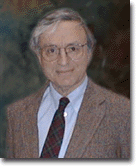
Michael Dougherty

Philosopher Michael Dougherty doesn’t take plagiarism sitting down. Over the years, the researcher at Ohio Dominican University has tipped us off to numerous instances of plagiarism he’s spotted. And it turns out, he’s done the same thing for publishers, as well. In a new paper in Metaphilosophy, Dougherty describes his experience contacting publishers over an instance of what he terms “serial plagiarism,” and how they responded – or didn’t respond – to his allegations.

Retraction Watch: Your paper focuses on the publications of one author – Martin W. F. Stone – who you claim has plagiarized numerous times. (We’ve reported on 14 retractions for Stone.) What made you decide to undertake this work?

Continue reading Does the philosophy literature have a plagiarism problem?

Journal flags two more papers by diabetes researcher who sued to stop retractions (and now has 12)

A diabetes journal has issued two notices of concern for papers co-authored by a researcher who took another publisher to court after it did the same thing — but ultimately lost.

The notices are for two papers co-authored by Mario Saad — who, after losing his legal battle with the American Diabetes Association, has since accumulated 12 retractions. Both notices — from the journal Diabetologia, published by Springer and the the European Association for the Study of Diabetes (EASD) — say they have alerted Saad to their concerns about some of the images in the papers, and the university where he is based was asked to investigate more than one year ago. Since the journal has not yet received any information from the University of Campinas in Brazil, however, it decided to issue expressions of concern for the two papers.

Here’s the text of the first notice:

Continue reading Journal flags two more papers by diabetes researcher who sued to stop retractions (and now has 12)

Gender-based violence researcher now up to 10 retractions for plagiarism

A publisher has retracted all of the papers it published by a researcher in Nigeria, citing plagiarism.

The papers, all about terrorism and gender-based violence, were written by Oluwaseun Bamidele. The journal editors and the publisher, Taylor & Francis, decided to retract nine papers by Bamidele because of the overlap to other works — which he also failed to reference.

Bamidele — who also lost a paper on Boko Haram for the same reason — told us he didn’t learn about what constitutes plagiarism until his graduate studies, after he’d already written the now-retracted manuscripts:

Continue reading Gender-based violence researcher now up to 10 retractions for plagiarism

Journal retracts paper eight months after U.S. Feds announce findings of misconduct

In August, the U.S. Office of Research Integrity announced that a former postdoctoral fellow at the National Human Genome Research Institute (NHGRI) doctored data in two published papers.

It took one journal a little longer than five months to remove the researcher’s name from the co-author list, and replace one figure.

It took the second journal more than eight months to retract the paper.

Here’s the notice for “A BLOC-1 Mutation Screen Reveals that PLDN Is Mutated in Hermansky-Pudlak Syndrome Type 9,” published by the American Journal of Human Genetics (AJHG):

Continue reading Journal retracts paper eight months after U.S. Feds announce findings of misconduct

First author objects to retraction (his fourth) in chemistry journal

The first author of a 2013 chemistry paper is objecting to his co-authors’ decision to retract the paper, which contains duplicated figures.

We recently encountered a similar scenario with papers by first author Khalid Mahmood. In late 2015, Mahmood lost three papers in the journal ACS Applied Materials & Interfaces over duplicated images. One of the notices also indicated that the figures had “been published elsewhere and identified with different samples” — the same language used in the notice of the most recent retraction, in Journal of Materials Chemistry C.

Mahmood performed the work on the papers at Korea Advanced Institute of Science and Technology (KAIST), along with his two co-authors, Seung Bin Park and Hyung Jin Sung (also co-authors on two of the retracted papers in ACS Applied Materials & Interfaces).

Seung Bin Park, who is dean of the College of Engineering at KAIST, told us: Continue reading First author objects to retraction (his fourth) in chemistry journal

Journal: Here’s why we didn’t retract this duplicated paper

Here’s something we don’t see every day: A journal explains in an erratum notice why it chose not to retract a paper that contains data published elsewhere.

According to the Journal of Business and Psychology, the authors violated the journal’s transparency policy by failing to disclose that they’d used the same data in their 2014 in three others. However, the editors ultimately concluded the current paper was different enough from the other three to save it from being retracted.

Here’s the erratum: Continue reading Journal: Here’s why we didn’t retract this duplicated paper

Controversial researcher loses 12th paper that’s “literally copied;” authors object

A physics journal has retracted a 2011 paper by a group of scientists based in Italy, noting it’s “literally copied” from a paper by the same authors.

This is the 12th retraction for the paper’s first author Alberto Carpinteri, who is known in the engineering community for championing some controversial ideas, such as that the Shroud of Turin is as old as Jesus (contradicting carbon dating). In 2015, a journal he used to edit — Meccanica — retracted 11 of his papers, noting that “the editorial process had been compromised.”

In the latest notice, the Journal of Statistical Mechanics: Theory and Experiment (JSTAT) says its investigation found a substantial portion of the paper—including the main analysis and conclusion—had been lifted from a paper published in another journal several months before.

Last author of the latest paper to be retracted, Amedeo Manuello Bertetto from Polytechnic University of Turin, told us the authors strongly opposed the journal’s decision:  Continue reading Controversial researcher loses 12th paper that’s “literally copied;” authors object