Geneticists take HeLa sequence off-line after Lacks family notes they hadn’t given consent

g3HeLa — the cell line that has apparently taken over any number of others commonly used in science, suggesting that many researchers may not have been studying what they thought they were studying — is back in the news. This weekend, it was the DNA sequence of the cells that’s made headlines, with a quiet unpublishing of data.

As Rebecca Skloot, author of The Immortal Life of Henrietta Lacks — Lacks’s name is where “HeLa” comes from, as they’re her cells — wrote in the New York Times Sunday, a group of researchers at the European Molecular Biology Laboratory published an analysis of the HeLa cells’ genome on March 11 in G3: Genes, Genomes, Geneticsa new journal from the Genetics Society of America.

That genome, of course, could be very useful in research, given how widely used HeLa cells are. But the problem was Continue reading Geneticists take HeLa sequence off-line after Lacks family notes they hadn’t given consent

Seals of disapproval, as pinniped paper gets yanked for plagiarism

ImageJoseph Hoffman, an animal behavior researcher at the University of Bielefeld in Germany says he got a “kind of odd” feeling as he read a recent paper on the transcriptome of the spotted seal. Let’s just call it deja vu.

The article, “Characterization of the spotted seal Phoca largha transcriptome using Illumina paired-end sequencing and development of SSR markers,” which appeared in Comparative Biochemistry and Physiology Part D: Genomics and Proteomics:

Continue reading Seals of disapproval, as pinniped paper gets yanked for plagiarism

Charge of “scientific yellow journalism” has supervisor seeing red, leads to retraction

small gtpasesLast October, Anica Klockars, a neuroscience researcher at Uppsala University in Sweden, and a colleague published a controversial comment in the journal Small GTPases, a Landes Bioscience title.

The title of the letter was meant to provoke: “Scientific yellow journalism.”

As the authors wrote: Continue reading Charge of “scientific yellow journalism” has supervisor seeing red, leads to retraction

U Wisconsin neuroscientist who faked images has first paper retracted

jbc315Rao Adibhatla, a University of Wisconsin scientist who was found by the Office of Research Integrity (ORI) to have faked data in two papers, has had one of those studies retracted.

Here’s the notice for “CDP-choline significantly restores phosphatidylcholine levels by differentially affecting phospholipase A2 and CTP: phosphocholine cytidylyltransferase after stroke,” by Adibhatla and a number of colleagues in the Journal of Biological Chemistry (JBC): Continue reading U Wisconsin neuroscientist who faked images has first paper retracted

“Redundant in principle”: Blood retracts paper built on double-dipping of data by co-author

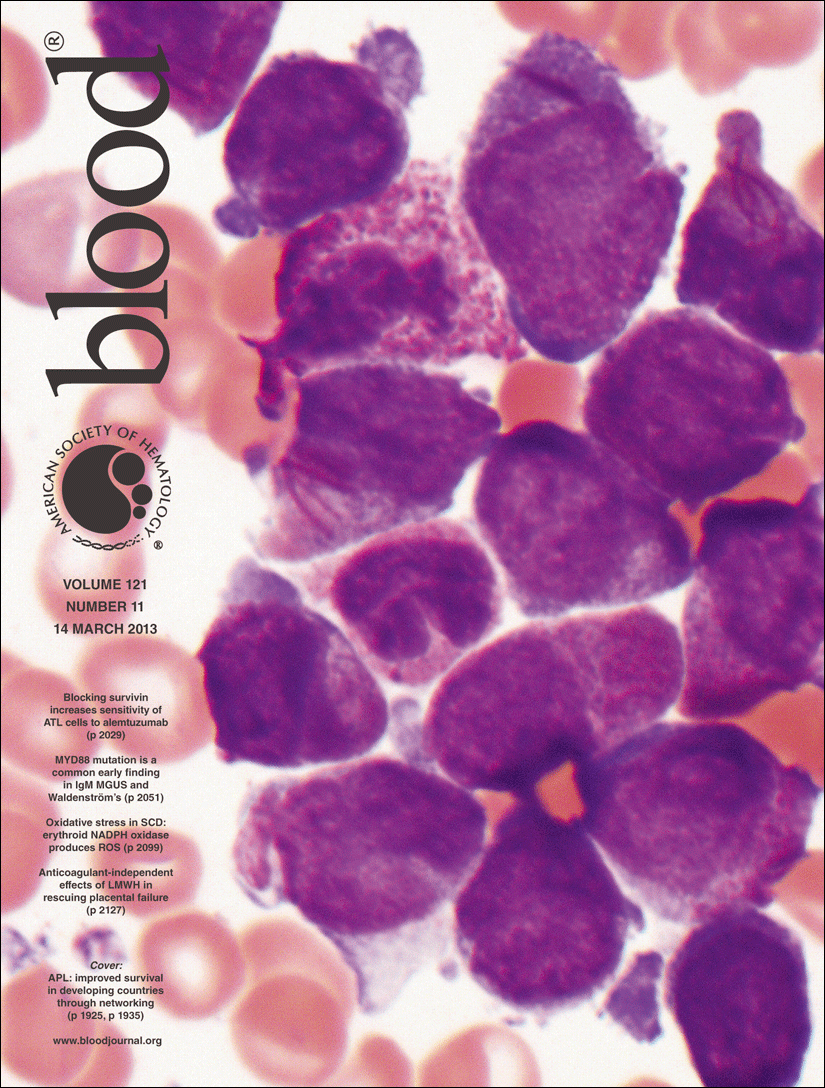
blood coverBlood has retracted a 2012 paper by a pair of Swedish authors, one of whom appears to have misappropriated data from his mentor.

The article, titled “Microparticles are the basic storage units for different proteins in platelet granules,” appeared online in July 2012 and was written by Chi Zhang and Yang Yang, of the Royal Institute of Technology in Stockholm.

But as the retraction notice explains, there was a problem:

Continue reading “Redundant in principle”: Blood retracts paper built on double-dipping of data by co-author

Paper with “missing or placed wrongly” controls retracted because there’s “no editorial mechanism to review the errors”

jgvTwo researchers from Singapore are retracting a paper that included errors in three figures because there’s apparently no way to fix the mistakes and have the new work reviewed.

Here’s the notice for “Host-dependent effects of the 3′ untranslated region of turnip crinkle virus RNA on accumulation in Hibiscus and Arabidopsis,” by Weimin Li and Sek-Man Wong of National University of Singapore and Temasek Life Sciences Laboratory: Continue reading Paper with “missing or placed wrongly” controls retracted because there’s “no editorial mechanism to review the errors”

Another win for transparency: JBC takes a step forward, adding details to some retraction notices

jbc 3115Retraction Watch readers may recall that we have been frequent critics of the Journal of Biological Chemistry (JBC) — published by the American Society for Biochemistry & Molecular Biology (ASBMB) — for their opaque retraction notices. Such notices often read simply “This article has been withdrawn by the authors.”

But we are — despite what some might say is evidence to the contrary — eternal optimists, so when the ASBMB announced they were hiring a manager of publication ethics late last year, we cheered. (Patricia Valdez, a former NIH staff scientist, has since filled that position.) And today, we have another reason to say “Hurrah!”: JBC retraction notices will now include “additional details provided by official [Office of Research Integrity] ORI or institutional reports,” the journal tells us.

Here, for example, are five retractions in the March 1, 2013, issue by former University of Kentucky scientist Eric J. Smart, whom the ORI found to have faked dozens of images: Continue reading Another win for transparency: JBC takes a step forward, adding details to some retraction notices

You plagiarized? No problem, says journal, we’ll retract so you can rewrite, and we’ll republish

mol cell biochemHere’s something we haven’t seen before: A group of researchers plagiarize, are called on it, and are then allowed to resubmit a new version that’s published, while their offending paper is retracted.

A reader  flagged the plagiarism in the original paper, “Protein domains, catalytic activity, and subcellular distribution of mouse NTE-related esterase,” by Ping’an Chang and colleagues, which led the research team to revise and resubmit the manuscript. After the journal Molecular and Cellular Biochemistry — a Springer title — published the plagiarism-scrubbed paper, the original paper required retraction.

The retraction refers to a dispute between labs, but not plagiarism: Continue reading You plagiarized? No problem, says journal, we’ll retract so you can rewrite, and we’ll republish

Scientist whose work is “not fully supported by the available laboratory records” to retract 8 more papers

SK Manna
SK Manna

Yesterday, we reported that Sunil Kumar Manna, the head of immunology at India’s Centre for DNA Fingerprinting and Diagnostics, had retracted two papers for image problems.

Turns out Manna will be retracting eight more, he told us today. Here they are: Continue reading Scientist whose work is “not fully supported by the available laboratory records” to retract 8 more papers

Two retractions for scientist whose work is “not fully supported by the available laboratory records”

SK Manna
SK Manna

The head of immunology at India’s Centre for DNA Fingerprinting and Diagnostics, Sunil Kumar Manna, has retracted two papers for image problems.

Here’s the notice from Cell Death and Differentiation for “Inhibition of RelA phosphorylation sensitizes apoptosis in constitutive NF-kappaB-expressing and chemoresistant cells:” Continue reading Two retractions for scientist whose work is “not fully supported by the available laboratory records”