Zhiguo Wang retractions appear in the Journal of Cellular Physiology

Last month, we reported that the last three of six promised retractions by Zhiguo Wang, who was a researcher at the Montreal Heart Institute until the results of an Institute investigation forced him to resign in early September — would be in the Journal of Cellular Physiology. They’ve now appeared.

Here are the three notices, which are far more informative than the Journal of Biological Chemistry was — and which make it clear Wang acted alone: Continue reading Zhiguo Wang retractions appear in the Journal of Cellular Physiology
Retraction comes as death of PI leads to lost records

The Journal of Experimental Medicine has retracted a 2011 article after the principal investigator’s home institution suggested that the PI might have manipulated his data. Complicating matters, the PI in this case died two weeks after the paper appeared and his notes have gone missing — making an affirmative declaration of fraud or honest error difficult.

Here’s the notice: Continue reading Retraction comes as death of PI leads to lost records

A retraction as a group’s papers on smoking and weight loss are too close for comfort

The American Journal of Physiology Endocrinology and Metabolism is retracting a 2009 article by Japanese researchers who appeared to be so fond of their data they published them thrice.

The paper, “Dual suppression of adipogenesis by cigarette smoke through activation of the aryl hydrocarbon receptor and induction of endoplasmic reticulum stress,” by Masanori Kitamura and colleagues, looked at the biochemical mechanism by which cigarette smokers seem to be able to keep weight off. It has been cited eight times, according to Thomson Scientific’s Web of Knowledge.

But according to the retraction notice: Continue reading A retraction as a group’s papers on smoking and weight loss are too close for comfort

Retracted retraction leaves Genomics paper intact — but authors wonder if anyone will know

Last March, the journal Genomics retracted a paper, “Discovery of transcriptional regulators and signaling pathways in the developing pituitary gland by bioinformatic and genomic approaches,” for reasons that don’t really fit into a tight lede sentence. Let’s just say that at times the problems involved both questions of authorship and the validity of the research. More on all that in a moment.

Meanwhile, things change. Now the journal, an Elsevier title, is un-retracting (that can’t be a real word, can it?) the retraction. You’d think that would please the authors, and it does to an extent. But they also wonder, legitimately, whether the original retraction will refuse to relinquish its grip on the resurrected article and consign it to database oblivion.

First, some background. Continue reading Retracted retraction leaves Genomics paper intact — but authors wonder if anyone will know

Remaining Zhiguo Wang retractions will be in the Journal of Cellular Physiology

We’ve been following the case of Zhiguo Wang, the former Montreal Heart Institute researcher who was forced to resign his post in early September following an investigation into his work. At the time of that announcement, two retractions of the Wang group’s papers — which we had reported on in August — had appeared. The Institute said they had requested three more.

We figured that meant a total of five, although the Institute wouldn’t say which they were. So when we found out about a third retraction, in the Journal of Cell Science, we said it was the first of the remaining three.

We were wrong. Continue reading Remaining Zhiguo Wang retractions will be in the Journal of Cellular Physiology

ExpungedBob? Algae journal pulls phytoplankton paper with unwitting co-author

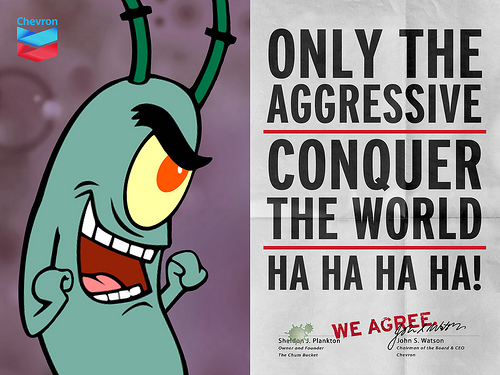
Mashup of Chevron-SpongeBob ad courtesy http://www.flickr.com/photos/jonathanmcintosh/

While looking at a recent retraction notice in the Journal of Phycology, the one of us with small children at home couldn’t help but imagine a conversation between cartoon character SpongeBob and his nemesis, Plankton:

SpongeBob: You used me … for land development! That wasn’t nice.

Sheldon J. Plankton: Haven’t you figured it out, SpongeBob? Nice guys finish last. Only aggressive people conquer the world. Ha ha ha ha!

SpongeBob: Well … what about aggressively nice people?

Who knew the world of phytoplankton could be so cutthroat? (Spoiler alert: we did.)

Consider: The Journal of Phycology — phycology is the study of algae and related organisms — is retracting a paper after learning that one of the three co-authors, well, wasn’t. Cyanobacteria may be the oldest known life form on earth, but the hyper-ambitious aren’t far behind.

Here’s the notice: Continue reading ExpungedBob? Algae journal pulls phytoplankton paper with unwitting co-author

Two detailed retraction notices appear in PNAS

We’ve fallen a bit behind in our coverage of retractions in the Proceedings of the National Academy of Sciences (PNAS), so we wanted to call attention to two very helpful ones from recent months.

Here’s one notice, which appeared online on August 5: Continue reading Two detailed retraction notices appear in PNAS

That’s a Mori! Seven more retractions brings latest count to 30

The other day we reported that Naoki Mori had lost his 23rd paper to retraction for image manipulation and duplication. Turns out we were wrong by a pretty wide margin.

The International Journal of Cancer has retracted seven more articles by the disgraced Japanese researcher, all for the same reasons:

The following article has been retracted through agreement between the first author and several coauthors, the journal Editor in-Chief, Peter Lichter, and John Wiley & Sons, Ltd. … After an investigation the retraction has been agreed due to inappropriate duplication of images and overlap with other published work.

The papers are as follows: Continue reading That’s a Mori! Seven more retractions brings latest count to 30

Does a new retraction suggest a glimmer of hope for transparency at the Journal of Neuroscience?

Believe it or not, we look for policies to praise here at Retraction Watch HQ, especially if they mark a change from approaches that we and others have criticized. So we were heartened to read this retraction notice in The Journal of Neuroscience for “Lmx1b-Controlled Isthmic Organizer Is Essential for Development of Midbrain Dopaminergic Neurons:”

The Journal of Neuroscience has received a report describing an investigation by the Shanghai Institute of Biological Sciences, Chinese Academy of Sciences, which found major data misrepresentation in the article by Guo et al. Because the results cannot be considered reliable, The Journal is retracting the paper.

The study has been cited five times since it was published in 2008, according to Thomson Scientific’s Web of Knowledge. Here’s some background on why we thought we’d have something to praise, from a Nature feature this week on retractions: Continue reading Does a new retraction suggest a glimmer of hope for transparency at the Journal of Neuroscience?

“Ill communication” leads to retraction of tissue paper (sorry) for authorship issues

Like many researchers, Frank Walboomers frequently checks the scientific databases to see when his latest publications appear. He was doing so a few months ago when he came across his name on an article — “Effects of pro-inflammatory cytokines on mineralization potential of rat dental pulp stem cells” — published online in July in the Journal of Tissue Engineering and Regenerative Medicine, that he hadn’t written.

The first author of the paper, Xuechao Yang, was a former doctoral student in Walboomers’ laboratory at Radboud University Nijmegen. It didn’t take Walboomers long to figure out what had happened: Continue reading “Ill communication” leads to retraction of tissue paper (sorry) for authorship issues