193 papers could be retracted: Journal consortium issues ultimatum in Fujii case

A group of editors representing nearly two dozen medical journals has issued an ultimatum of sorts to officials at seven Japanese institutions that once employed Yoshitaka Fujii: Validate the papers of the disgraced anesthesiologist or they will be retracted.

Fujii, as we have reported, was fired by Toho University in late February, putatively for failing to obtain ethics approval for a handful of his studies. That much may be true, but the integrity of his data has been in question for more than a decade. At the time of his dismissal, journal editors expressed concern that the university would not pursue an inquiry into Fujii’s data.

Last month, the journal Anaesthesia published a statistical analysis of Fujii’s research bya UK anesthesiologist named John Carlisle which cast serious doubt on the veracity of the studies.

The joint letter forces the question. Continue reading 193 papers could be retracted: Journal consortium issues ultimatum in Fujii case

Endocrinologist Shigeaki Kato resigns amidst University of Tokyo misconduct investigation

Shigeaki Kato

Shigeaki Kato, an endocrinology researcher at the University of Tokyo who retracted a paper late last month, has resigned amidst an investigation into whether he committed misconduct, Japanese media outlets are reporting.

According to the reports, the university has been investigating Shigeaki Kato and his group, affiliated with the Institute of Molecular and Cellular Biosciences, for scientific misconduct. The investigation was prompted by an outside whistleblower’s allegations in January about 24 of Kato’s papers. The whistleblower claimed that the papers manipulated and reused data improperly, and created a YouTube video to spread the word, as ScienceInsider reported earlier this year.

One of the 24 papers, Continue reading Endocrinologist Shigeaki Kato resigns amidst University of Tokyo misconduct investigation

Back in the saddle: After more than 30 retractions, Naoki Mori publishing again

Naoki Mori

Perhaps it’s appropriate given the Easter season, but we have learned that Naoki Mori, the Japanese cancer researcher who received a 10-year publishing ban from the American Society of Microbiology (ASM) for imagine manipulation, has published a new paper.

Mori, who was fired and then rehired by the University of the Ryukyus over the scandal, is listed as the senior author on the paper, “Honokiol induces cell cycle arrest and apoptosis via inhibition of survival signals in adult T-cell leukemia,” which appears in the March issue of Biochimica et Biophysica Acta. The journal, an Elsevier title, is an umbrella for nine publications in the biosciences.

Two of Mori’s retracted articles appeared in the Elsevier journals Leukemia Research and Biochemical and Biophysical Research Communications. Continue reading Back in the saddle: After more than 30 retractions, Naoki Mori publishing again

Third retraction arrives for Alirio Melendez, this one in the Journal of Cellular Physiology

Alirio Melendez, the former National University of Singapore researcher who has already retracted two papers in the midst of an investigation into about 70 of his publications, has had a third retracted a third.

Here’s the notice from the Journal of Cellular Physiology: Continue reading Third retraction arrives for Alirio Melendez, this one in the Journal of Cellular Physiology

A “retraction in part” for Anil Potti and colleagues, in Molecular Cancer Therapeutics

A partial retraction has joined the ten retractions and five corrections of Anil Potti’s papers, this one of a 2008 paper in Molecular Cancer Therapeutics. The move comes 14 months after the retraction of the Nature Medicine paper upon which much of the Molecular Cancer Therapeutics paper was based.

Here’s the notice: Continue reading A “retraction in part” for Anil Potti and colleagues, in Molecular Cancer Therapeutics

Protein structure retracted after investigation into “highly improbable features,” journal calls it fraud

In 2010, a group of crystallographers immunologists and allergy researchers at the University of Salzburg published a paper in the Journal of Immunology claiming to have derived the structure of a birch pollen allergen.

That structure, however, caught the attention of Bernhard Rupp, an eminent crystallographer. In January of this year, Rupp submitted a paper to Acta Crystallographica Section F pointing out problems with it, which prompted the editors of the crystallography journal to contact the authors of the original paper a month later. Those authors, it turns out, agreed with Rupp, they write in a response to his paper published in the April 2012 issue of Acta Crystallographica Section F: Continue reading Protein structure retracted after investigation into “highly improbable features,” journal calls it fraud

Three more retractions for resveratrol researcher Dipak Das, in free radical journals

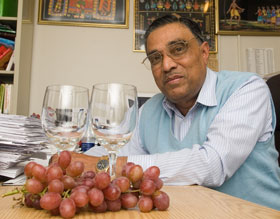
Das, via UConn

The retraction count for Dipak Das, the resveratrol researcher whom the University of Connecticut found to have committed 145 counts of fabrication and falsification of data, has risen to eight with withdrawals by Free Radical Biology & Medicine and Free Radical Research.

The two Free Radical Biology & Medicine retractions, for “Expression of the longevity proteins by both red and white wines and their cardioprotective components, resveratrol, tyrosol, and hydroxytyrosol” (cited 38 times, according to Thomson Scientific’s Web of Knowledge) and “Redox regulation of resveratrol-mediated switching of death signal into survival signal” (cited 32 times), are carefully detailed and read the same way: Continue reading Three more retractions for resveratrol researcher Dipak Das, in free radical journals

Cell paper, once plagiarized, pulled for dodgy figures

A while back (last June, to be precise), we wrote about a group of Japanese endocrinologists who found a creative way to up their citation counts using duplicate publication. At the time, the researchers were docked a 2004 paper in the Journal of Steroid Biochemistry & Molecular Biology that had self-plagiarized extensively from a 2003 article in Cell.

Well, skeptics of this new math take heart: The group’s publication total has fallen yet again. Turns out that 2003 paper — which has been cited 160 times, up from 144 when we checked last year, according to Thomson Scientific’s Web of Knowledge — wasn’t quite up to snuff, either.

According to the retraction notice for the article, “The Chromatin-Remodeling Complex WINAC Targets a Nuclear Receptor to Promoters and Is Impaired in Williams Syndrome:” Continue reading Cell paper, once plagiarized, pulled for dodgy figures

Japanese universities find pair of researchers guilty of misconduct in 19 papers

Kenji Okajima

We have an update in the case of two Japanese scientists who first came to our attention when they retracted a 13-year-old paper in the Journal of Neuroscience last year. Shortly after that, we learned, thanks to a report in Sankei Shimbun and a helpful Retraction Watch reader, that some 17 papers were being investigated.

It now appears that 19 papers by the two researchers, Kenji Okajima and Naoki Harada, ended up under scrutiny.

Nagoya City University said last week that their investigation had concluded that Okajima and Harada committed misconduct. The university dismissed Harada, whom they found guilty of misconduct in at least eight of the papers. The investigation couldn’t find any evidence that Okajima was directly involved, but suspended him for six months because he supervised the work. Continue reading Japanese universities find pair of researchers guilty of misconduct in 19 papers

Hold the broccoli, garlic, and wine: Three Dipak Das retractions appear in Journal of Agricultural and Food Chemistry

The Journal of Agricultural and Food Chemistry has retracted three papers by Dipak Das, the resveratrol researcher found to have committed more than 100 counts of fraud by the University of Connecticut.

Journal editor James Seiber writes: Continue reading Hold the broccoli, garlic, and wine: Three Dipak Das retractions appear in Journal of Agricultural and Food Chemistry