A paper was published in 2015; the authors already lost the data

American Journal of Physiology Renal PhsyiologyThe authors of a 2015 study have retracted it after discovering that several Western blots in their paper “do not represent the experiments that were reported.”

They couldn’t check some of the original blots, because — according to the retraction notice in the American Journal of Physiology – Renal Physiology — they could not be located. The ones that could be found, however, are “inconsistent with what is presented in the figures.”

Here’s the retraction notice, published last month: Continue reading A paper was published in 2015; the authors already lost the data

More co-author misconduct raises NIH neuroscientist’s retraction count to 8

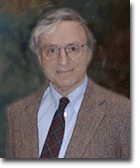
Stanley Rapoport. Source: NIH

Not again.

That’s the sound of learning that a third scientist you worked with committed misconduct.

In the last two years, we reported on two retractions for neuroscientist Stanley Rapoport, the result of misconduct by two different first authors. We’ve since discovered more retractions resulting from those cases — and a new retraction stemming from the actions of yet another co-author.  

Although the latest retraction notice doesn’t reveal the reason for retraction, both the journal editor and Rapoport — based at the National Institute on Aging (NIA), part of the National Institutes of Health (NIH) — confirmed to us that it is the result of misconduct by the last author, Jagadeesh Rao. According to Rapoport, a “number of retractions [for] Rao are still in the works.”

We asked Rapoport for his reaction to multiple cases of misconduct by his colleagues, including the two first authors we’ve already reported on, Fei Gao and Mireille Basselin:

Continue reading More co-author misconduct raises NIH neuroscientist’s retraction count to 8

Surprise! Paper retracted after author tells journal it’s a “pile of dung”

journal-of-clinical-research-bioethics-logoThis summer, Ottawa Citizen reporter Tom Spears was sitting by a lake on vacation when he opened a spam email from a publisher. Amused to see the sender was a journal focused on bioethics, he got an idea.

I thought, what if I just throw something outrageous at them?

The situation should sound familiar to readers who follow such “sting” operations: Spears submitted a fake paper to the so-called “predatory” journal, it was accepted one month later with no changes, and published.

But after Spears submitted a comment on the paper saying it was “a steaming pile of dung from start to meaningless finish” (which the journal never posted), wrote an article about it (picked up by other outlets, including The Huffington Post Canada) — surprise, surprise! — the paper was retracted.

Most authors don’t celebrate retractions. But Spears told us he felt “sheer triumph:”  Continue reading Surprise! Paper retracted after author tells journal it’s a “pile of dung”

How a Cell journal weeds out the “bad apples”

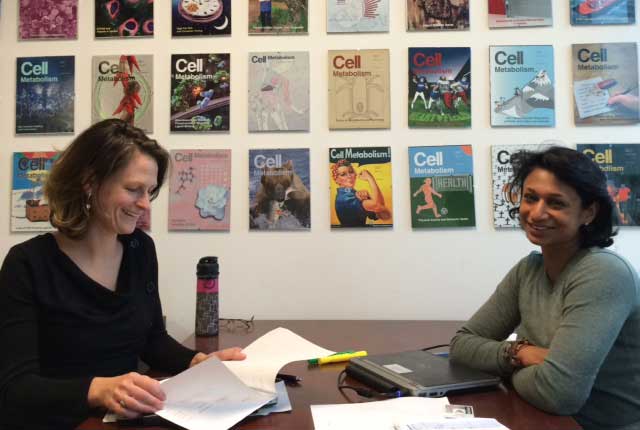
Anne Granger (left) and Nikla Emambokus (right)

There are a lot of accusations about research misconduct swirling around, and not every journal handles them the same. Recently, Cell Metabolism Scientific Editor Anne Granger and Cell Metabolism Editor-in-Chief Nikla Emambokus shared some details about their investigative procedure in “Weeding out the Bad Apples.” We talked to them about why they don’t necessarily trust accusations leveled on blogs (including ours), but will consider the concerns of anyone who approaches the journal directly – even anonymously.

Retraction Watch: What made you decide to write an editorial about research fraud now? Continue reading How a Cell journal weeds out the “bad apples”

A grad student was caught in the crossfire of fraud — and fought back

uqIn March, 2013, a graduate student joined the lab of a prominent researcher in Australia, investigating new therapies for Parkinson’s. A few months later, everything fell apart.

In September 2013, the University of Queensland (UQ) announced it was retracting one of the lab’s papers, returning the money used to fund the research and launching a fraud investigation.  Since then, the scandal has grown to the point where the lead researcher and his co-author have been convicted of fraud in an Australian court.  

Now, the graduate student is fighting back. After losing her research project and being escorted off campus for allegedly erratic behavior, she has appealed to UQ to reimburse her for tens of thousands of dollars in tuition, and is now awaiting a verdict from a government ombudsman. The graduate student goes by “Dominique,” which is not her real name; Retraction Watch is keeping her identity confidential to protect her privacy. Continue reading A grad student was caught in the crossfire of fraud — and fought back

Tomato study didn’t get co-author okays, includes unreliable data

scientia-horticulturaeA journal has retracted a paper examining the traits of drought-resistant tomatoes after an investigation at the first author’s institution in Italy found a number of problems.

For starters, the first author — Maria Riccardi of the National Research Council of Italy-Institute for Agricultural and Forest Systems in the Mediterranean (CNR-ISAFOM) in Ercolano, Naples, Italy — apparently submitted the paper without consulting the study’s four other listed co-authors. What’s more, according to the retraction notice in Scientia Horticulturae, the paper’s description of the experiment “does not reflect the real conditions under which the data was collected,” rendering the findings invalid.  

Riccardo d’Andria, CNR-ISAFOM’s former director who conducted an investigation into the case, said Continue reading Tomato study didn’t get co-author okays, includes unreliable data

Details of investigative report into Sarkar released by ACLU

Fazlul Sarkar
Fazlul Sarkar

We knew that Wayne State University had investigated allegations of misconduct against Fazlul Sarkar, the scientist who is suing PubPeer commenters over criticisms of his work. We knew The Scientist had obtained a copy of the report, which concluded he had engaged in widespread misconduct, and he should retract more than 40 papers.

And now, thanks to the American Civil Liberties Union, which is representing PubPeer in court and has filed a motion to include the report as evidence in the case, we have a copy.

It’s a long read, but here are some highlights:

Continue reading Details of investigative report into Sarkar released by ACLU

Official notice published for chem paper slated for retraction in 2011

process-safetyAfter five years, Elsevier has finally issued a notice of retraction for a paper it announced it was pulling for fraud in 2011.

All of the papers were produced by a research group in Brazil; all were retracted after the publisher conducted an investigation, concluding that the NMR results had been manipulated. At the time, the last author on the latest retraction, Claudio Airoldi, defended the work. Since then, however, Airoldi has logged two more retractions, bringing his total to 13.

Here’s the full text of the retraction notice, from Process Safety and Environmental Protection: Continue reading Official notice published for chem paper slated for retraction in 2011

Former Duke researcher at center of lawsuit lodges 16th retraction

ajrcmb-2016-55-issue-5-coverTwo former researchers at Duke University at the center of a lawsuit by a whistleblower to recoup millions in federal funding have lost yet another paper.

This is hardly the first retraction for Erin Potts-Kant, who used to work in the pulmonary lab of now-retired William Michael Foster. Earlier this year, a lawsuit filed by a former colleague of Potts-Kant and Foster was unsealed alleging that the pair — along with the university — included fraudulent data in materials involving more than 60 grants, worth hundreds of millions of dollars.

That is the legal side of their story. The science publishing side is that Potts-Kant and Foster have been steadily adding to their list of retractions — this paper represents her 16th, and his 13th.

Here’s the notice for “Nitric oxide mediates relative airway hyporesponsiveness to lipopolysaccharide in surfactant protein A-deficient mice:” Continue reading Former Duke researcher at center of lawsuit lodges 16th retraction

Eye researcher loses fourth paper for misconduct following Georgia, VA investigation

Azza B. El-Remessy
Azza B. El-Remessy

A biologist at the University of Georgia has lost a paper after an investigation revealed she had tampered with three images.

In 2014, Azza El-Remessy notched three retractions for a series of image errors. Now, a fourth retraction notice, and an expression of concern, explain there has been an investigation into her work. The investigation — conducted by two Georgia institutions, along with the Charlie Norwood Veterans Affairs Medical Center, where El-Remessy has additional appointments — has found evidence of misconduct.

The retraction notice for “Oxidative stress inactivates VEGF survival signaling in retinal endothelial cells via PI 3-kinase tyrosine nitration” explains:

Continue reading Eye researcher loses fourth paper for misconduct following Georgia, VA investigation