Retraction record broken, again: University report should up Fujii total to 183

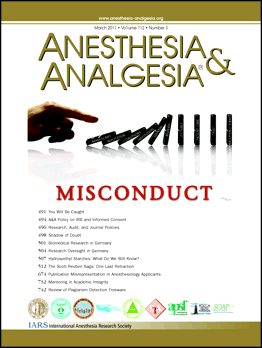
a&amisconductcoverKeeping up with the various investigations into the activities of Yoshitaka Fujii — the assumed record holder for retractions by a single author, with 172 likely — can be a challenge. Between the journals pulling his papers and the institutions looking into his misconduct, it’s hard to keep everything straight.

But we have a new report, from a past employer, that makes for interesting reading and helps tie up some loose ends. The document is from Tsukuba University, where Fujii worked more than a decade ago when questions about the propriety of his findings first surfaced. Continue reading Retraction record broken, again: University report should up Fujii total to 183

Retraction eight appears for social psychologist Lawrence Sanna

jespEarlier this week, we reported on retractions six and seven , in the Journal of Experimental Social Psychology, for Lawrence Sanna, the former University of Michigan psychologist who resigned last May after questions were raised about his work. Retraction eight has now appeared, also in the JESP.

Here’s the notice for “When thoughts don’t feel like they used to: Changing feelings of subjective ease in judgments of the past:” Continue reading Retraction eight appears for social psychologist Lawrence Sanna

Retraction 32 appears for Diederik Stapel

stapel_npcDiederik Stapel has another retraction, his 32nd.

Here’s the notice, for “”Information to go: Fluency enhances the usability of primed information,” which first appeared in 2010 in the Journal of Experimental Social Psychology: Continue reading Retraction 32 appears for Diederik Stapel

“Fraud committed by any social psychologist diminishes all social psychologists”: New Sanna, Smeesters retractions

jespThree new retractions — two of papers by Lawrence Sanna and one of work by Dirk Smeesters —  have appeared in the Journal of Experimental Social Psychology. The retractions come along with a hard-hitting piece by the journal’s editor.

In a tough soul-searching editorial called “On Fraud, Deceit, and Ethics” (unfortunately only available behind a paywall), journal editor in chief Joel Cooper writes that “Fraud committed by any social psychologist diminishes all social psychologists.” He continues: Continue reading “Fraud committed by any social psychologist diminishes all social psychologists”: New Sanna, Smeesters retractions

First retraction for Eric Smart, who faked dozens of images, appears in PNAS

Eric J. Smart, via U Kentucky

Eric Smart, who as we reported in November was sanctioned by the Office of Research Integrity (ORI) for faking dozens of images in ten papers and seven grants over the past decade, has had his first retraction.

Here’s the December 24 notice, from PNAS: Continue reading First retraction for Eric Smart, who faked dozens of images, appears in PNAS

Former Harvard dental school researcher committed misconduct: ORI

Martin Biosse-Duplan

Last week was a busy one at the U.S. Office of Research Integrity (ORI), at least judging by how many cases they posted. There were sanctions against researchers at Ohio State, Texas Tech, and the Gladstone Institutes, as we reported. And it turns out there was another case closed, of a former Harvard dental school research fellow, The Scientist reports.

According to the ORI, Martin Biosse-Duplan “engaged in research misconduct in research supported by National Institute of Arthritis and Musculoskeletal and Skin Diseases (NIAMS), National Institutes of Health (NIH), grant R01 AR054450.”

The misconduct involved a lab presentation and two published abstracts: Continue reading Former Harvard dental school researcher committed misconduct: ORI

Retractions three and four for Hopkins cancer biomarker group

ccrA group of cancer researchers formerly centered at Johns Hopkins have retracted two more studies. The previous two retracted papers — one of which was the focus of a lawsuit — were about prostate cancer, while the new retractions are of papers about colon cancer.

Here’s the notice for one paper: Continue reading Retractions three and four for Hopkins cancer biomarker group

Neuroscientist made up data in NIH grant applications, says ORI

muchowskip111
Paul Muchowski, via Gladstone Institute

Paul Muchowski, a neuroscience researcher at the Gladstone Institute of Neurological Disease in San Francisco, faked data in multiple grant applications, according to findings released today by the Office of Research Integrity (ORI).

In a funded NIH grant, R01 NS054753-06A1, and two submitted grant applications, R01 NS054753-06 and R01 NS047237-06, ORI says that Muchowski “knowingly and intentionally” committed “research misconduct by falsifying and fabricating data” as follows:

ORI investigating work from Caltech lab as PNAS paper is retracted

pnas1219The U.S. Office of Research Integrity is investigating work done at a Caltech lab after researchers there couldn’t replicate it, and retracted a paper based on the findings.

Here’s the notice, which ran this week in the Proceedings of the National Academy of Sciences (PNAS): Continue reading ORI investigating work from Caltech lab as PNAS paper is retracted

Elsevier editorial system hacked, reviews faked, 11 retractions follow

elsevierFor several months now, we’ve been reporting on variations on a theme: Authors submitting fake email addresses for potential peer reviewers, to ensure positive reviews. In August, for example, we broke the story of a Hyung-In Moon, who has now retracted 24 papers published by Informa because he managed to do his own peer review.

Now, Retraction Watch has learned that the Elsevier Editorial System (EES) was hacked sometime last month, leading to faked peer reviews and retractions — although the submitting authors don’t seem to have been at fault. As of now, eleven papers by authors in China, India, Iran, and Turkey have been retracted from three journals.

Here’s one of two identical notices that have just run in Optics & Laser Technology, for two unconnected papers: Continue reading Elsevier editorial system hacked, reviews faked, 11 retractions follow