Bad blood at a lab leads to retraction after postdoc publishes study without supervisor’s permission

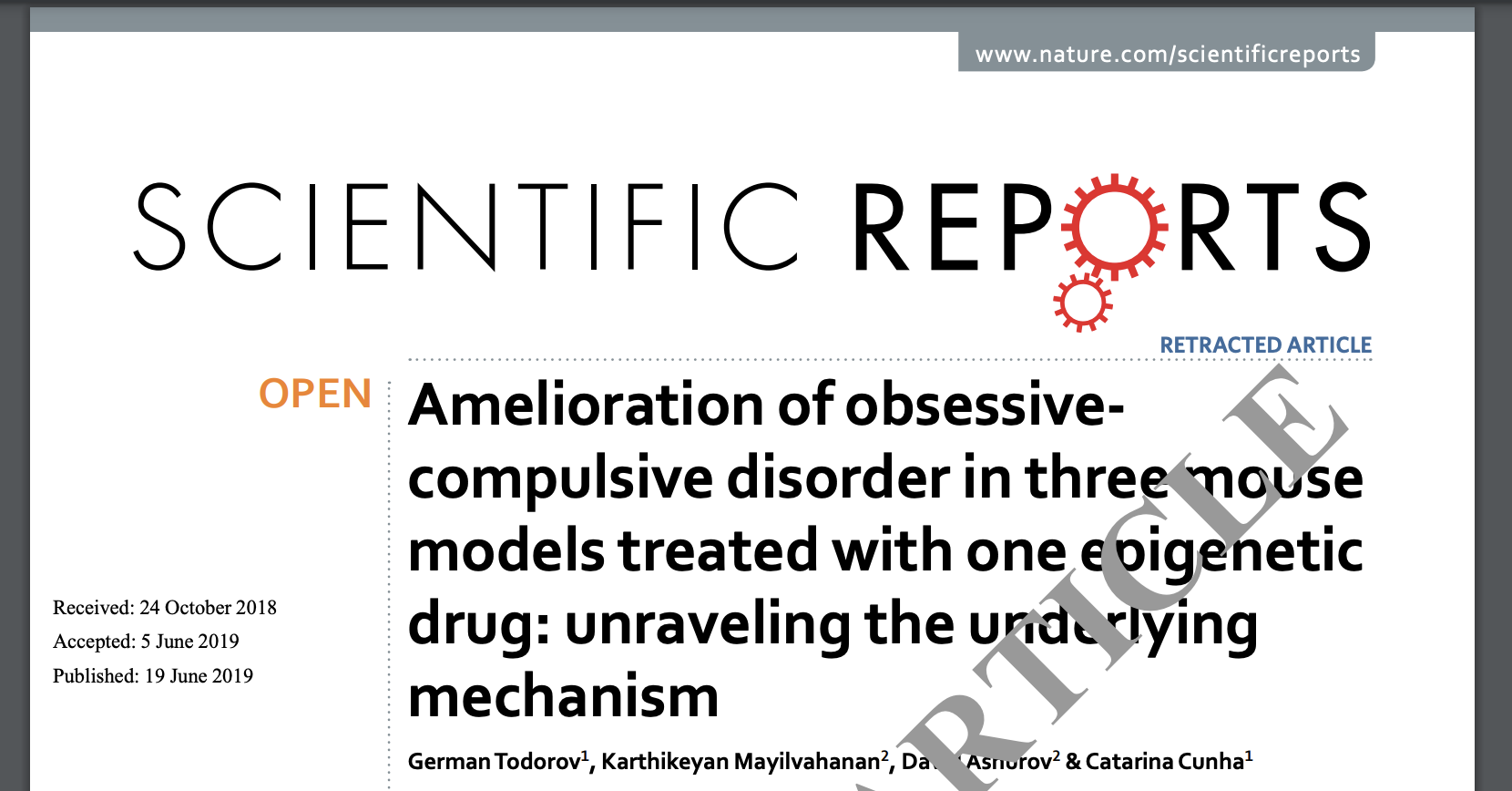
A former postdoc at Stony Brook University who was moonlighting in a different lab has lost a study after a university investigation found issues with the work, including “overlap” with prior grants and an earlier study that her supervisor had published, as well as misreported data.

The supervisor — neuroscientist Joshua Plotkin, who was the complainant in the investigation — said that the study was published without his permission, according to an email seen by Retraction Watch. The former postdoc, Catarina Cunha, has denied wrongdoing and called the investigation a “witch hunt,” claiming that the university ignored her exculpatory evidence and that the paper’s findings are valid and original. 

Continue reading Bad blood at a lab leads to retraction after postdoc publishes study without supervisor’s permission

Legal researcher who claimed false affiliation up to 31 retractions

A law researcher who has falsely claimed to have been affiliated with several institutions has lost eight more publications, bringing his retraction total to 31 and earning him a spot in the top 20 of our leaderboard.

The most recent retractions for Dimitris Liakopoulos include The Regulation of Transnational Mergers in International and European Law, an entire book he co-authored. They also include three papers from Homa Publica and two from Lex et Scientia International Journal. An example:

Continue reading Legal researcher who claimed false affiliation up to 31 retractions

What happened when a group of sleuths flagged more than 30 papers with errors?

Jennifer Byrne

Retraction Watch readers may recall the name Jennifer Byrne, whose work as a scientific sleuth we first wrote about four years ago, and have followed ever since. In a new paper in Scientometrics, Byrne, of New South Wales Health Pathology and the University of Sydney, working along with researchers including Cyril Labbé, known for his work detecting computer-generated papers, and Amanda Capes-Davis, who works on cell line identification, describe what happened when they approached publishers about errors in 31 papers. We asked Byrne several questions about the work.

Retraction Watch (RW): You focused on 31 papers with a “specific reagent error.” Can you explain what the errors were?

Continue reading What happened when a group of sleuths flagged more than 30 papers with errors?

Former Cleveland Clinic researcher’s papers “more likely than not” included falsified images, says investigation

Cleveland Clinic, via Wikimedia

A former researcher at the Cleveland Clinic who studied cardiac genetics has lost three papers for what an institutional investigation concluded was “more likely than not” a case image falsification. 

As we reported last year, the work of Subha Sen, once a highly funded scientist at Cleveland Clinic but who left the institution in 2011, has come under scrutiny on PubPeer (note: a researcher with the same name, but at a different institution, also appears in these search results). With the latest papers, Sen now has nine seven retractions for issues including questions about the integrity of the data and the validity of the images. 

The three newest removals involve studies published in the American Journal of Physiology-Heart and Circulatory Physiology between 2004 and 2009. The notices are very similar while referring to different images.

Here’s the statement for the 2005 article, “Inhibition of NF-κB induces regression of cardiac hypertrophy, independent of blood pressure control, in spontaneously hypertensive rats”: 

Continue reading Former Cleveland Clinic researcher’s papers “more likely than not” included falsified images, says investigation

Widely shared vitamin D-COVID-19 preprint removed from Lancet server

A preprint promoted by a member of the UK Parliament for claiming to show that vitamin D led to an “80% reduction in need for ICU and a 60% reduction in deaths” has been removed from a server used by The Lancet family of journals.

The preprint, “Calcifediol Treatment and COVID-19-Related Outcomes,” was posted to Preprints with The Lancet on January 22. On February 13, David Davis, a Conservative member of UK’s Parliament, tweeted:

Continue reading Widely shared vitamin D-COVID-19 preprint removed from Lancet server

Leading evidence-based group blames pandemic for 9-month delay pulling flawed cancer review

Last February, Richard Pollock was reading a review in the Cochrane Database of Systematic Reviews — a prominent resource for evidence-based medicine —  when he spotted an error. 

In the first figure, which compared the effectiveness of two different treatments for the most common form of liver cancer, a label was switched. The error made it seem like the “worse” treatment was better than the more effective option.

Pollock, a health economist, was concerned enough to send an email to Omar Abdel-Rahman, the corresponding author, on February 20th. Abdel-Rahman, an oncologist at the University of Alberta, wrote back the next day, saying he would review the comments with experts at Cochrane, “and if there is any typos in the publication, it will be corrected immediately.” Emails seen by Retraction Watch show that, when replying to this email, Abdel-Rahman copied one of Cochrane’s editors, Dimitrinka Nikolova.

Months passed. Pollock sent another email to Abdel-Rahman and two Cochrane editors — Nikolova and Christian Gluud — on June 15th. Then, on November 16th, the journal pulled the review with a brief notice:

Continue reading Leading evidence-based group blames pandemic for 9-month delay pulling flawed cancer review

Why “good PhD students are worth gold!” A grad student finds an error

Leon Reteig

Researchers in the Netherlands have retracted and replaced a 2015 paper on attention after discovering a coding error that reversed their finding. 

Initially titled “Effects of Transcranial Direct Current Stimulation over Left Dorsolateral pFC on the Attentional Blink Depend on Individual Baseline Performance,” the paper appeared in the Journal of Clinical Neuroscience and was written by Heleen A. Slagter, an associate professor of psychology at VU University in Amsterdam, and Raquel E. London, who is currently a post-doc at Ghent University. It has been cited 19 times, according to Clarivate Analytics’ Web of Science.

But while trying to replicate the findings, Slagter and a then-PhD student of hers, Leon Reteig, found a critical mistake in a statistical method first proposed in a 1986 paper. Slagter told us: 

Continue reading Why “good PhD students are worth gold!” A grad student finds an error

Mathematician ranked as Clarivate “highly cited researcher” has third paper retracted

A math professor named as a “highly cited researcher” by Clarivate Analytics has had his third paper retracted after issues with it were flagged last year.

The mathematician, Abdon Atangana, is a professor at The University of the Free State, in Bloemfontein, South Africa, and China Medical University, Taiwan. 

Atangana’s article, “Derivative with two fractional orders: A new avenue of investigation toward revolution in fractional calculus,” was published in The European Physical Journal Plus — where Atangana is an editor — on Oct. 24, 2016, and has been cited 37 times, according to Clarivate Analytics’ Web of Science. 

Continue reading Mathematician ranked as Clarivate “highly cited researcher” has third paper retracted

Researcher to overtake Diederik Stapel on the Retraction Watch Leaderboard, with 61

Ali Nazari and Swinburne University vice-chancellor Linda Kristjanson, presenting him with a commendation in 2017

A construction researcher is watching his publishing edifice crumble, as more upcoming retractions of his papers will bring his total to 61. 

Ali Nazari is believed to be a member of a ring of authors whom a whistleblower has claimed are churning out unreliable research — hundreds of papers, according to the sleuth, who goes by the pseudonym Artemisia Stricta. Nazari lost his job at Swinburne University, in Australia, following a misconduct investigation in 2019. 

According to the whistleblower (who laid out the case in a recent email to a journal editor): 

Continue reading Researcher to overtake Diederik Stapel on the Retraction Watch Leaderboard, with 61

What is a figure about budgies doing in four different plant papers?

via Scientific Reports

As Antonella Longo was peer-reviewing a study for the journal Plant and Soil, she became “alarmed by one figure.” The figure’s title — ”Level2 GO terms of Melopsittacus_undulates” — seemed to be a misspelled reference to a bird species called Melopsittacus undulatus

More commonly known as a budgie or parakeet, undulatus is a vibrantly colored parrot found in scattered parts of Australia. So what was a figure about a bird doing in a study about plants?

Concerned, Longo, of the BioDiscovery Institute at the University of North Texas, searched the internet for words used in the figure, “GO terms of Melopsittacus undulates.” She identified at least three additional studies that contained an image similar to the one in the study she was peer-reviewing, each with an identical title and color scheme, but with varying data. None of the studies are about birds.

Continue reading What is a figure about budgies doing in four different plant papers?