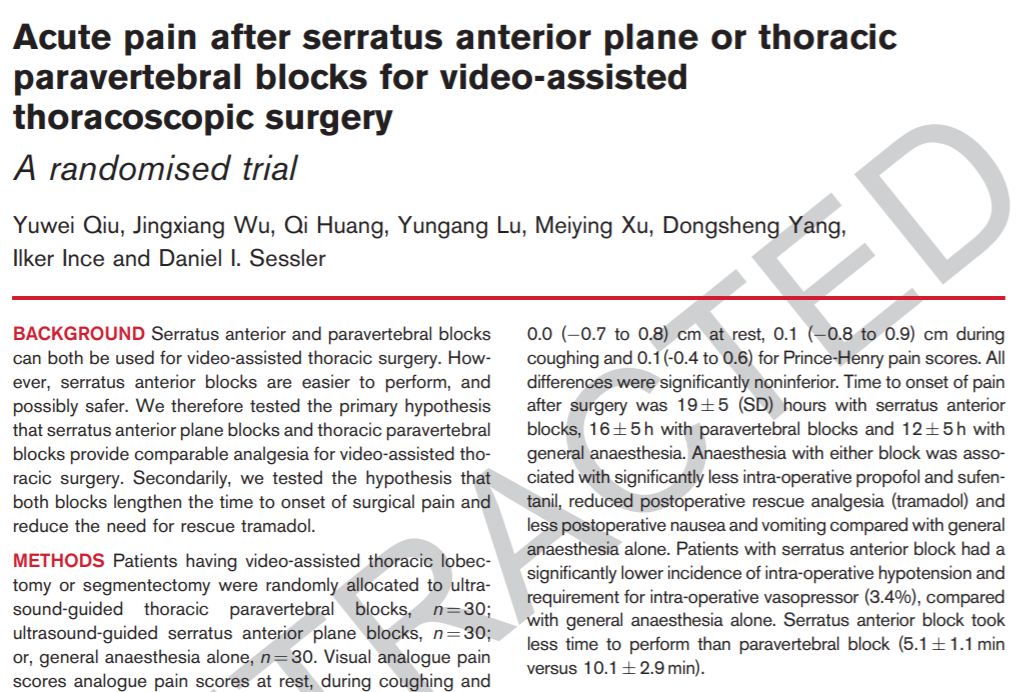
Leading anesthesiologist retracts paper after reader “noticed that the statistical approach was sub-optimal”

An anesthesia journal has retracted a 2020 paper by a group from China, Turkey and the United States after a post-publication review discovered issues with the analysis. 

According to the notice, in the European Journal of Anaesthesiology:  

Continue reading Leading anesthesiologist retracts paper after reader “noticed that the statistical approach was sub-optimal”

Retraction of paper on police killings and race not due to “‘mob’ pressure” or “distaste for the political views of people citing the work approvingly,” say authors

via Tony Webster/Flickr

The researchers who earlier this week called for the retraction of their hotly debated paper on police shootings and race say the reasons for their decision to pull the article have been misinterpreted. 

Crime researchers David Johnson, of the University of Maryland, and Joe Cesario, of Michigan State University, initially referred in a retraction statement to citations to the work of Heather Mac Donald, of the right-leaning Manhattan Institute, who wrote about the PNAS article for the City Journal and the Wall Street Journal.

Those pieces, Cesario and Johnson said, had unfairly co-opted the paper, ““Officer characteristics and racial disparities in fatal officer-involved shootings,” to argue against the existence of racial bias in police shootings. 

In an amended statement, the authors noticeably omit references to Mac Donald. On Wednesday, Cesario told Retraction Watch: 

Continue reading Retraction of paper on police killings and race not due to “‘mob’ pressure” or “distaste for the political views of people citing the work approvingly,” say authors

77-year-old paper by controversial psychologist Hans Eysenck earns an expression of concern

Hans Eysenck

Journals have issued expressions of concern for seven more papers by Hans Eysenck, including one for a paper the now-deceased psychologist published in the middle of World War II. 

Suspicions about Eysenck, who died in 1997, surfaced in the early 1990s, if not before. At least 14 of his papers have been retracted so far — a total his biographer has said could well eclipse 60. And 71 have now been hit with expressions of concern.

The latest such moves come from the Journal of the Royal Society of Medicine, which issued the following notice

Continue reading 77-year-old paper by controversial psychologist Hans Eysenck earns an expression of concern

Journal calls 2012 paper “deeply offensive to particular minorities”

An Elsevier journal plans to issue a retraction notice this week about a widely criticized 2012 paper claiming to find links between skin color, aggression, and sexuality.

Earlier this month, we reported that the journal, Personality and Individual Differences (PAID), would retract the study “Do pigmentation and the melanocortin system modulate aggression and sexuality in humans as they do in other animals?” by the late authors Philippe Rushton and Donald Templer, published in 2012.

The paper was the subject of a highly critical Medium post in November 2019, and of a petition with more than 1,000 signatures sent to Elsevier earlier this month.

The four-page retraction notice, provided to Retraction Watch by Elsevier, begins with a description of the history, policies and procedures at the journal, then launches into a litany of issues with the paper:

Continue reading Journal calls 2012 paper “deeply offensive to particular minorities”

Editors in chief past and present apologize for publishing article that “feed[s] into racist narratives”

The previous and current editors in chief of a psychology journal have apologized for publishing an article about which one of them writes, “in retrospect I can certainly see that their article does feed into racist narratives.”

Earlier this month, we reported that the authors of “Declines in Religiosity Predict Increases in Violent Crime—but Not Among Countries With Relatively High Average IQ,” first published in January in Psychological Science, had requested its retraction because they realized they had not vetted the research behind the paper well enough before submitting.

In a retraction notice dated yesterday, the journal’s current editor in chief, Patricia Bauer, writes that the article “has been retracted at the request of the authors:”

Continue reading Editors in chief past and present apologize for publishing article that “feed[s] into racist narratives”

Journal temporarily withdraws COVID-19 “labor cage” study

via AJOG

A study whose title suggested an “effective” way to give birth during the coronavirus pandemic has been temporarily retracted because the publisher says the word “effective” was included in the title by accident.

The method (pictured above) involved an enclosed, transparent chamber walling off the mother’s upper half from the rest of the world. It wasn’t very well received, according to an Essential Baby article that cited Twitter users referring to the “delivery table shield”  as a “labor cage” and “greenhouse.”

The study, called “An effective protective equipment to use in the vaginal delivery of the pregnant women with suspected/diagnosed COVID-19: Delivery Table Shield” was published in the American Journal of Obstetrics and Gynecology (AJOG), an Elsevier journal, on June 15. Most of the authors were affiliated with the Turkish Ministry of Health at Ankara City Hospital.

But it was swiftly removed. The temporary retraction notice says:

Continue reading Journal temporarily withdraws COVID-19 “labor cage” study

“I want to apologize for my misconduct,” says anesthesiologist whose work is under investigation

Showa University Hospital, via Wikimedia

A Japanese anesthesiologist who just notched his sixth retraction apologized for his misconduct and said his institution is now investigating his entire body of work. 

Hironobu Ueshima, of Showa University in Tokyo, who has roughly 170 publications, told Retraction Watch by email: 

Continue reading “I want to apologize for my misconduct,” says anesthesiologist whose work is under investigation

And then there were six: three more retractions for Japanese anesthesiologist

Earlier this month, we reported on the retraction of two papers by a Japanese anesthesiologist for unreliable data. At the time, we noted that the case of Hironobu Ueshima bore watching, given his publication total runs to about 170.

[See an update on this story.]

The two retractions earlier this month came after an earlier one from the journal Medicine in April. Now, another anesthesia journal has retracted three more papers by Ueshima, citing misconduct, for a total of six.

The articles appeared in Regional Anesthesia & Pain Medicine in 2016 and 2019. According to the notice

Continue reading And then there were six: three more retractions for Japanese anesthesiologist

Consumer research study is retracted for unexplained anomalies

A study looking at how consumers relate to “social-benefit” brands has been retracted after several of its authors notified the journal that the data, provided and analyzed by a different author, had irregularities that couldn’t be explained.

Connections to Brands that Help Others versus Help the Self: The Impact of Incidental Awe and Pride on Consumer Relationships with Social-Benefit and Luxury Brands” was published in the Journal of the Association for Consumer Research of The University of Chicago Press.

The abstract reads:

Continue reading Consumer research study is retracted for unexplained anomalies

Tortuous and torturous: Why publishing a critical letter to the editor is so difficult

Often, when confronted with allegations of errors in papers they have published, journal editors encourage researchers to submit letters to the editor. Based on what we hear from such letter writers, however, the journals don’t make publication an easy process. Here’s one such story from a group at Indiana University: Luis M. Mestre, Stephanie L. Dickinson, Lilian Golzarri-Arroyo, and David B. Allison.

In late 2018, in the course of reviewing papers on obesity, one of us (DA) noticed a November 2018 article in the BMC journal Biomedical Engineering Online titled “Randomized controlled trial testing weight loss and abdominal obesity outcomes of moxibustion.” The objective of the study was to determine the effect of moxibustion therapy on weight loss, waist circumference, and waist-to-hip ratio in young Asian females living in Taiwan.

Some of the tabulated data in the paper seemed odd, so DA sent it to members of our research team asking for their input. The research team agreed, finding some irregularities in the data that seemed inconsistent with a randomized experimental design. After that, the task of carefully and thoroughly checking the published summary statistics and text in the paper was delegated to another of us (LM) and all of his work rechecked by professional statisticians and the research team.

The apparent inconsistencies and anomalies identified in the paper (i.e., large baseline differences, variance heterogeneity, and lack of details in the explanation of the study design) led to concerns about the extent to which the study report represented an accurate description of a properly conducted randomized controlled trial (RCT) and, therefore, whether the conclusions were reliable. Given the importance of reliable conclusions in the scientific literature on obesity treatment, as well as simply the integrity of the scientific literature overall, we decided to write a letter to the editor of the journal seeking either clarification or correction.

Continue reading Tortuous and torturous: Why publishing a critical letter to the editor is so difficult