The ‘Iran Connection’: A ring of four research groups has published hundreds of dodgy papers, says whistleblower

A scheme of far-reaching research misconduct among several groups of Iranian researchers may have created hundreds of low-quality and fraudulent publications, according to a new detailed report by an anonymous whistleblower who has already forced the retraction of dozens of papers by one author in the ring.

The whistleblower, who goes by the pseudonym Artemisia Stricta, says that he or she is an expert in the field of construction engineering — the same as researchers behind the alleged misconduct.

In a new report now being made public by Retraction Watch, Artemisia draws attention to four main groups centered on Ali Nazari, Mostafa Jalal, a postdoc at Texas A&M University, Ehsan Mohseni of the University of Newcastle in Australia, and Alireza Najigivi of Sharif University of Technology in Tehran. The whistleblower lists a total of 287 potentially compromised papers in the 42-page report.

Continue reading The ‘Iran Connection’: A ring of four research groups has published hundreds of dodgy papers, says whistleblower

Consumer researcher leaves Pitt after retractions for data anomalies

A brand researcher has parted ways with the Katz Graduate School of Business at the University of Pittsburgh, Retraction Watch has learned.

The researcher, Nicole Verrochi Coleman, was an associate professor of business administration. Her staff profile disappeared a few weeks after several recent retractions came to light. A Pitt spokesperson confirmed that Coleman was no longer at the university.

Journals pulled several of Coleman’s consumer research articles after learning of “unexplained irregularities” in her data. Coleman’s staff profile at the university now directs to a“page not found” error.

Continue reading Consumer researcher leaves Pitt after retractions for data anomalies

Getting medieval: Society says it is retracting 14 book reviews for plagiarism

More than a dozen book reviews by a history PhD student are under scrutiny for plagiarism concerns. 

The reviews are published in the Al-Masāq Journal of the Medieval Mediterranean, a Society for the Medieval Mediterranean journal published by Taylor & Francis. The majority of the papers appear to be stolen whole works from other authors published in different historical journals.

The society posted a retraction notice today saying that the reviews had been removed, but at the time of this writing, all 14 are still available on publisher Taylor & Francis’s site, without any editor’s notes or other flags.

The society’s notice says:

Continue reading Getting medieval: Society says it is retracting 14 book reviews for plagiarism

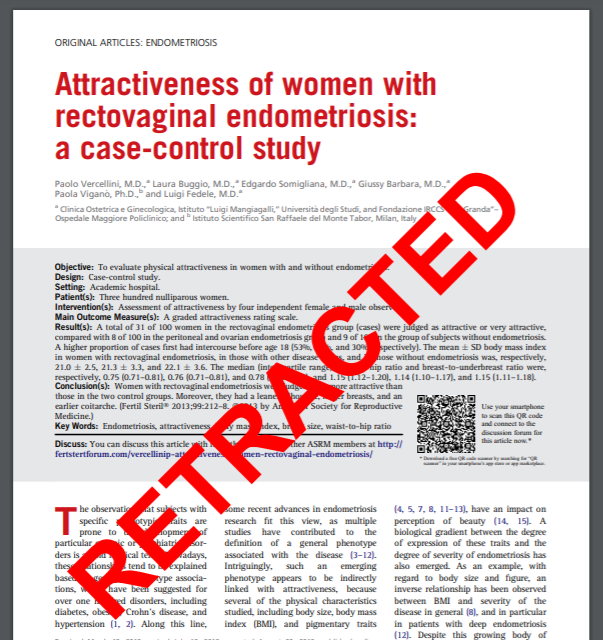
Study rating attractiveness of women with endometriosis is not yet retracted

Despite media reports announcing the retraction of a much-criticized study of whether women with endometriosis were more attractive than other women, the study has yet to be retracted by the journal.

Last week, several news outlets, picking up on a story in The Guardian, said the study, first published in 2012 in Fertility and Sterility, had been retracted. 

The study, called “Attractiveness of women with rectovaginal endometriosis: a case-control study,” claimed to show that:

Continue reading Study rating attractiveness of women with endometriosis is not yet retracted

A retraction and a retraction request as Twitter users call out sexism, fat-shaming, and racism

Overweight people are more dishonest, women with endometriosis are more attractive, and affirmative action needs to stop: Papers with these three conclusions have come under intense scrutiny on social media in recent days, with at least one retracted. 

First up, a study — widely criticized for being sexist — which claimed to find that

Women with rectovaginal endometriosis were judged to be more attractive than those in the two control groups. Moreover, they had a leaner silhouette, larger breasts, and an earlier coitarche.

The study, called “Attractiveness of women with rectovaginal endometriosis: a case-control study” was published in 2013 in Fertility and Sterility, an Elsevier publication. It received sharp criticism on PubPeer beginning a year ago when one commenter, “Ovine Mastadenovirus,” wrote:

Continue reading A retraction and a retraction request as Twitter users call out sexism, fat-shaming, and racism

Cancer surgery group in China may lose second paper

After whistleblowers in China prompted the retraction of a 2018 paper that overstated the number of patients treated in a study, another journal says it’s investigating a second article by the same group.

Last month, as we reported, the Journal of Surgical Oncology retracted “Long‐term outcomes of 530 esophageal squamous cell carcinoma patients with minimally invasive Ivor Lewis esophagectomy.” The move was prompted by whistleblowers who notified the journal that the 530 cases could not have been performed at the authors’ institution, Zhejiang University, in Hangzhou. 

After our post, a Twitter user pointed us to a second article by the group, in BMC Cancer, which claimed to report data on 697 subjects over just one additional year — a highly improbable figure. 

Continue reading Cancer surgery group in China may lose second paper

Journal editor breaks protocol to thank an anonymous whistleblower

As Retraction Watch readers may recall, we’ve been highlighting — and championing — the work of anonymous whistleblowers throughout the 10-year history of the blog. Our support for such anonymity, however, is not universally shared. 

In 2011, for example, in our column at Lab Times (unfortunately no longer online), we wrote:

Continue reading Journal editor breaks protocol to thank an anonymous whistleblower

A bitter aftertaste: Legal threats, alleged poisoning muddy the waters for a trial of a tea to treat malaria

Artemisia afra, via Wikimedia

Xavier Argemi first heard the claim that tea made from artemisia herbs could be useful in the treatment of malaria from a TV documentary in 2017.

The documentary, featuring Lucile Cornet-Vernet, the director of the La Maison de l’Artemisia, a non-profit organization that grows artemisia and promotes its use in centers across Africa, focused on the Democratic Republic of the Congo (DRC). The film claimed that for decades major pharmaceutical companies have been profiting from expensive malaria drugs based on artemisinin — the antimalarial for which Tu Youyou won a Nobel Prize in 2015, after distilling it from the Artemisia annua plant — while the tea itself, an ancient Chinese herbal remedy, was just as effective at treating the disease.

His interest piqued, Argemi reached out to Cornet-Vernet, an orthodontist at Paris’ Descartes University. She shared with him the unpublished manuscript of a study — their first large-scale clinical trial — which she said showed that artemisia outperformed a go-to treatment for schistosomiasis, a different parasite-induced disease.

Argemi immediately saw red flags. “I am not a specialist of malaria or schistosomiasis, but when I read the study I was simply totally surprised by the number of inconsistencies at the very first read,” Argemi, of the Clinique Axium in Strasbourg, France, told Retraction Watch by email. 

Continue reading A bitter aftertaste: Legal threats, alleged poisoning muddy the waters for a trial of a tea to treat malaria

Paper called “unscholarly, overtly racist” earns an editor’s note

Lawrence Mead

The journal that recently ran a controversial essay on poverty and race has flagged it with an editor’s note letting readers know about an investigation into the work. 

As we reported last week, Society, a Springer Nature title, published a paper by Lawrence Mead, of New York University, who argued that poor Blacks and Hispanics lack certain cultural traits that help European whites succeed in the face of economic adversity: 

Continue reading Paper called “unscholarly, overtly racist” earns an editor’s note

USC-Children’s Hospital Los Angeles researcher out following misconduct probe

Prasadarao Nemani

An infectious diseases researcher found by a federal U.S. watchdog to have “recklessly” faked data in grants worth millions left his job as the investigation was coming to a close, Retraction Watch has learned.

As we reported last week, Prasadarao Nemani, of Children’s Hospital Los Angeles (CHLA) and the University of Southern California (USC), “engaged in research misconduct by recklessly including falsified and/or fabricated data” in a 2009 paperretracted in 2018 — and four NIH grant applications, according to the U.S. Office of Research Integrity.

Earlier this week, in a statement provided to Retraction Watch, CHLA said that he was no longer with the hospital or with USC:

Continue reading USC-Children’s Hospital Los Angeles researcher out following misconduct probe