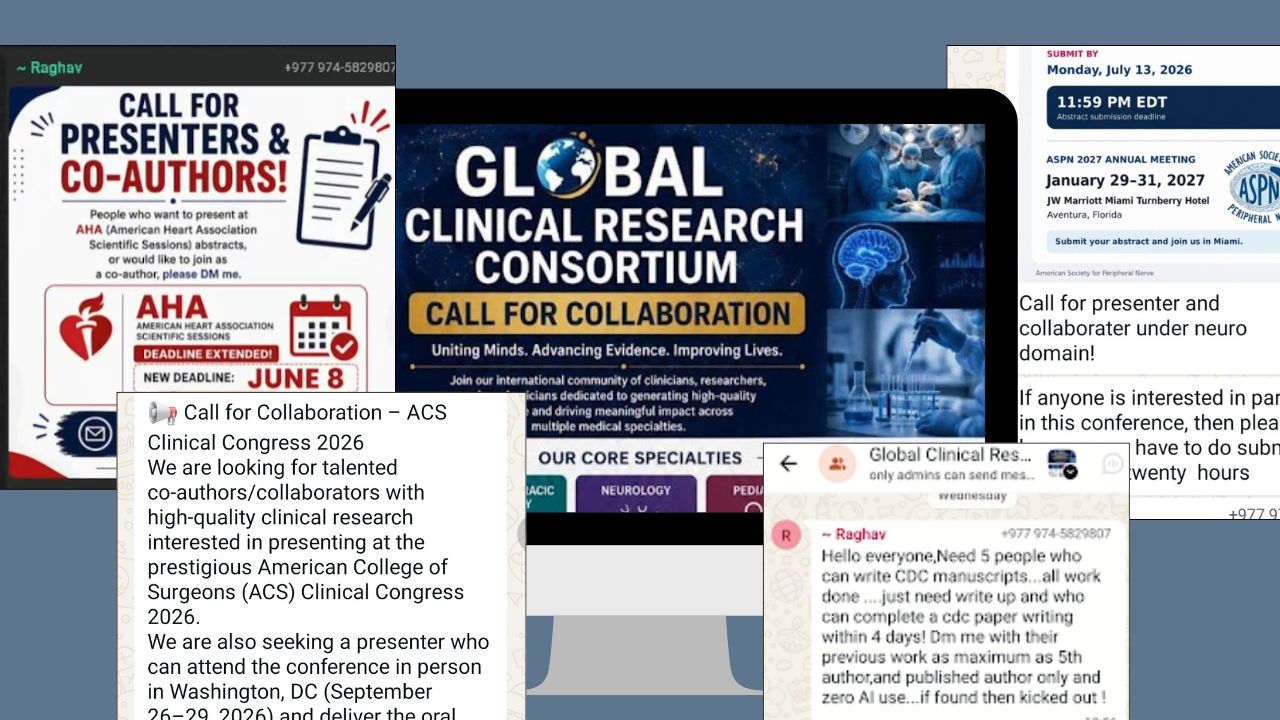
A second-year medical student in Nepal is at the center of an international research network churning out everything from systematic reviews and meta-analyses to case reports and database studies, Retraction Watch has learned.
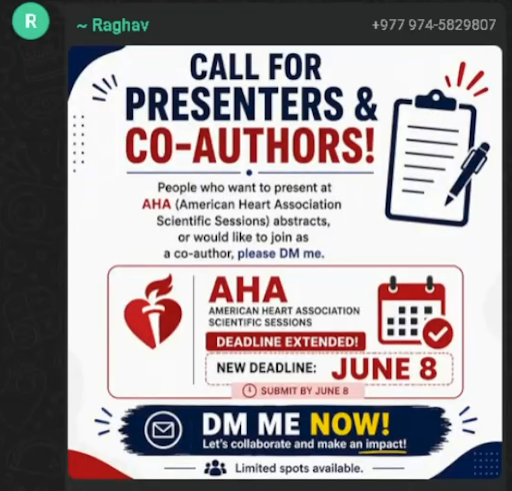
The student, Raghabendra Kumar Mahato, leverages this network, which includes nearly 1,000 members connected through the WhatsApp messaging platform, to produce large numbers of conference abstracts and journal papers at breakneck speed, according to posts and messages we have reviewed. The work has been presented or accepted for presentation at conferences organized by the American Heart Association (AHA), the European Society for Medical Oncology (ESMO) and many other medical societies and has appeared in journals from major publishers.
But a review of dozens of WhatsApp messages we obtained and an interview with a disillusioned member of the community, called the “Global Clinical Research Consortium,” suggests the network produces fast-churn science, includes a known paper miller and treats authorship as a tradable commodity.
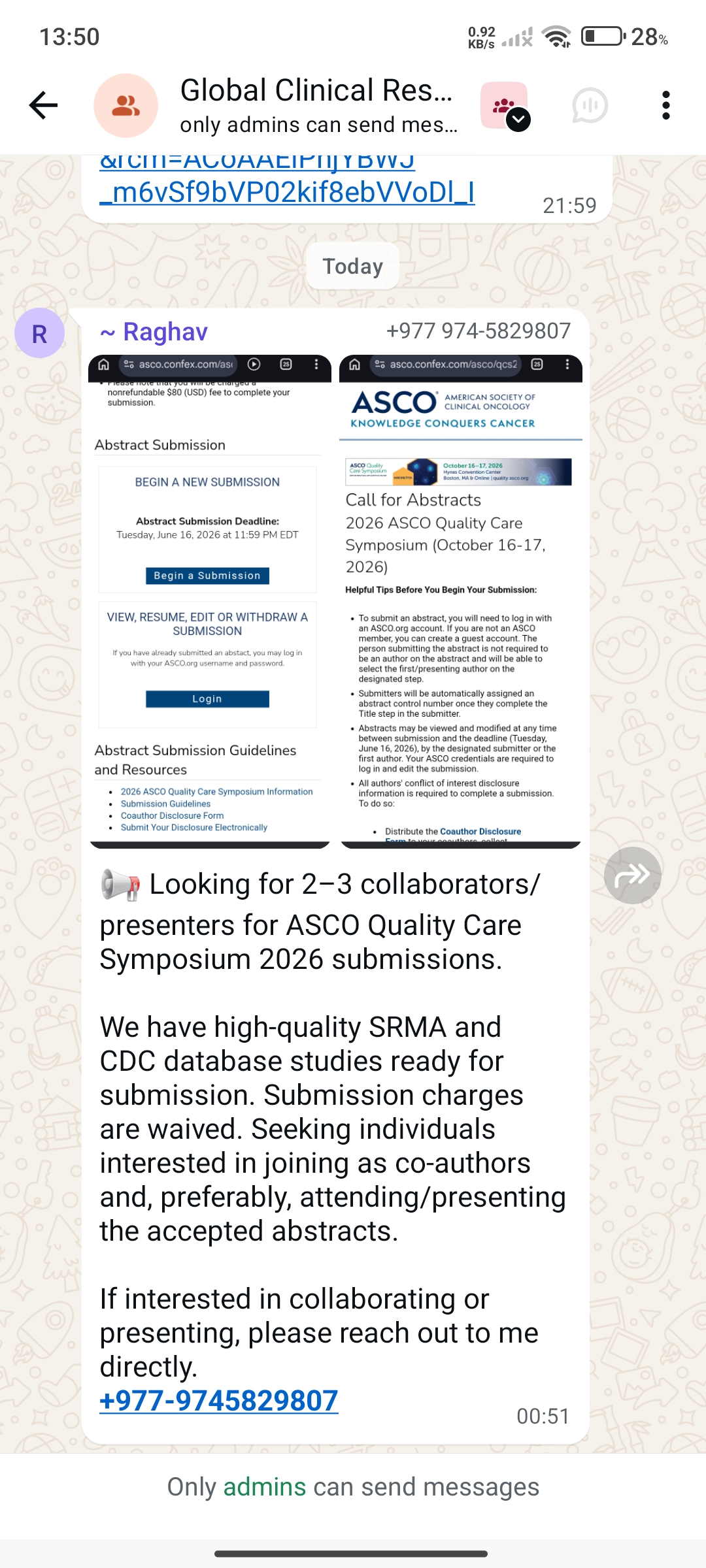
“We have high-quality SRMA [systematic review and meta-analysis] and CDC [U.S. Centers for Disease Control and Prevention] database studies ready for submission,” Mahato wrote in a recent message regarding the American Society of Clinical Oncology’s Quality Care Symposium in Boston this fall. “Seeking individuals interested in joining as co-authors and, preferably, attending/presenting the accepted abstracts.”
Conferences often require abstracts to be presented in person, but registration and travel costs can be prohibitive for many in the global south, as can journal publication fees. The materials we obtained show Mahato bartered authorship to people willing to present the network’s research and shoulder the associated expenses.
“Is it possible for you to present physically in US,” Mahato, who owns the WhatsApp community, asked a member of the network in a message earlier this year. After receiving an affirmative, Mahato replied that in return, “We can offer you authorship from ourside [sic].”
Representatives from AHA and ESMO confirmed several abstracts coauthored by Mahato have been accepted for their upcoming conferences, and, following our inquiry, will be giving them a closer look.
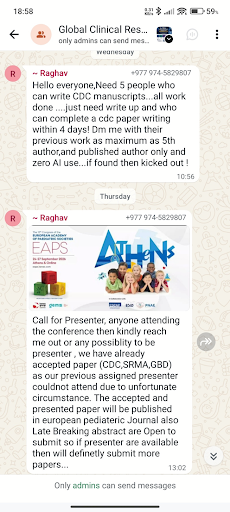
Other messages to the community included “urgent” calls for conference presenters and collaborators for submission-ready abstracts, and in one case for an “already accepted paper.” Mahato noted that researchers “wishing to present their own work are also welcome.” In one message he promised “guaranteed authorship” to collaborators who had publication-fee waivers from the publishers MDPI or Frontiers.
In an email to us, Mahato, who already has more than 100 publications to his name, denied “authorship is exchanged solely in return for conference presentation.”
He said presenters were identified in advance for “many conference-based projects” and that presenters were “expected to make meaningful scholarly contributions” such as “reviewing conference submission guidelines,” “critically reviewing the scientific content prepared by collaborators” and “participating in data curation where appropriate.”
There is no indication in the material we obtained that Mahato sells authorship for money. He rejected the characterization of his organization as a paper mill, adding, “Our objective is to facilitate collaborative academic research involving contributors with different areas of expertise.”
The Global Clinical Research Consortium belongs to a growing cottage industry of businesses and organizations catering to medical students and junior physicians under pressure to publish, often in hopes of landing prestigious residencies in the U.S. Some of these outfits charge for their services, which may or may not involve some amount of research training, while others say they don’t. All of them aim at the same thing: Helping customers or members pad their resumés.
Efforts like these can create a disconnect between authorship and publication and the underlying purpose of research, Martina Linnenluecke, director of the Centre for Climate Risk and Resilience at the University of Technology Sydney, told us. “The primary objective of research should not be to simply to secure an acceptance at a conference or journal for career purposes but to answer a meaningful research question through rigorous analysis,” said Linnenluecke, coauthor of the 2025 paper, “The junkification of research.”
Mahato’s organization works across several medical specialties, including neurology, cardiology, pediatrics and oncology. One of its strengths, according to advertising materials, is “Turning Ideas Into High-Impact Publications.” Based on Mahato’s LinkedIn posts and WhatsApp messages, well over 70 of his conference abstracts appear to have been accepted for presentation, and he has submitted, or is planning to submit, dozens more. He also has more than a dozen full-length studies and case reports in journals such as Wiley’s Clinical Cardiology and Clinical Case Reports and Springer Nature’s Journal of Cardiothoracic Surgery and BMC Neurology.
Like other organizations of its kind, the Global Clinical Research Consortium produces studies that can be done in front of a computer, such as analyses of open datasets. A recent surge in open science suggests the efforts are being felt at the journal level. In particular, a preprint from January found exponential growth in publications based on the CDC WONDER database, with an increasing proportion of authors from Pakistan and, to a lesser extent, India. According to the preprint, most of the papers bore signs of “being produced from a template, with formulaic titles and identical methods.”
Mahato’s network could be one source of such publications. Most of his coauthors are in Pakistan. His WhatsApp group is also dominated by Pakistani numbers, although hundreds are from other countries, including India, Egypt, Nigeria, the United States, United Kingdom, Georgia, Peru and South Korea.
So far, Mahato has published one CDC WONDER study with coauthors in Pakistan and has uploaded two more to preprint servers. More may follow. In a WhatsApp message from this summer, Mahato wrote he needed “5 people who can write CDC manuscripts…all work done ….just need write up and who can complete a cdc paper writing within 4 days!”
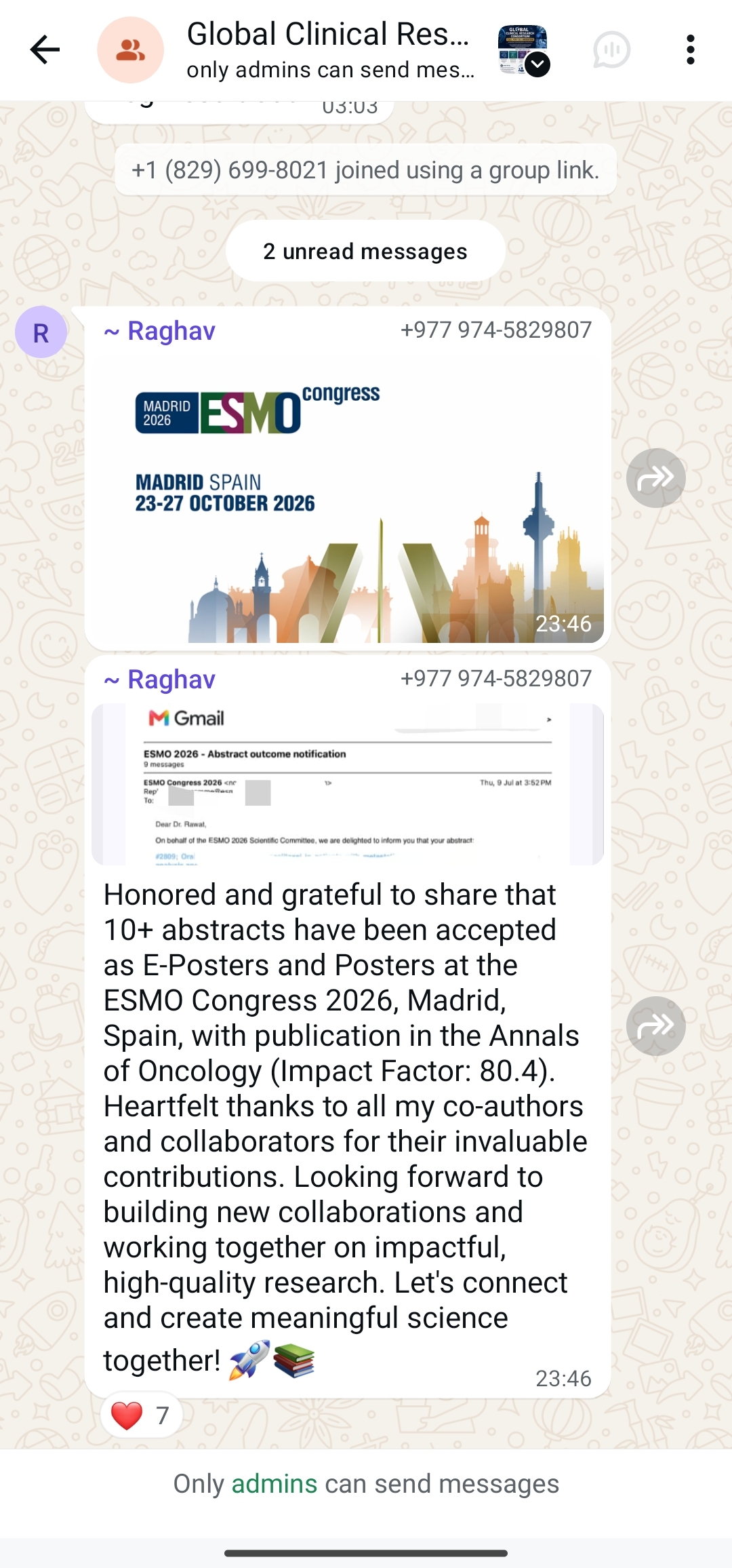
On his LinkedIn page, Mahato wrote that “11+ of our research abstracts have been accepted for presentation” at the European Society for Medical Oncology Congress 2026 in October, and that five abstracts were accepted by the American Heart Association’s Basic Cardiovascular Sciences Scientific Sessions, which took place July 13 to July 16.
Vanessa Pavinato, head of communications for ESMO, told us the society was not aware of any questionable practices by Mahato or his network. ESMO officials were able to find seven accepted abstracts coauthored by Mahato, primarily ePosters, Pavinato told us. The society is now reviewing the submissions, she said.
“We have immediately started an internal investigation, based on the information you kindly shared,” she told us. “It will take us some time though to get to the bottom of it.”
Likewise, a spokesperson from AHA confirmed Mahato had five abstracts accepted for their recent conference. “As part of our review when allegations are brought forward, we will work with our volunteer leaders to identify the best action for each case and/or abstract,” the spokesperson said. “This step is currently in progress.”
At scale, Linnenluecke said, “practices aimed at securing places at conferences or getting articles into journals place significant pressures on already stretched review and conference systems and adds to the growing volume of poorly verified research that makes it much more difficult to identify credible findings.”
The disillusioned network member we interviewed, Anit Sinha, provided more detail about the network’s inner workings. Sinha recently graduated from Gandaki Medical College in Pokhara, Nepal – the same school Mahato is now attending – and is preparing for his residency. He joined Mahato’s network to boost his CV, but says he became “suspicious” of its practices after he started working on a review paper in “one of the subgroups.”
After seeing a bulleted outline of the manuscript, which looked like it was generated with AI, Sinha said, he and seven other network members each picked one section they would write “under the direction of an associate admin” whose WhatsApp username was “S.B.”
“Neither admin (including Raghabendra Kumar Mahato) wrote any section,” Sinha told us. “Their feedback consisted entirely of formatting instructions. When I asked for substantive content feedback, none was given.”
S. B.’s number belongs to Shreya Singh Beniwal, an entrepreneurial physician and known paper miller in India. Beniwal was first author on a questionable paper advertised for sale by the erstwhile iTrilon, as we reported in 2024 in an investigation for Science. She also ran an organization on WhatsApp that sold author slots on research papers, we later found.
Beniwal, who continues to publish widely, told us she was “not aware of [Mahato’s] WhatsApp group or any of its subgroups” and did “not know any of the administrators or active members of this community.” She could have been “added to the group by someone else or may have joined through a shared link unintentionally.”
But screenshots we reviewed show Beniwal was an administrator of a subgroup called “New Cardio topic” along with Mahato and another person in India. She managed the group’s work on various sections of a manuscript on heart disease and often used an authoritative tone with other members, including Mahato. “Get it done by evening,” she told Mahato at one point. “Sure, give me few time [sic],” he replied. The owner of the manuscript in Google Docs was an email she has used on several recent papers.
On June 4, Beniwal asked the subgroup if anyone was “interested in joining abstracts with us in AHA 6th is deadline so where we are submitting a few more topics [sic].” And on July 19, four days after we contacted her, she announced in a subgroup called “Ongoing Projects Community 6” that she would be starting “only 3-4 topics this month” due to time constraints, and that these collaborations would be “fast-track projects.”
After we contacted her, Beniwal’s WhatsApp handle changed from “S. B.” to an asterisk, but she remained in Mahato’s group. Another number in the group also belongs to Beniwal.
Mahato, who appears as corresponding author on nearly all of his papers, told us his “role extends well beyond managing communication” between network members.
“I participate in project planning, coordination of collaborators, manuscript drafting, scientific editing, integrating contributions from multiple authors, organizing revisions, ensuring consistency throughout the manuscript, managing submissions, corresponding with editors, responding to reviewer comments where applicable, and coordinating projects through completion,” he said.
Mahato began publishing last year, shortly after enrolling in medical school in December 2024. Since then, his research career has been meteoric. According to his Google Scholar profile, he already has amassed nearly 120 publications – including an abstract in Neurology on which Beniwal is also an author. The abstract states the authors did a “retrospective comparative analysis of trial and open label extension data,” but it simply rehashes already–published data points, as Sinha pointed out. “They never even did any independent analysis,” he said.
Posts on his LinkedIn profile show Mahato is a reviewer for several journals from major publishers, including the International Journal of Surgery, Annals of Medicine and Surgery and the International Journal of Surgery Case Reports, all of which belong to a troubled collection of Wolters Kluwer titles. And soon, he told Sinha in a WhatsApp exchange, he will be joining a journal editorial board; he did not specify which.
Most of Mahato’s early publications are commentaries, but lately he has added several systematic reviews, database studies and case reports to his bibliography. His many conference abstracts have only just begun to appear in supplements of society journals.
On several of his papers, Mahato appears with an “MBBS” appended to his name, suggesting he already earned his medical degree. Some articles also state he provided “senior academic oversight.” Mahato told us the suffix was supposed to indicate his “academic program of study” and “was never intended to misrepresent my academic status.”
Sinha said unethical behavior is “quite common” among students and researchers in Nepal, “but not at the scale Raghabendra Mahato is operating at.”
With additional reporting by Alicia Gallegos and Kate Travis.
Like Retraction Watch? You can make a tax-deductible contribution to support our work, follow us on X or Bluesky, like us on Facebook, follow us on LinkedIn, add us to your RSS reader, or subscribe to our daily digest. If you find a retraction that’s not in our database, you can let us know here. For comments or feedback, email us at [email protected].
So where is the problem? If all these authors contribute to these papers and publish them then there are no concerns. Publishing 20+ papers per year with organised team is not an issue, given that SRMAs can be done much quicker…
I don’t know what in this article gives you the impression that “coauthors” actually contribute to these articles in any meaningful way. And what’s more likely: that Mahato, a 2nd-year med student, has the competence, expertise, and *time* to conduct dozens of high-quality meta-reviews and data analyses across many different fields of medicine… or he is using an LLM to generate these “reviews” and disguising them with a network of unethical, non-contributory coauthors who are further incentivized to present the “work” at conferences.
It is unethical. And also misleading, a second year mbbs student essentially has no idea about his own curriculum or the gravity of clinics in his pathway, and yet he has 120 papers to his name. While having publications from a young age isn’t something illegal, but then churning out research like a paper mill industry is unethical and against the whole idea of what research stands for in the first place. Plus these groups essentially target Pakistani kids as pakistan is listed as an economically weak country and it allows them to bypass the APCs. Where articles are meant to provide you with information that guide you forward, these paper mills have basically converted the art of writing in research into a transaction. (This is similar to using 1000s of people to churn out 100s of poems everyday, and then gaining a seat at the table with Keats and Tagore)
This is far from an isolated incident. There are hundreds of WhatsApp-based “research groups” that have effectively turned scientific publishing into a marketplace. I have personally seen groups where authorship opportunities are advertised with messages such as: “Submitting to Journal X today at X PM. Authorship slots available. First come, first served.” Prospective authors are sent a catalogue of prices based on author position, allowing people to buy their way onto manuscripts.
The most disturbing part is that many of these papers eventually find their way into reputable journals, including high-impact medical journals. This shows that the problem is not necessarily the scientific quality of every manuscript, it is the integrity of the authorship itself. A paper can contain good science while still have authorship that does not accurately reflect who made the intellectual contribution.
Authorship is meant to recognize substantial scholarly work, not the ability to pay. When authorship becomes a commodity, publication records stop reflecting scientific contribution and instead reflect purchasing power. That is profoundly unfair to researchers who spend months or years conducting ethical research and earning their place on a paper.
This practice makes a mockery of academic publishing, erodes trust in the scientific literature, and devalues the very currency on which science depends: credibility. If journals, institutions, and regulators are serious about protecting research integrity, they must investigate credible evidence of authorship-for-sale networks and treat them as a serious threat to science rather than an open secret.
Thanks Retraction Watch for writing this fascinating investigative article — really intriguing content.
My understanding: there’s no fabricated data, no authorship for sale as cash, and he’s using publicly available CDC databases, which is legitimate science in my view. But bartering authorship for presentations and fee waivers, and recruiting “co-authors” after the work is done? Any objective thoughts about it?
It sure is easy to hijack science. Maybe decent scientists could find time to get their heads out of the sand.
It’s good these cheats are being caught and must be taken down. If they lie about their academic degrees, their work is meaningless.
All the hand wringing about access to science from the “global south”! Lol. Amoral behavior at scale will dash the entire research exercise. And their governments let it happen? And their colleagues? Do these people have no ethical foundations? What is the end game? A few hundred bucks? A thousand?
PubMed currently lists 92 papers on which Mahato is an author. These have been published in just 12 months (July 2025 to Jun 2026) in 13 journals, covering a huge variety of topics ranging from deep brain stimulation for movement disorders to use of tourniquets in snakebite. The vast majority (77) are in Annals of Medicine and Surgery – one of these has been retracted owing to concern about fabricated references. I’d suggest that every single one of these papers need to be investigated.
Well-spotted. This ‘journal’ Annals of Medicine and Surgery is in the meantime discontinued in Scopus (https://www.scopus.com/sourceid/21100283772 ) and has been put on hold in Clarivate’s ESCI index (which can be checked here https://mjl.clarivate.com/home ).
The fact that this ‘journal’ accepted so many papers of one and the (co-)author is most likely one of the reasons.
PS. Looking at the ranking of Nepal https://en.wikipedia.org/wiki/List_of_countries_by_number_of_scientific_and_technical_journal_articles then Nepal is ranked disproportionally high in this journal https://www.scilit.com/sources/2293