
Earlier this year, Tushar Sen, an independent researcher based in New Delhi, submitted a manuscript to Security and Privacy about the modeling of polymorphic malware. On May 15, a purported reviewer for the journal wrote Sen indicating he received the article, but that it was not ready for publication.
“i may revise it with you but you should follow paid review for my efforts,” the email read. “i may finalise it in one week and i will recommend acceptance as a final decision.”
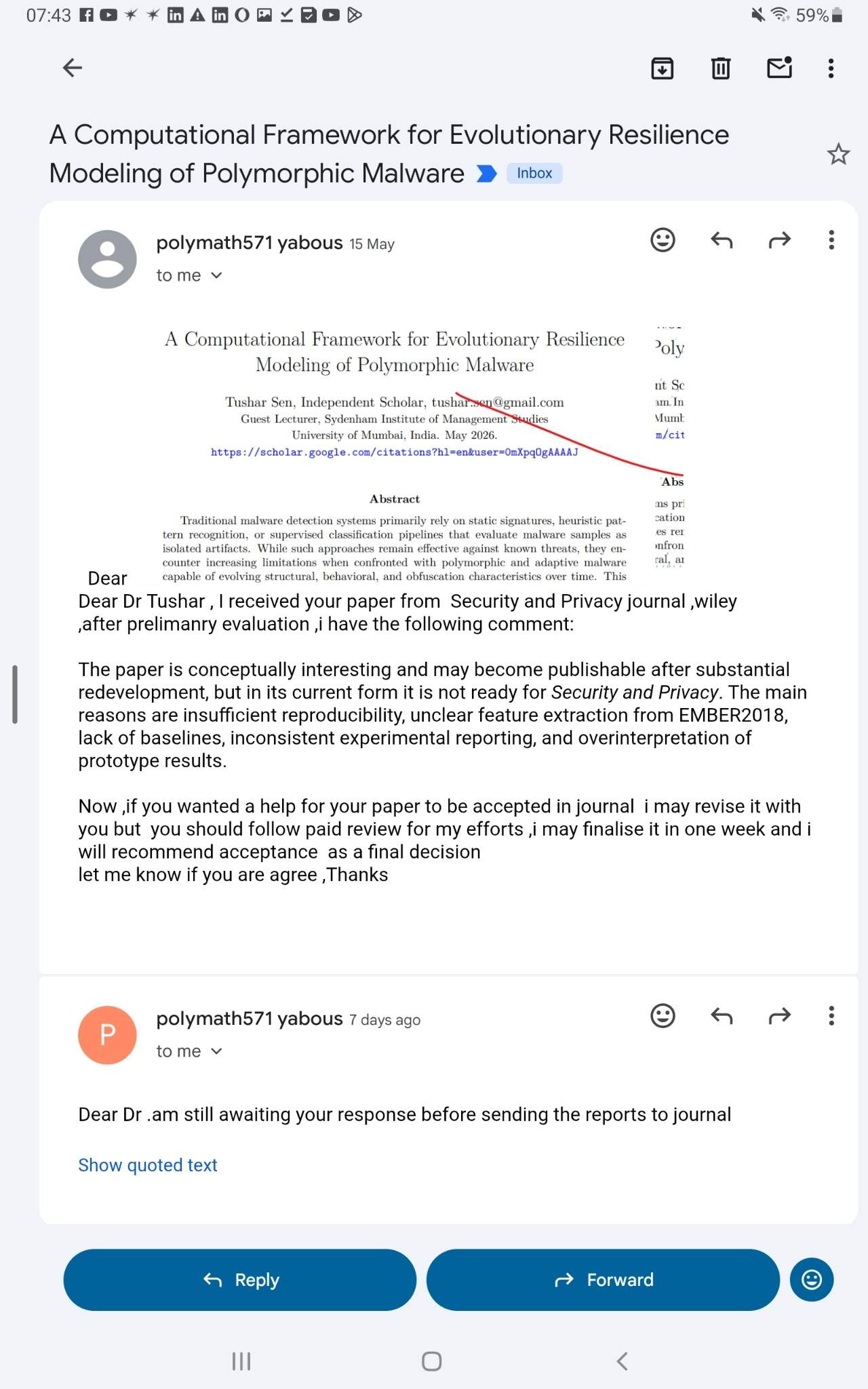
Sen, a cybersecurity researcher, believed the writer was attempting to extort money from him in exchange for recommending acceptance of his submission. He did not respond, but continued to receive more emails from the individual about the proposal. In a May 20 email, the person wrote they were “still awaiting” Sen’s response before “i submit rejection to the journal.” On May 23, the purported reviewer wrote, “I recommended the rejection decision” and “Gud (sic) luck.”
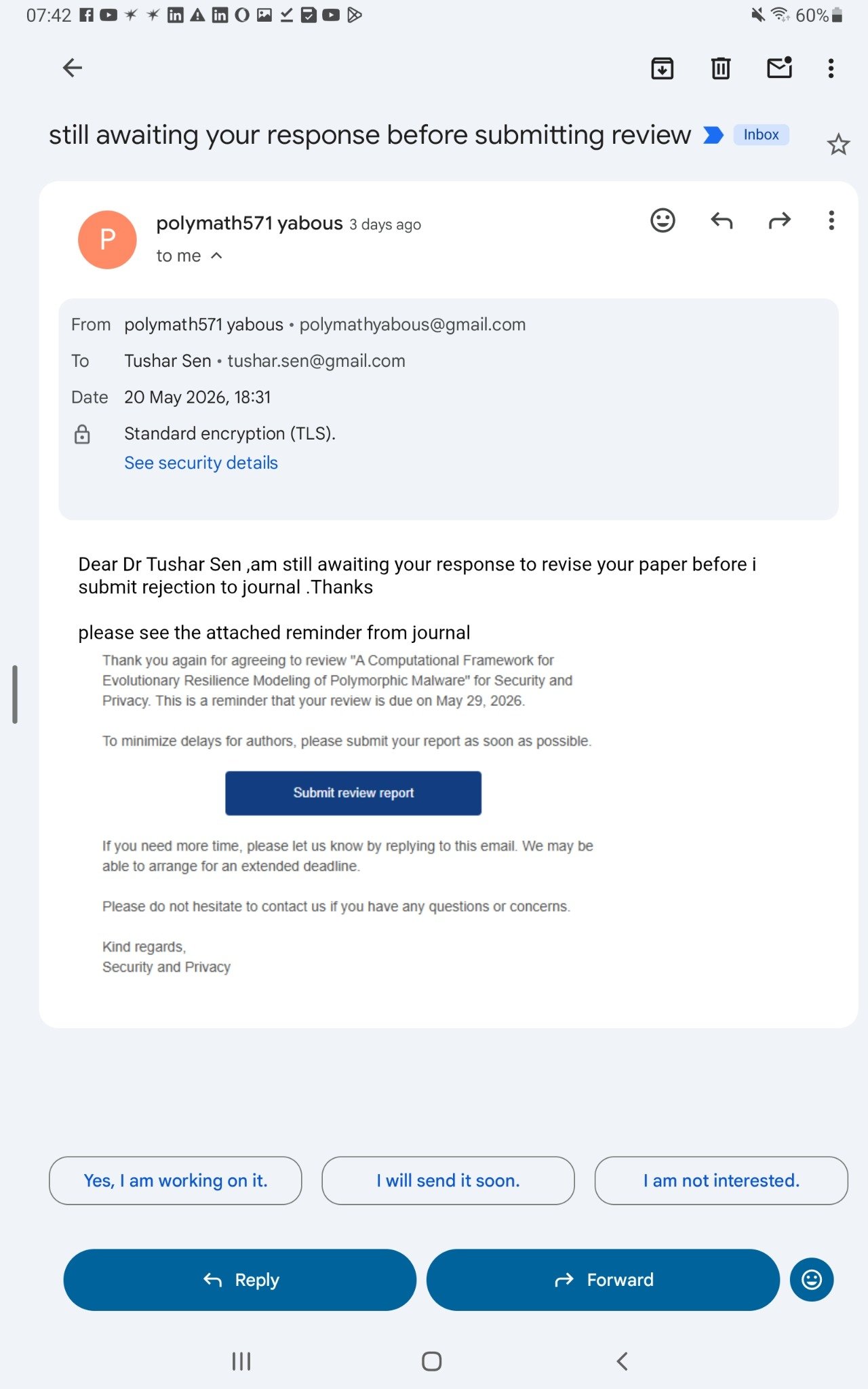
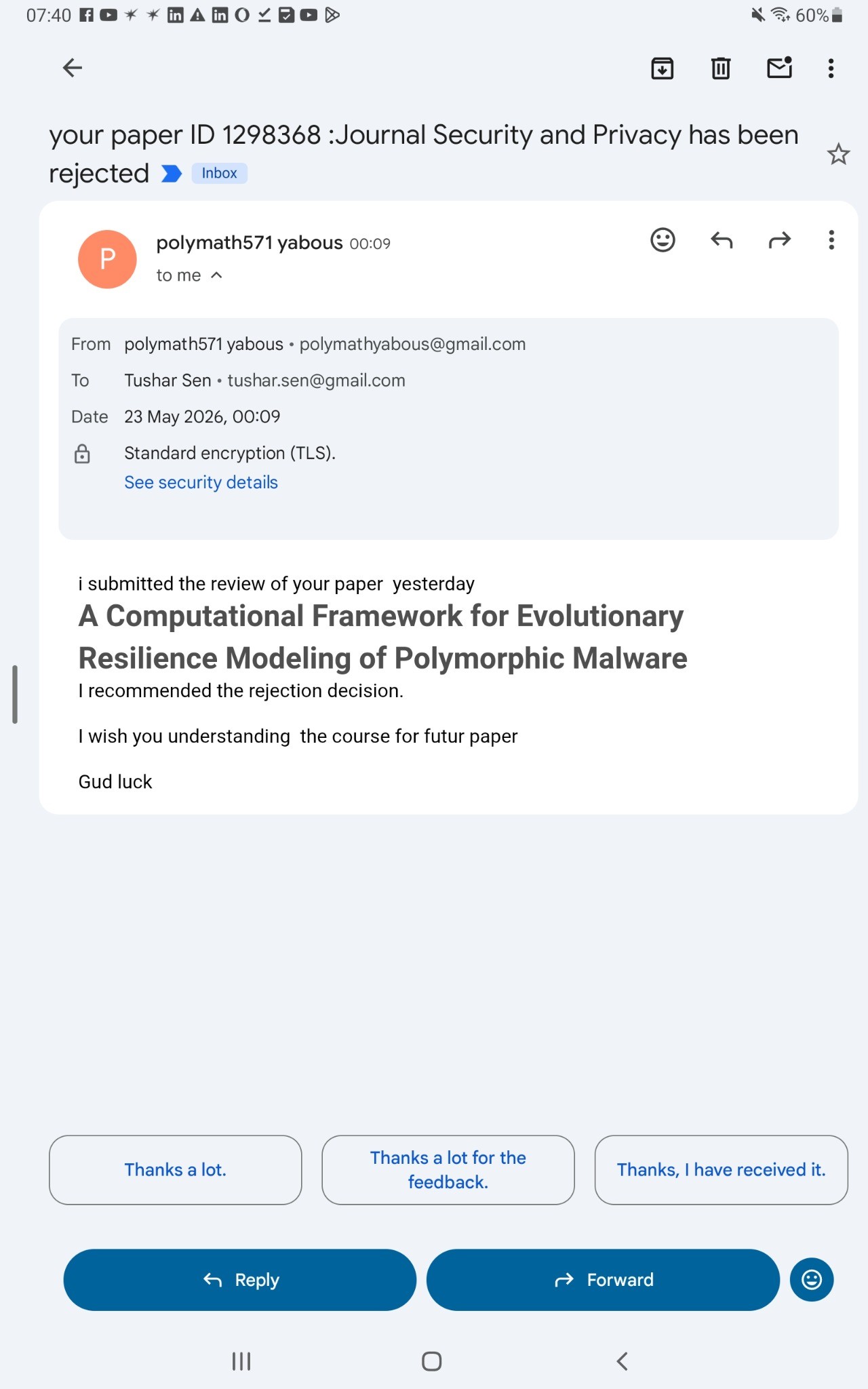
Wiley, which publishes the journal, told Retraction Watch they are investigating Sen’s claims and may take action if the complaint proves valid. In our own efforts to validate the claims, we asked Sen to forward us the emails he had sent as attachments and screenshots. He did not respond to that request.
The alleged extortion and its aftermath also include an editor-in-chief who admonished Sen for “making accusations” and using “unprofessional language,” a complaint to the FBI, and the manuscript’s author suggesting Retraction Watch accepted a “bribe” from Wiley because he felt we took too long to publish this story.
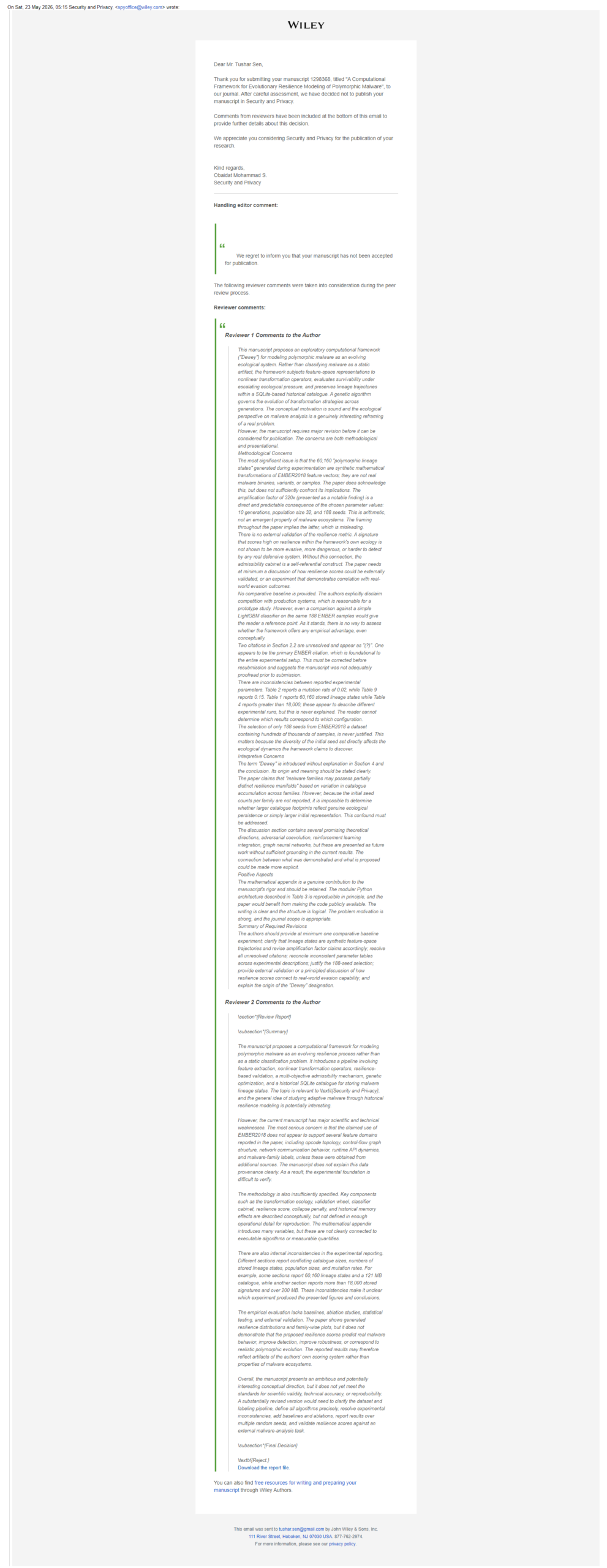
The same day the alleged reviewer told Sen about rejecting his submission, Sen said he received a formal email from Security and Privacy declining to publish his manuscript. The letter contained assessments from two reviewers with concerns similar to those in the prior email Sen received, such as problems with how he used a cybersecurity dataset. After receiving the rejection, Sen reported the alleged reviewer to the journal, according to correspondence he sent us.
The experience has been “mental torture” and has greatly shaken Sen’s fatih in the peer review system, he told us.
“Everytime I received [an] mail from that ID, I was really disturbed. I had to abandon that day’s work due to acute anxiety,” he said.
A spokesperson for Wiley told us the publisher’s research integrity team is investigating the complaint, and that Sen’s concerns are “supported by copies of corresponding email conversations.” Reviewers for Security and Privacy know the authors’ identities, but reviewer identities are hidden from authors. “Confidentiality is a main responsibility for peer reviewers,” the spokesperson said.
“Reviewer conflicts of interest must be avoided and reviewers are not allowed to contact the authors in the context of the peer review process,” the spokesperson told us. “Receiving or requesting financial compensation from authors is strictly prohibited.”
The Wiley spokesperson told us the reviewer’s email in the correspondence provided “does not match the email address of any invited reviewer,” although that doesn’t rule out the purported reviewer using a different email address to contact Sen. The publisher received screenshots of the alleged email exchanges and “cannot otherwise speak to their legitimacy,” the spokesperson said.
Sen’s experience appears to be a “unique and isolated case,” and the journal has not seen similar cases in the past, the spokesperson added.
In a May 23 email to Mohammad S. Obaidat, the editor-in-chief for Security and Privacy , Sen wrote the journal “is bugged with CORRUPT reviewers,” and that he hoped Obaidat is “not involved in this scandal.” He suggested Obaidat have Sen “revise the paper” and that Obaidat “accept, as it is clear from the review comments that it just needs revision. Or we take this the legal way.”
In a reply email Sen shared with us, Obaidat thanked him for bringing the matter to his attention, but admonished him for how he approached the issue.
“We are warning you here that using unprofessional language, making accusations, and belimihsing [sic] reputations of highly respected entities will not help in finding out what has happened and may entail serious consequences,” Obaidat responded.
Sen told us the person who emailed him never gave a name nor specified a price. Sobhan Sobhan Allah, who seems to have published several papers in mathematics, lists the alleged reviewer’s email address in some of his works. “Sobhan Sobhan Allah,” often spelled “Subhan Allah,” translates to “Glory be to Allah” in Arabic.
Emails sent by Retraction Watch to the address bounced back as undeliverable. In his research, Allah cites two affiliations in Algeria: The University of Batna2 and Abbès Laghrour University Khenchela.
Administrators in the department of mathematics at the University of Batna2 told us they do not know Allah and are “not aware of anyone with this name being affiliated with our department.”
Allah also has no affiliation with Abbès Laghrour University Khenchela, department of mathematics staff told us.
Zeraoulia Rafik, who completed his master’s degree at the University of Batna2 in 2021, has coauthored at least two papers with Allah. He told us his scientific collaboration with Allah occurred “entirely online and has ended.” He had no contact information for Allah other than the nonworking email address, he said.
“In our final exchanges, he described himself as an independent Palestinian researcher interested in astronomy and mathematics,” Rafik told us. “I asked him to provide a verifiable institutional or professional email address, but I received no response. My inability to verify his stated affiliations was the principal reason I ended our collaboration years ago.”
Since May, Sen has sent at least five emails to the journal, Wiley, COPE officials, reporters, professors, sleuths and the U.S. Department of Health and Human Services, requesting “an immediate, independent audit into Wiley’s Security and Privacy journal editorial logs,” a “full ethical review” of the journal’s conduct and a “complete re-evaluation of the journal’s indexing status due to structural fraud and compromised peer-review integrity.”
He has also filed a complaint with the FBI and the U.S. Securities and Exchange Commission, and has threatened the journal with legal action for “mental harassment,” according to emails we’ve seen. Sen accuses Obaidat of “choosing to ratify the extortionist’s fraudulent rejection” by declining his manuscript.
The Wiley spokesperson told us as a “precautious measure,” the final editorial decision about Sen’s manuscript was re-evaluated, and the feedback from “the specific reviewer” was not considered. Depending on the investigation’s findings, Wiley may consider banning the reviewer from receiving reviewer invitations in the future, the spokesperson said.
Sen grew frustrated with the duration of our reporting on this matter and accused us of accepting a “bribe” from Wiley. He ultimately stopped answering our questions, including providing more information about his research background.
“I can be a farmer or a school teacher, how does it matter[?]” he wrote in an email.
Like Retraction Watch? You can make a tax-deductible contribution to support our work, follow us on X or Bluesky, like us on Facebook, follow us on LinkedIn, add us to your RSS reader, or subscribe to our daily digest. If you find a retraction that’s not in our database, you can let us know here. For comments or feedback, email us at [email protected].
Based on the details given, I see no reason for publishing this story at this stage.
Why not? It’s a very interesting and important incident. It’s obviously worth sharing. The victim is clearly an immature person, but that’s no reason to disregard the incident.
I felt that you are using the power of press to release unverified claims and create on us readers and scientists a feeling of untrust in the sistem. It is not perfect but is worse if we trust in unverified claims.