A composer published a paper on theoretical physics. His lack of credentials drew criticism.

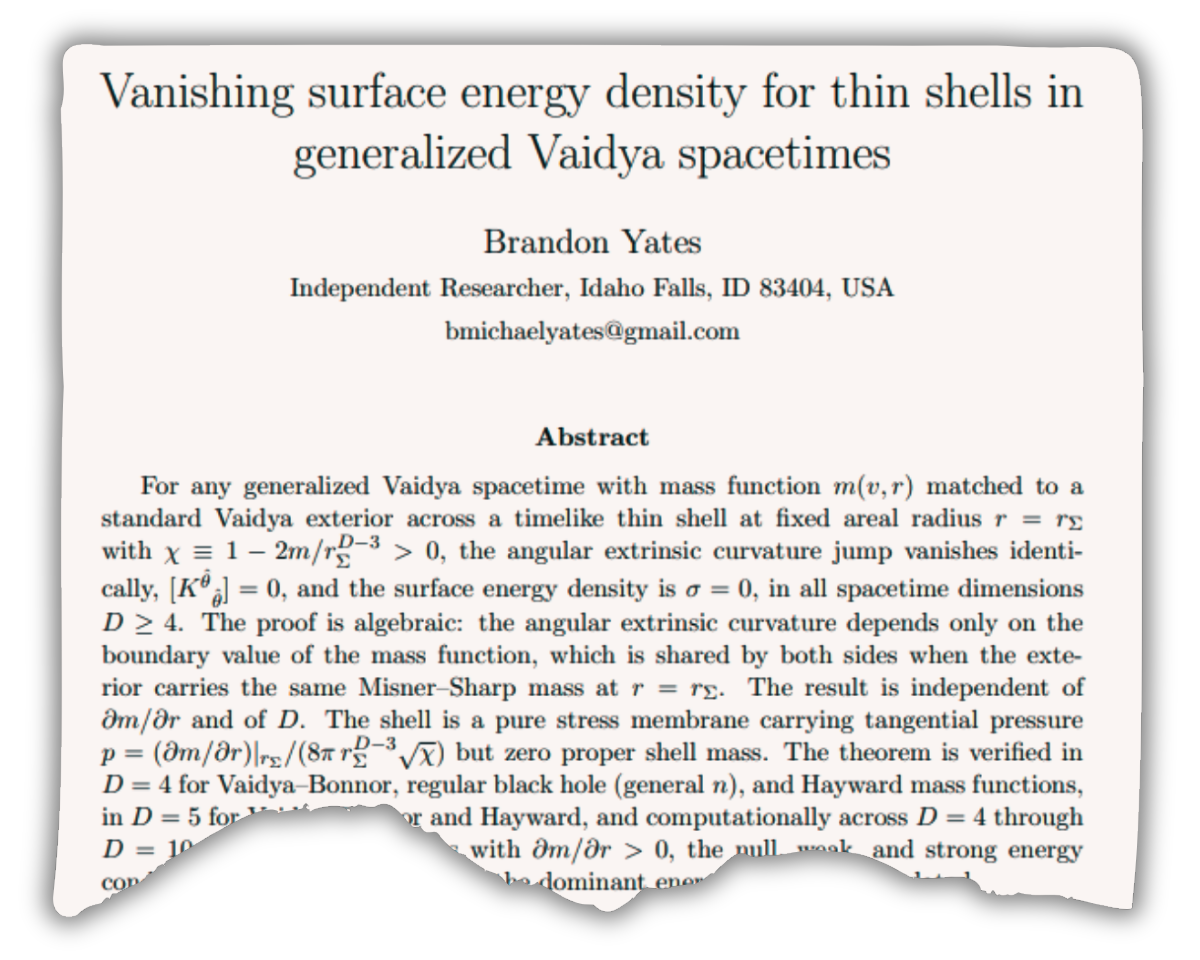
Some people compose music or make YouTube videos for a hobby. That’s Brandon Yates’ job — so in his spare time, he tries his hand at theoretical physics. But his only published paper was questioned because of his lack of professional training in the field — despite the physicist who inspired his work saying the work looks legitimate.

Based in Las Vegas, Yates earns a living as a composer for the animated series called “Death Battle.” He also has had an “intuitive understanding of, and love for, General Relativity for as long as I can remember,” he told Retraction Watch. But he has no formal training in physics and is self-taught, he said. 

After watching a video lecture series online by Canadian physicist Eric Poisson, in January, Yates built a computer algebra program to look into rules in general relativity used to fuse two spacetimes across a thin shell, Yates said. By March, he had come across a conditional result he believed to be novel.

Continue reading A composer published a paper on theoretical physics. His lack of credentials drew criticism.
After resigning en masse, math journal editors launch new publication

The editor in chief, managing editors, and entire editorial board of a mathematics journal all resigned earlier this year following a dispute with their publisher over special issues and article volume. 

Changes the publisher wanted to make to the journal “would have the effect of jeopardizing scientific integrity for the sake of financial gain,” the editors wrote in their announcement of their resignations, which took place on January 11. 

The mass resignation at the Journal of Geometric Mechanics, previously published by the American Institute of Mathematical Sciences (AIMS), is one of at least five such collective actions journal editors took in 2023, according to a list Retraction Watch has compiled

The former editors have started a new journal named Geometric Mechanics with World Scientific. 

Continue reading After resigning en masse, math journal editors launch new publication

Enthusiastic retraction and retracted correction mark loss of researcher’s fourth and fifth papers

IJMPBHere’s a physics retraction whose use of an exclamation point — the only one we’ve ever seen in a retraction notice! — makes the editors’ exasperation palpable.

It’s also the the fourth retraction for R. K. Singhal, of the University of Rajasthan, Jaipur, India. Behold the notice for “Magnetic behavior of functionally modified spinel Ni0.4Ca0.6Fe2O4 nanoferrite,” in the International Journal of Modern Physics B: Continue reading Enthusiastic retraction and retracted correction mark loss of researcher’s fourth and fifth papers

University of Virginia business PhD student has second paper retracted

j enterprising cultureA PhD student at the University of Virginia’s Darden School of Business who had a paper retracted for plagiarism in March has had a second paper retracted.

Bloomberg BusinessWeek was first to report the new retraction by Eugene Z. Geh. The study, “Understanding the Antecedents to an Entrepreneurial Firm’s Intent to Engage in International Strategic Alliances,” originally published in the Journal of Enterprising Culture, now simply reads: Continue reading University of Virginia business PhD student has second paper retracted

Computer science paper retracted for plagiarism

jcsccoverNote to computer scientists: a publication is not a reconfigurable logic device.

The Journal of Circuits, Systems and Computers has retracted a 2010 article by a pair of Iranian researchers who put the paper together using previously published work that, simply put, they reconfigured for their own purposes.

The article, “Autonomous Group Testing Based Fault Tolerance in Reconfigurable Logic Devices,” was written (ostensibly, at least) by Javad Sababeh and Karim Mohammadi, of Iran University of Science and Technology, in Tehran.

But according to the retraction notice, much of the paper was taken from work by two computer scientists at the University of Central Florida: Continue reading Computer science paper retracted for plagiarism

Vacuum force researcher retracts paper that failed to name collaborators

Science doesn’t occur in a vacuum. Even vacuum science.

The International Journal of Modern Physics A has retracted a 2011 paper by a physicist who failed to acknowledge the contributions — instrumental, it seems — of his collaborators.

The paper, “Measurement of the Casimir Interaction Between a au Sphere and au Gratings” [au in this case being the atomic symbol for gold, not the French article], was published last summer by Ricardo Decca as part of a conference proceedings. According to the notice: Continue reading Vacuum force researcher retracts paper that failed to name collaborators