A legal scholar who claims to have held professorships in Italy and the United States and to have written more than 600 papers has had 10 of those articles retracted, some for plagiarism and the most recent also because of a faked affiliation.
At least two more journals are fighting decisions by Clarivate — the company behind the Impact Factor — to suppress them from the 2019 list of journals assigned a metric that many rightly or wrongly consider career-making.
In a letter to the editorial board of Body Image, an Elsevier journal that was one of 33 suppressed by Clarivate for excessive self-citation, editor in chief Tracy Tylka and nine journal colleagues write:
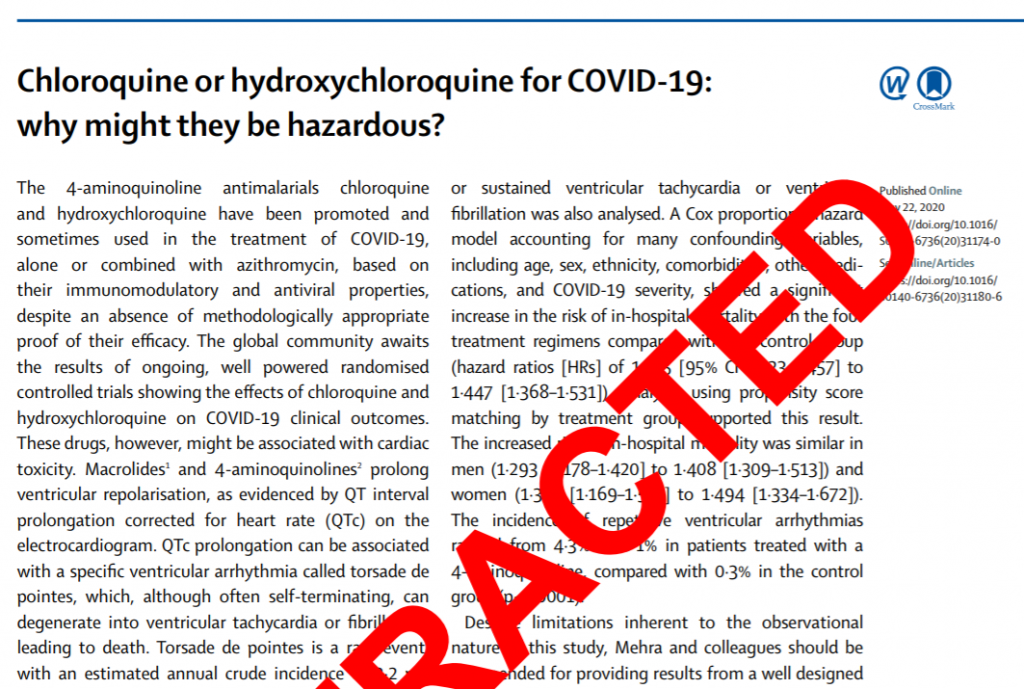
In early June, as controversy swirled over a high-profile study of hydroxychloroquine and COVID-19, Christian Funck-Brentano started receiving aggressive emails, texts and tweets.
Funck-Brentano, professor of medicine and clinical pharmacology at Sorbonne Université and Pitié-Salpêtrière University Hospital in Paris, and a colleague had published an editorial in The Lancet alongside the study — purportedly based on data from a company called Surgisphere — citing the results and sounding an alarm about the cardiac risks of hydroxychloroquine. Within days, that paper was retracted, along with a paper in The New England Journal of Medicine about different medications also allegedly based on Surgisphere data.
“I’m 65 and I have no real concerns,” Funck-Brentano told Retraction Watch, but his co-author was in an earlier stage of his career, and Funck-Brentano wanted to handle the situation in a way that would cause the least collateral damage.
At the time, Kenneth White, a lawyer at Southern California firm Brown White & Osborn who frequently blogs at Popehat about legal issues related to free speech, said of the suit:
Zoologists are up in arms that a leading taxonomy journal is being called out for excessive self-citation and being denied an Impact Factor.
Last week, Clarivate announced that it was suppressing 33 journals from its Journal Citation Report, which would mean no Impact Factor for those journals, because of high levels of self-citation that distorted journal rankings. One of those journals was Zootaxa, which since 2015 has published more than a quarter of all newly described taxa in the literature.
Denying Zootaxa an Impact Factor — which is used, for better or for worse, by universities and other institutions to determine whether a journal is worthy of publishing in — is unfair and damages the field, taxonomists said this past week.
For example, Wayne Maddison, a professor of botany and zoology at the University of British Columbia in Vancouver, tweeted:
More than 70% of the citations in one journal were to other papers in that journal. Another published a single paper that cited nearly 200 other articles in the journal.
The list includes some of publishing’s biggest players: Nine journals published by Elsevier, seven by Springer Nature, six by Taylor & Francis, and five by Wiley.
The previous and current editors in chief of a psychology journal have apologized for publishing an article about which one of them writes, “in retrospect I can certainly see that their article does feed into racist narratives.”
In a retraction notice dated yesterday, the journal’s current editor in chief, Patricia Bauer, writes that the article “has been retracted at the request of the authors:”