A Japanese anesthesiologist who just notched his sixth retraction apologized for his misconduct and said his institution is now investigating his entire body of work.
Hironobu Ueshima, of Showa University in Tokyo, who has roughly 170 publications, told Retraction Watch by email:
Earlier this month, we reported on the retraction of two papers by a Japanese anesthesiologist for unreliable data. At the time, we noted that the case of Hironobu Ueshima bore watching, given his publication total runs to about 170.
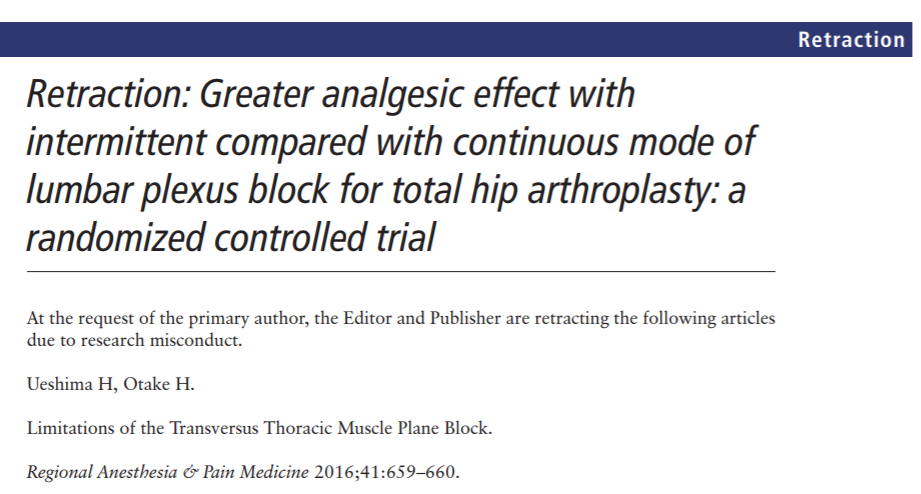
The two retractions earlier this month came after an earlier one from the journal Medicine in April. Now, another anesthesia journal has retracted three more papers by Ueshima, citing misconduct, for a total of six.
The articles appeared in Regional Anesthesia & Pain Medicine in 2016 and 2019. According to the notice:
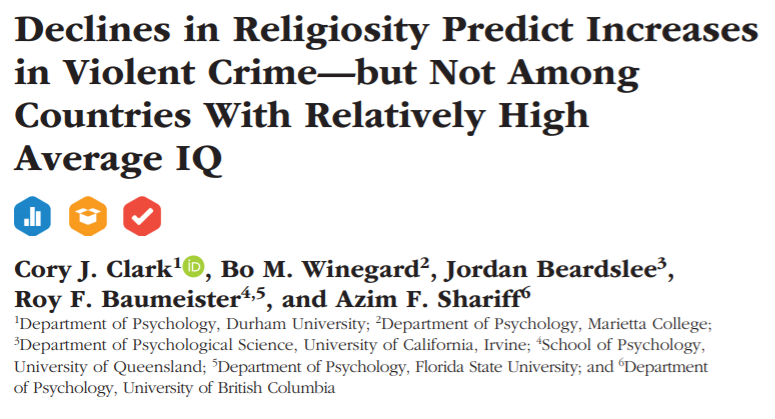
The authors of a paper that some critics have labeled white supremacy in academic robes say they will be retracting the article because some of the data they’d used for their analysis were “highly questionable.”
The January 2020 article, from a group led by Cory Clark, of Heterodox Academy and New York University, was titled “Declines in religiosity predict increases in violent crime—but not among countries with relatively high average IQ.”
Appearing in Psychological Science, the flagship publication of the Association for Psychological Science, the paper argued that:
A group of researchers based at Harvard Medical School have retracted their 2019 paper in Nature after a data sleuth detected evidence of suspect images in the article.
The move comes ten months after the journal first heard from the sleuth, Elisabeth Bik.
The paper, “Fatty acids and cancer-amplified ZDHHC19 promote STAT3 activation through S-palmitoylation,” came from the lab of Xu Wu, of the Cutaneous Biology Research Center at Massachusetts General Hospital, and his colleagues. It appeared last August — and immediately caught the attention of Rune Linding, who flagged it for Bik, who in turn noticed several regions of concerning duplications in a few of the Western blots that appeared in the paper.
Is too much irony even a thing? Let’s test the principle.
The guest editor of a special issue on failures in public health and related projects has quit the effort because she and her colleagues couldn’t convince the journal to include more researchers from developing countries in the initiative.
In a blog post about the ill-fated venture, the “WASH Failures Team” — Dani Barrington, Esther Shaylor and Rebecca Sindall — describe their initial excitement, and subsequent dismay, as the International Journal of Environmental Research and Health, an MDPI title, first agreed to publish the special issue but then informed the team that it wanted to focus on first-world problems.
Initially, all three women believed they would be responsible for the project, but the journal approved only Barrington for the guest editor post:
A Springer Nature journal has issued an editor’s note — which seems an awful lot like an Expression of Concern — for a widely circulated but quickly contested paper about how the novel coronavirus might infect white blood cells, akin to HIV.
However, readers could be forgiven for missing that fact. Indeed, the journal itself appears to be struggling to deal with the article — which one of the corresponding authors told us he asked to withdraw weeks ago.
Just because you work in a lab doesn’t mean you get to call the data you produce your own. Ask Constantin Heil.
In the mid-2010s, Heil was a PhD student at La Sapienza University in Rome, where he conducted studies with his mentor, Giuseppe Giannini. That research led to Heil’s dissertation, a paper titled “One size does not fit all: Cell type specific tailoring of culture conditions permits establishment of divergent stable lines from murine cerebellum.”
A journal has retracted two case reports by a prolific Japanese anesthesiologist who appears to be embroiled in a misconduct investigation.
The two case studies, in JA Clinical Reports, were written by Hironobu Ueshima and Hiroshi Otake, of Showa University Hospital in Tokyo. Ueshima has roughly 170 publications to his name, according to Google Scholar, so we’ll be closely watching for developments in this case.
Facing a storm of criticism on social media, a chemistry journal in Germany has suspended two editors who handled a controversial essay that it said “highlights the bias displayed in our field and many others” to women and minority researchers.
The article, “Organic synthesis-where now?’ Is thirty years old. A reflection on the current state of affairs,” by Tomas Hudlicky, of Brock University in St. Catharines, Ontario, had appeared in Angewandte Chemie, the flagship publication of the German Chemical Society. Hudlicky’s argument included several statements that suggested a hostility to efforts on university campuses to promote diversity.