“The retraction that took years” is a commonenoughrefrain on Retraction Watch that it might as be itsowngenre. Here’s one that didn’t.
A journal wasted no time pouncing on a suspect paper, retracting the 2016 article just three days after a commenter flagged concerns about the images in the work on PubPeer.
As the commenter, Actinopolyspora biskrensis, wrote:
A group of structural engineering researchers based in Iran has lost at least five papers for problems with the data – and a data sleuth says more look shaky, too.
Four of the articles appeared in Construction and Building Materials between 2018 and 2020 and were written by a changing cast of characters with two constants: Mansour Ghalehnovi and Arash Karimipour, both of the Department of Civil Engineering at Ferdowsi University of Mashhad. Karimipour’s LinkedIn profile lists an affiliation with the University of Texas at El Paso from 2019 to January of this year.
The journal, an Elsevier title, says it began investigating the papers after a whistleblower raised questions about the integrity of the data. In some cases, for example, data in one article were found in other papers but were represented as demonstrating different materials. The authors also used images from other researchers or the internet without proper attribution.
Here’s the notice for “Experimental study on the flexural behaviour and ductility ratio of steel fibres coarse recycled aggregate concrete beams,” from 2018:
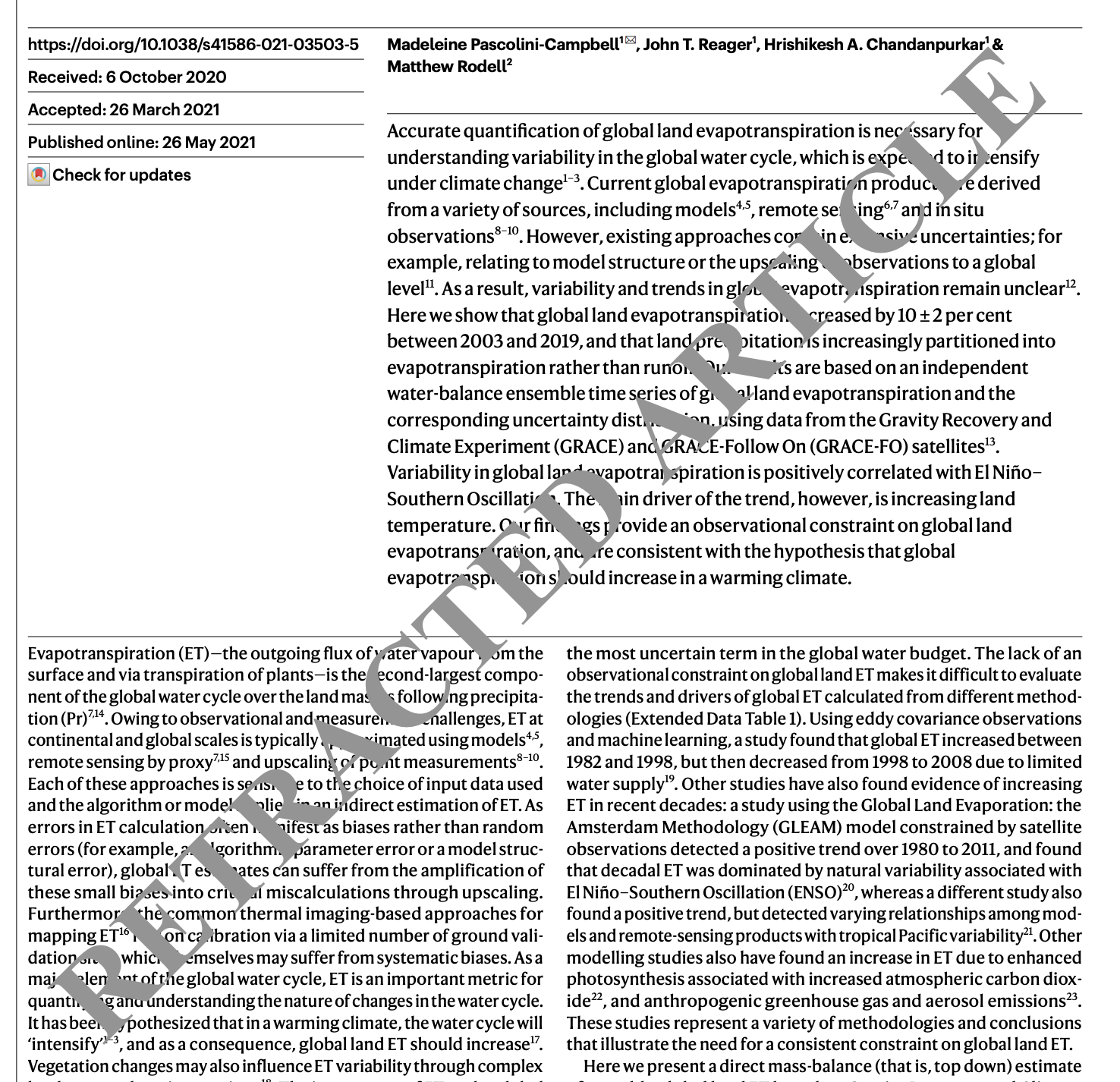
The authors of a 2021 Nature paper on how climate change might affect the amount of evaporation from the earth’s land surface have retracted the article after learning of a crucial error in their analysis.
The crux of the paper, titled “A 10 per cent increase in global land evapotranspiration from 2003 to 2019,” was the finding that:
Variability in global land evapotranspiration is positively correlated with El Niño–Southern Oscillation. The main driver of the trend, however, is increasing land temperature. Our findings provide an observational constraint on global land evapotranspiration, and are consistent with the hypothesis that global evapotranspiration should increase in a warming climate.
In other words, according to the authors – from a pair of NASA labs in California and Maryland – the rate of evapotranspiration over that 17-year-period was twice as high as previous estimates. As the lead author, Madeleine Pascolini-Campbell, said in this press release (Wayback Machine link) from NASA:
Earlier this week, we wrote about a case of plagiarism in the British Journal of Sports Medicine (BJSM) involving a highly credentialed researcher and Australian Football League consultant who’d cribbed roughly half of an article from another scholar.
The researcher, Paul McCrory, has still not responded to our requests for comment. But in an email to Steve Haake, whose work McCrory lifted while editor of the BJSM, Paul McCrory said that the offense was:
an isolated and unfortunate incident …
That resulted from the uploading to the journals’ website of a “working draft” that “failed to appropriately cite your original and excellent work as the source of the manuscript.”
Unfortunate, yes. Isolated? That’s a bit less clear.
A Springer Nature journal has retracted a 2020 paper on exposure among cement workers to a potentially harmful chemical for a litany of errors that one might have expected peer reviewers to catch before publication – and the corresponding author is not happy.
Farmany, of Hamadan University of Medical Sciences in Iran, also happens to be a member of the journal’s editorial board, although he joined after the paper was accepted.
Joe Hilgard’s son wasn’t even a twinkle in his father’s sharp eye for bad data when an Elsevier journal notified the social psychologist that it intended to retract a 2015 article he’d flagged on the link between exposure to violent media and aggression in adolescents.
Well, the journal has finally retracted the paper – but not before Hilgard’s son was born and started speaking (more on that in a moment).
Hilgard’s ability to spot bad data, and his tenacity at holding journals accountable for their publications, has now led to five retractions. Four of those papers belong to a researcher in China named Qian Zhang, of Southwest University in Chongqin. As readers of this blog might recall, Zhang lost a pair of papers in 2019 after Hilgard and others raised questions about the integrity of the data.
As Hilgard, who also notified Southwest University about his findings, told us back in 2019 about Zhang’s previously retracted papers:
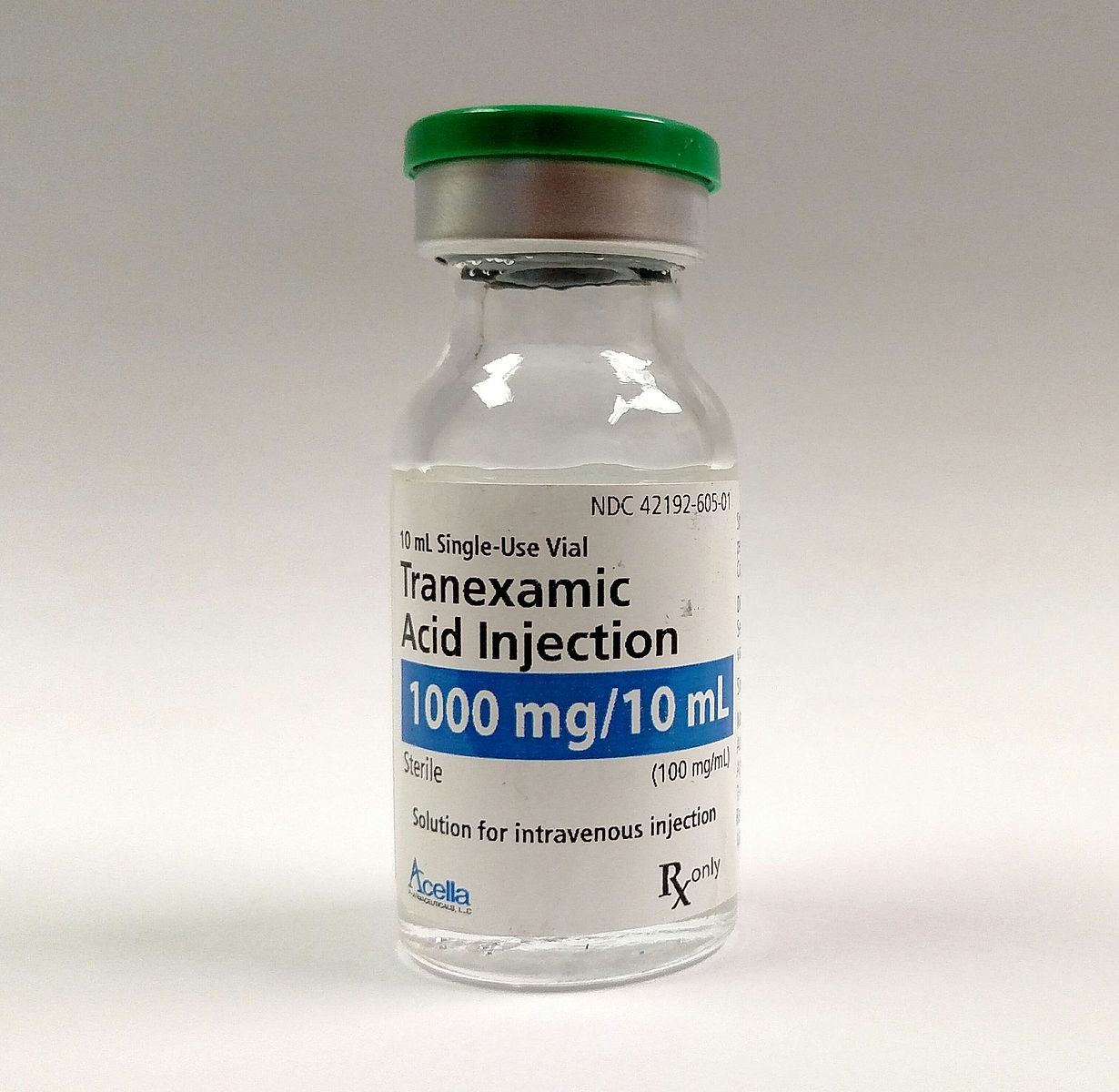
Mark Oniffrey, CC BY-SA 4.0, via Wikimedia Commons
Can you retract something that never existed in the first place? At least one journal thinks the answer to that conundrum is yes.
That journal would be Medicine. In September 2020, the Wolters Kluwer journal published a paper titled “Tranexamic acid reduces blood cost in long-segment spinal fusion surgery: A randomized controlled study protocol” by a group in China led by Linyu Yang, of the Department of Orthopedics at the Affiliated Hospital of Southwest Medical University, in Sichuan.
The article promised – but failed to deliver – a “Table 1”, an omission the peer reviewers and journal staff missed during the production process. Five months later, said table still had not materialized, prompting the following notice:
Science has issued an expression of concern for a 2014 paper on the harmful effects of ocean acidification on fish and coral after the first author of the article was accused of fabricating data in the study and other research.
The work – cited 171 times so far, according to Clarivate Analytics’ Web of Science – received immediate challenge from other researchers, who questioned the validity of the findings.
A leading repository of social science which is owned by Elsevier has reposted an article it removed on New Year’s Day after the author was accused of defamation and the site was threatened with legal action if it didn’t remove the paper.
The article in question was written by Ann Lipton, the associate dean for faculty research at Tulane University Law School and appeared on the Social Science Research Network (SSRN).
Titled “Capital Discrimination,” the paper – which has been accepted by the Houston Law Review – explores:
A journal has issued expressions of concern for a pair of 2021 meta-analyses purporting to find that ivermectin is an effective treatment for Covid-19 after data sleuths raised questions about some of the research in the studies.
As we reported last fall, one of the two papers – “Ivermectin for Prevention and Treatment of COVID-19 Infection: A Systematic Review, Meta-analysis, and Trial Sequential Analysis to Inform Clinical Guidelines” – began to wobble when data central to its conclusion were retracted from the journal Viruses. That article has been cited 37 times, according to Clarivate Analytics’ Web of Science, making it a highly-cited, “hot” paper.
The other article was titled “Review of the Emerging Evidence Demonstrating the Efficacy of Ivermectin in the Prophylaxis and Treatment of COVID-19” and was written by a group led by Pierre Kory. Kory is a controversial Wisconsin physician whose ideas about how to treat the infection, and particularly ivermectin, have made him a darling of ivermectin proponents like Joe Rogan.
The two meta-analyses were the subject of an editorial in the November/December 2021 issue of the journal by its editor, Peter Manu, who cautioned that: